
Palm Valley STR Case Study: $100K+ Annual Revenue, Top 5% Airbnb Ranking & Strategic Bonus Depreciation Planning in Goodyear, AZ
Case Study · 14632 W Columbus Ave, Goodyear, AZ 85395 · Palm Valley
The Palm Valley Playbook: A $100K Airbnb, the STR Loophole, and 100% Bonus Depreciation
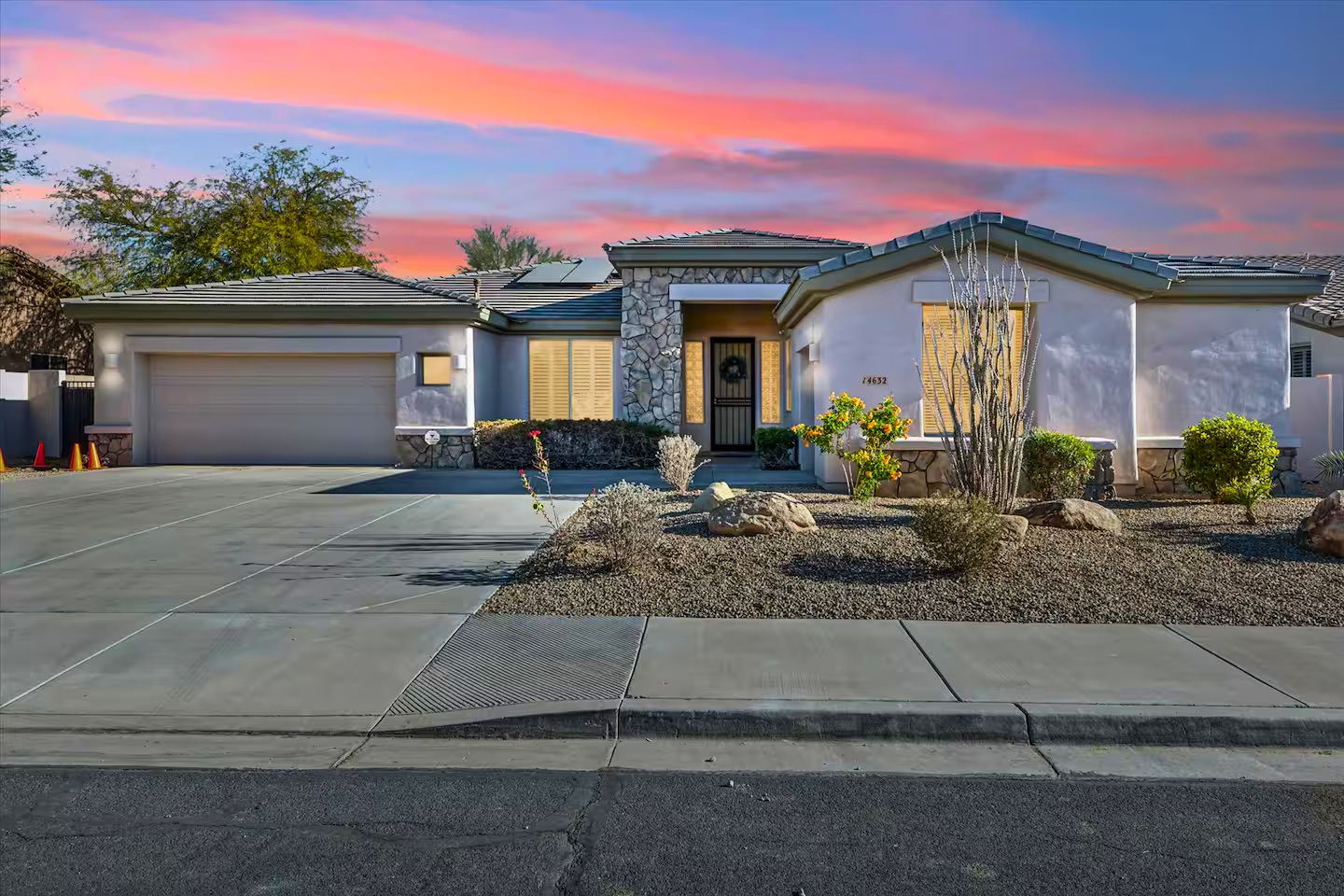
Inside 14632 West Columbus Avenue — a fully remodeled 5-bedroom short-term rental in Palm Valley (Goodyear, AZ 85395) that clears six figures a year, ranks in the Top 5% of homes on Airbnb, and was acquired specifically to unlock the short-term rental tax loophole for a high-income W-2 household.
 Eric Ravenscroft, CRS, GRI, ABR · Real Estate Advisor & Former Director of Wealth Management · Updated July 2026 ·14 min read





Phoenix's Preferred Agent for Leading Financial Institutions
Eric is a preferred real estate partner for USAA, Chase, SoFi, PennyMac, Citibank, Citizens, Huntington, and Fifth Third — reinforcing his standing among the industry's most trusted advisory professionals.








There are short-term rentals people "try." And there are assets people engineer. This Palm Valley property was built around three pillars — durable, layered demand; guest-experience differentiation; and a tax-aligned acquisition strategy — and it's worth walking through exactly how, because the framework travels far better than the address does.
The result: a five-bedroom Goodyear, AZ vacation rental generating over $100,000 a year, sitting in the Top 5% of homes on Airbnb, holding Guest Favorite status, and rated 4.98 out of 5 across 63 reviews. But the interesting part isn't the outcome — it's the sequence of decisions that made the outcome close to inevitable before the first guest ever checked in.
01Starting With Strategy, Not Listings
Before touring a single home across the Greater Phoenix Metro, we defined what "success" had to look like on paper. The client wasn't shopping for "an Airbnb" — they were underwriting a scalable, tax-aware asset, which changed the screening criteria completely:
That list eliminated most of the available inventory immediately — this was never about the lowest price per square foot, it was about the highest probability of performance and the strongest depreciation profile at acquisition.
Clarity came through elimination. We passed on 2-car garage homes, smaller lots, properties needing 60–90 days of renovation runway, and layouts that capped group sleeping configurations. By the time this Palm Valley property surfaced, we already knew exactly why it fit.
02Why Palm Valley, Goodyear Was the Target

Palm Valley sits inside one of the West Valley's strongest demand corridors — without Scottsdale-level pricing. Within roughly 15–20 minutes of the property sit five distinct, largely uncorrelated demand generators. None of them alone would justify the strategy. Stacked together, they do.

⚾Cactus League Spring Training
Goodyear Ballpark has hosted Cleveland Guardians and Cincinnati Reds spring training since 2009–2010, drawing well over 150,000 fans across a 30-game season every February–March, plus regional youth and travel-ball tournaments the rest of the year.

🏟️State Farm Stadium & Events
About 20 minutes away in Glendale, State Farm Stadium hosts Arizona Cardinals games, Super Bowl rotations, NCAA Final Fours, the Fiesta Bowl, and stadium-scale concerts — each one compressing area-wide nightly rates for group-friendly homes.

✈️Luke Air Force Base
Luke AFB adds training rotations, visiting military families, and PCS relocation transitions nearby — a demand source with almost no tourism seasonality, which quietly reduces the property's dependence on any single travel calendar.

⛳Golf & Resort Corridor
Proximity to the Wigwam Resort and Palm Valley Golf Club feeds golf groups, wedding-guest overflow, and corporate retreat stays — experience-driven travel that supports premium nightly rates well outside of peak season.
Why This Corridor Has Year-Round Demand
Five demand layers, mapped across the calendar. Notice how few months rely on only one driver.
Read it this way: a single-driver rental — say, a ski cabin or a stadium-only condo — has a short season and a long off-season. This corridor rarely drops to one active layer. Even the quietest months (May–September) still carry military-driven demand plus the start of NFL/event season, which is exactly the volatility reduction this acquisition was underwritten for.
Phoenix Sky Harbor International Airport is roughly 30 minutes away, which keeps the booking pool open to out-of-state and fly-in travelers rather than limiting the property to a regional drive-market audience.
03The Asset: Built for the Experience, Not Just the Listing
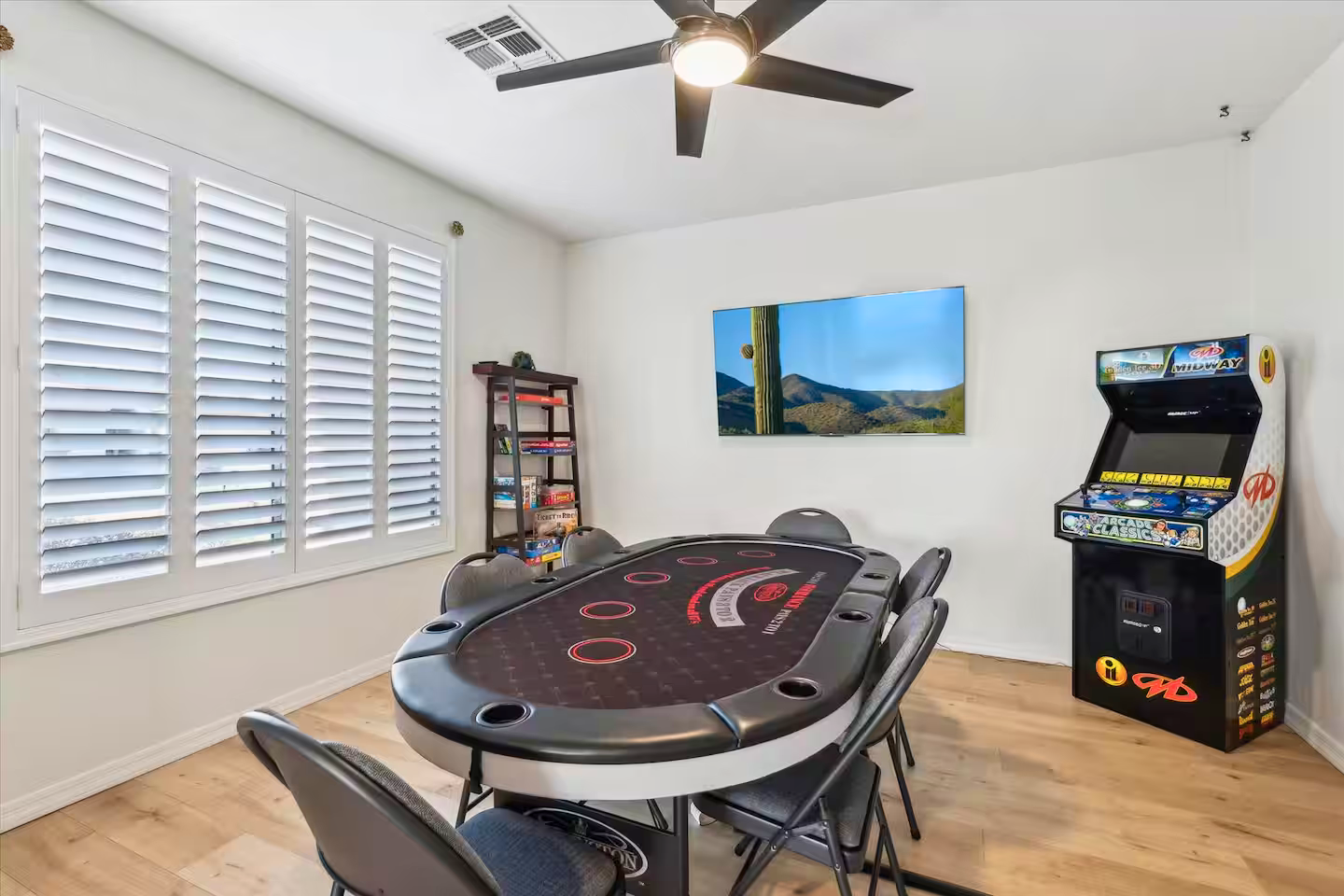
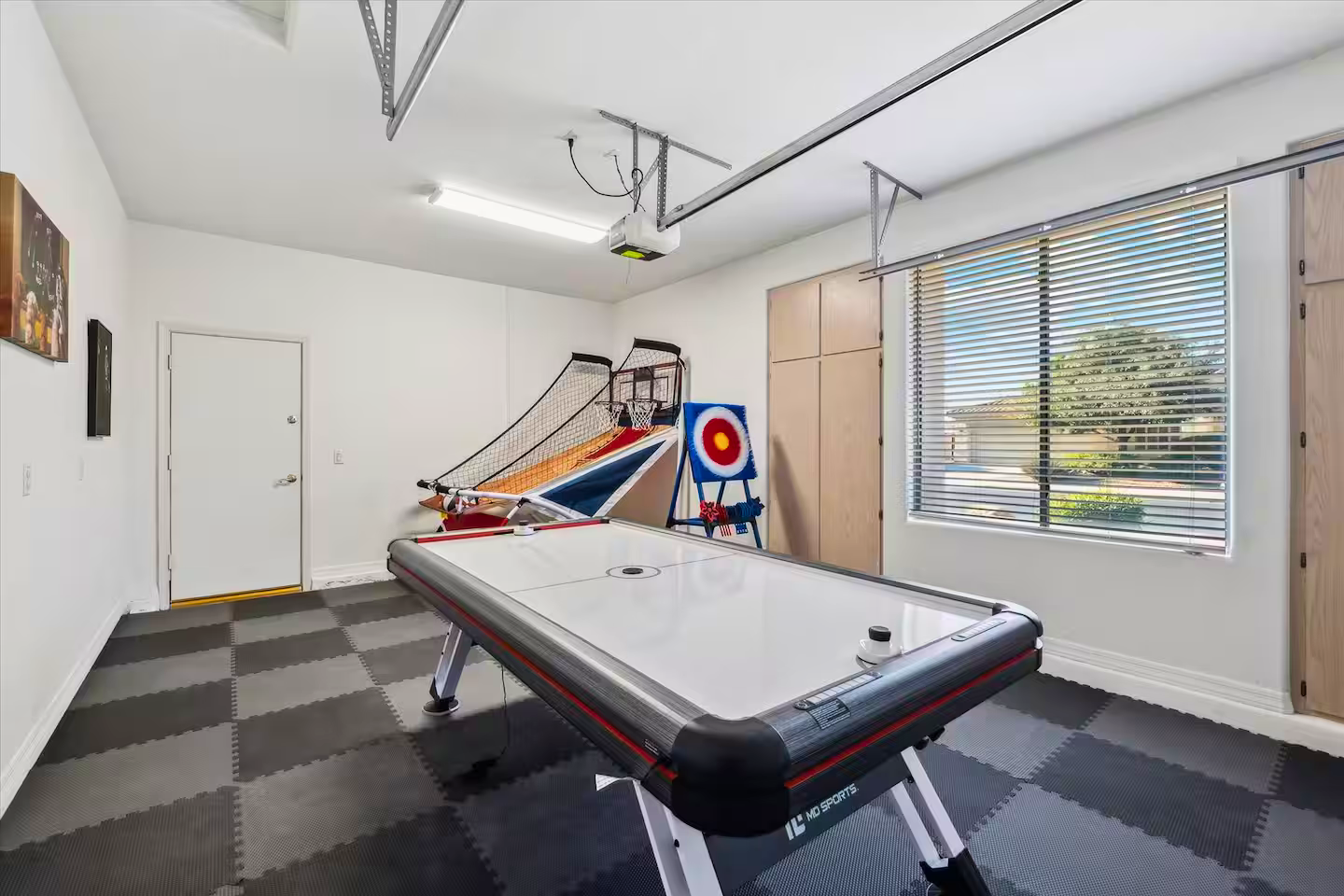
Three-bedroom homes compete on nightly rate. Five-bedroom homes compete on experience — and this one, 14632 West Columbus Avenue in Goodyear, AZ 85395, was fully remodeled with that distinction in mind: 5 bedrooms, 2.5 baths, heated pool and spa, a near quarter-acre lot, 3-car garage, RV gate, owned solar, and a converted bonus room built for group entertainment. It was turnkey from day one — no renovation runway, no delayed revenue timeline, and no gap between closing and the depreciation clock starting to run.
04Inside the Home
A quick walk-through of the spaces that do the heaviest lifting for group bookings — the shared living areas, the primary suite, a second bedroom set up for kids and multi-family stays, and the outdoor living space that anchors the heated pool and spa.
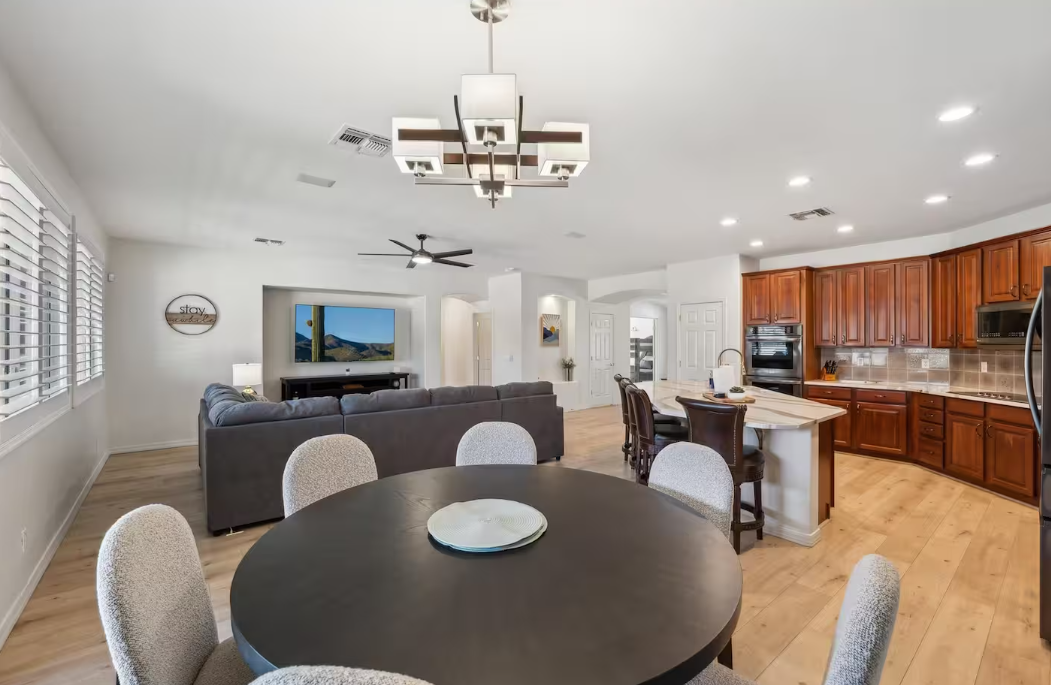
Open-concept living, dining, and kitchen — the space that anchors group stays.
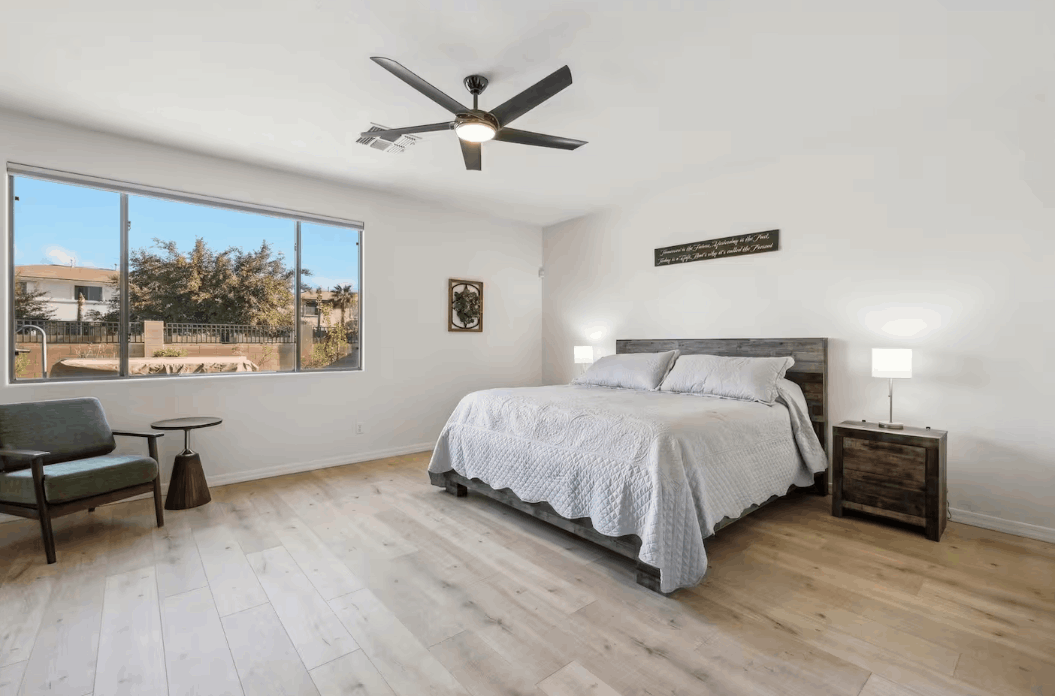
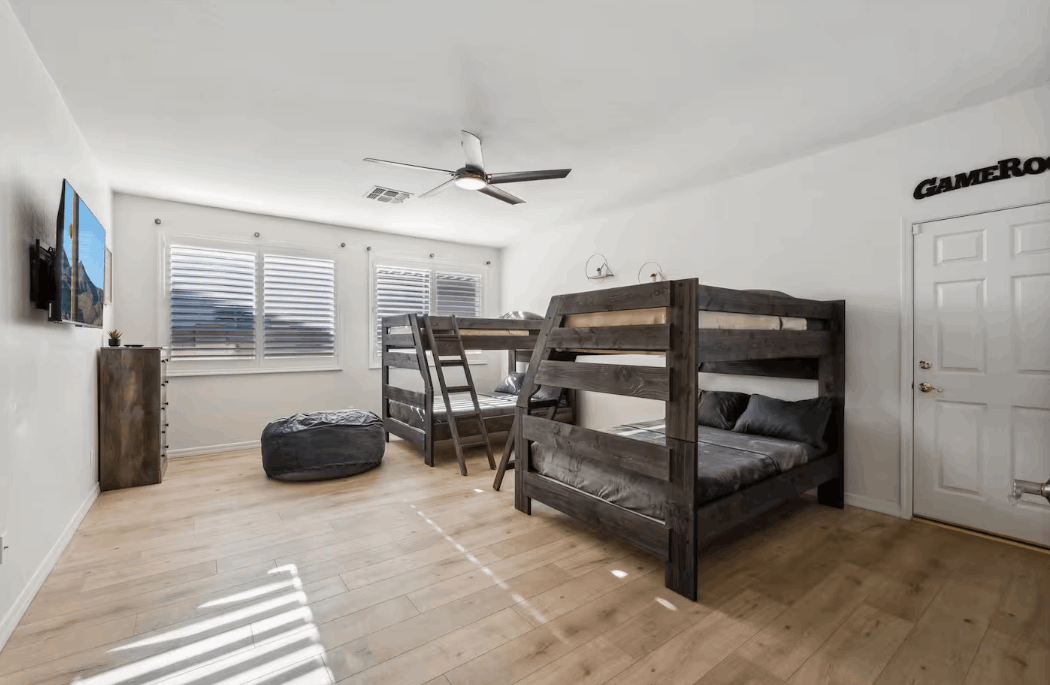
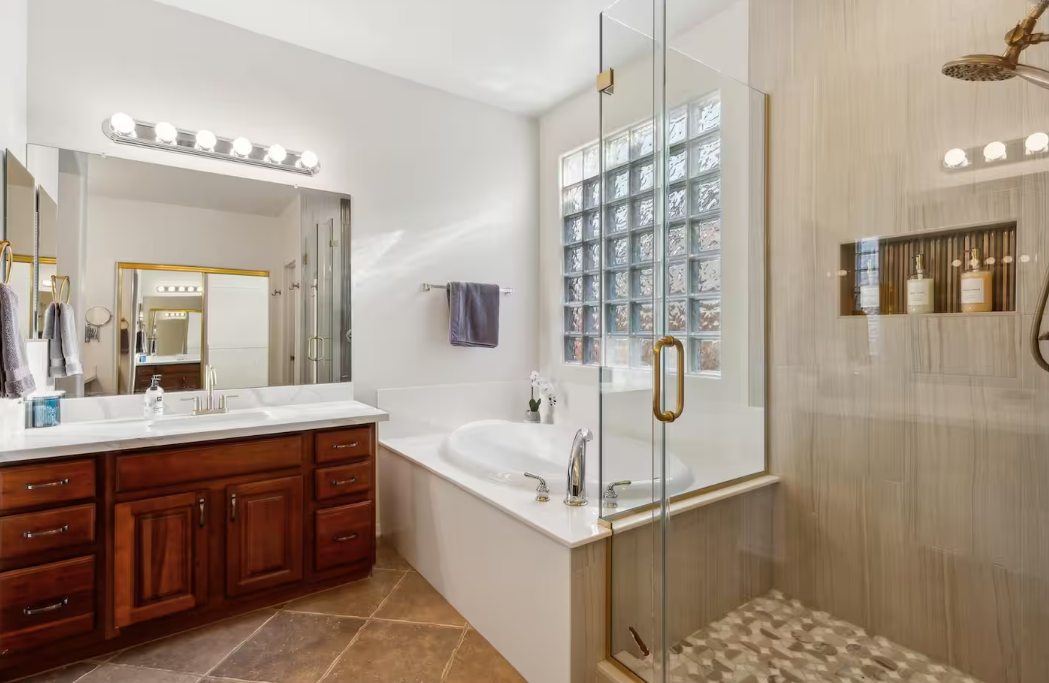
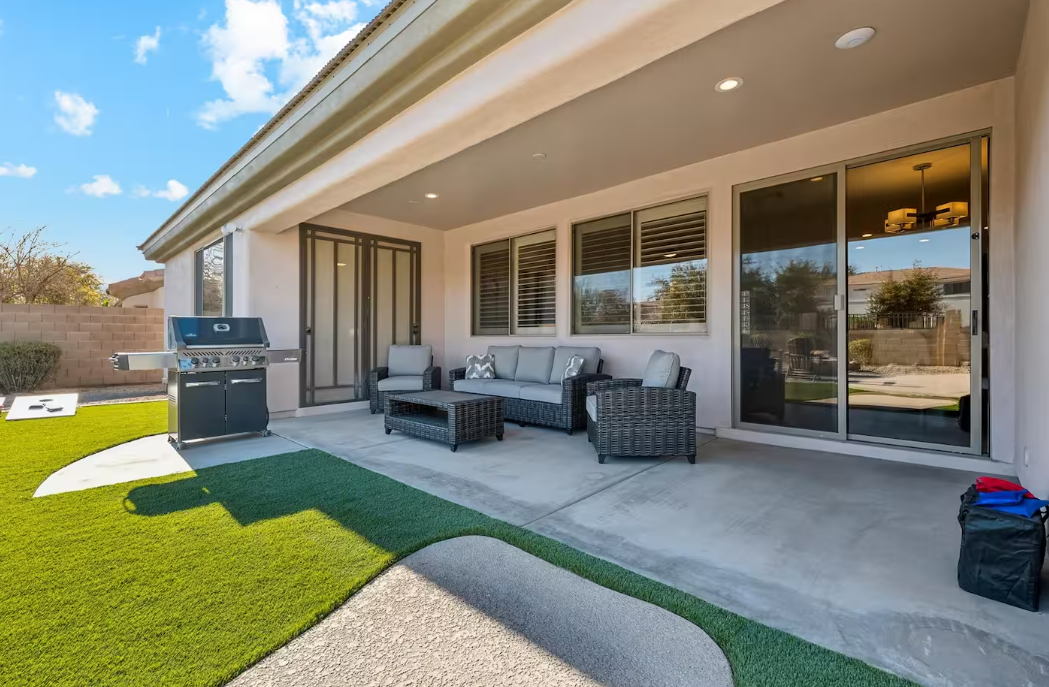
Left to right, top to bottom: the primary bedroom, a second bedroom configured for kids and group travel, the remodeled primary bath, and the patio anchoring the heated pool and spa.
For the full photo set — every room, the pool, and the game rooms — see the live Airbnb listing.
05Not a One-Off: The Same Playbook, Twice in Palm Valley
One winning Airbnb could be luck. A second engineered acquisition in the same golf-course community, built around the same tax logic, is a pattern. In a separate Palm Valley transaction, a buyer secured a rare basement home with a detached casita — a floor plan that shows up in only a small fraction of Phoenix Metro listings each year. The layout added separate guest quarters and a finished basement built for multi-group stays, while the casita added flexibility no standard single-structure home can offer.
🏡Goodyear Basement & Casita STR Case Study
Same corridor, same demand thesis, a different property type: a scarce basement-plus-casita configuration acquired and structured for material participation and cost segregation from day one — with the tax benefit enhancing an already-strong asset rather than propping up a weak one.
06Performance: Platform Status, Not Just a Listing
The live listing holds Top 5% of homes ranking, Guest Favorite status, and a 4.98-out-of-5 average across 63 reviews (98% five-star, 2% four-star) — perfect 5.0 marks on cleanliness, check-in, communication, location, and value. That ranking wasn't an accident of location alone — it was driven by professional photography, disciplined pricing adjustments, strong guest communication, amenity differentiation, and consistent review management. Acquisition sets the ceiling; execution decides how close you get to it.
For the specific revenue, rate, and return numbers behind that ranking, see the investment analysis directly below — it's the same property, benchmarked against its local comp set.
07The Numbers: Investment Analysis
Here is the underwriting behind the platform performance above, pulled from a BNBCalc investment analysis run on the property (14632 W Columbus Ave, Goodyear, AZ 85395) and prepared July 7, 2026. These figures benchmark the property against its local comp set — they're a planning and valuation model, not a substitute for the property's own trailing booking data, but they show the math behind why this property was worth engineering in the first place.
| Revenue metric | Value |
|---|---|
| Projected annual revenue | $104,414 |
| Projected monthly revenue | $8,701 |
| Average Daily Rate (ADR) | $529 |
| Projected occupancy | 54% |
| RevPAR | $285 |
The monthly revenue curve in the analysis backs up the demand-layering thesis directly: revenue peaks above $14K in March — squarely inside Cactus League spring training — stays elevated through February and April, dips to its low point around $5K–$6K in August and September, and climbs again through the holidays. That's a real, data-backed shape, not a hand-wavy claim: strong shoulder months on either side of the summer trough, with no month falling to zero.
| Financial summary (annual) | Value |
|---|---|
| Revenue | $104,414 |
| Operating expenses | $27,254 |
| Operating income | $77,161 |
| Mortgage & taxes | $48,812 |
| Profit (cash flow) | $28,349 |
💰Cash-on-Cash Return
17.56%
📈Cap Rate
10.66%
Modeled forward at a conservative 3% property and revenue appreciation rate, the analysis projects total return (cumulative cash flow, home equity, and property appreciation, net of the down payment) growing from roughly $205,000 in Year 1 to $458,500 by Year 5 and $807,400 by Year 10. Those figures assume a 20% down payment on the property's current market estimate of $723,600, a 30-year loan at 6%, and a 1.58 DSCR — comfortably above the 1.0 lenders typically require.
The property itself: a single-story, 2001-built home with 2,813 interior square feet on a 10,863-square-foot lot, a private pool, 3-car garage, and central air — zoned within the Millennium High School attendance boundary (rated 7/10). At $257 per square foot against a $723,600 market estimate, it sits inside a dense cluster of comparable 4- and 5-bedroom STRs within roughly 2 miles, several of which are also producing six-figure annual revenue — reinforcing that this isn't a single lucky listing, but a corridor that consistently rewards well-run, well-positioned homes.
08The STR Loophole, Explained Plainly
"STR loophole" sounds like a gray-area trick. It isn't — it's a rule that's been in the Treasury Regulations since 1988, and it changes the entire tax posture of a short-term rental relative to a standard long-term rental.
With a long-term rental, losses are generally treated as passive and can't offset W-2 income unless the owner qualifies as a Real Estate Professional — a 750-plus-hour standard that rules out most full-time W-2 earners entirely. A short-term rental is treated differently. Under Treas. Reg. § 1.469-1T(e)(3)(ii)(A), a rental where the average guest stay is seven days or less is not a "rental activity" in the first place — which means the passive-loss trap doesn't automatically apply.
- Confirm the 7-day average stay.Measured across the tax year's actual bookings — this is a factual test, not an election.
- Materially participate.Typically satisfied by logging 100-plus hours on the property, with no one else participating more, under Treas. Reg. § 1.469-5T(a).
- Document accelerated depreciation.A cost segregation study reclassifies eligible components into shorter-life categories, creating the deduction that actually offsets income.
- Keep a contemporaneous log.Retroactively reconstructed hours are a common audit flag — track participation as you go, not after the fact.
When all three conditions hold in the same tax year — short average stay, material participation, and accelerated depreciation — the resulting loss can offset active income, including a W-2 salary, dollar for dollar. That's the mechanism behind every "STR tax savings" headline; it's simply the ordinary, non-passive-loss treatment of a business the owner actively runs.
09Bonus Depreciation in 2026: Why the Timing Matters
Under the original Tax Cuts and Jobs Act schedule, bonus depreciation was stepping down toward zero — 80% in 2023, 60% in 2024, and a scheduled 20% for 2026 on its way out entirely in 2027. The One Big Beautiful Bill Act (OBBBA), signed into law on July 4, 2025, reversed that phase-down and permanently restored 100% bonus depreciation for qualifying property placed in service after January 19, 2025 — which covers any STR bought and placed in service in 2026.
In practice, this means any component of the property with a MACRS recovery period of 20 years or less — identified through a cost segregation study — can be deducted in full in year one, rather than spread across 5, 7, or 15 years. Short-term rentals tend to carry more of these short-life components than a standard long-term rental, because furniture, hospitality-grade fixtures, pools, spas, outdoor living areas, and smart-home systems all typically qualify.
| Cost segregation category | Typical recovery period | 2026 bonus rate |
|---|---|---|
| Building structure | 27.5 years | Not eligible |
| Furniture, appliances, fixtures | 5–7 years | 100% |
| Land improvements (pool decking, fencing, landscaping) | 15 years | 100% |
| Typical share of an STR purchase price reclassified | — | Often 20–30% |
The IRS issued interim guidance on the OBBBA's permanent 100% bonus depreciation rules through Notice 2026-11 (issued January 14, 2026), which clarifies acquisition-date rules, the component election for self-constructed property, and available elections for transition-year assets — worth a direct read with your CPA if your purchase spans a tax year.
| Year-1 tax analysis for this property | Value |
|---|---|
| Standard depreciation (Years 2+, annual) | $9,091 |
| Bonus depreciation (Year 1 only) | $155,780 |
| Total depreciation, Year 1 | $164,872 |
| Property tax, Year 1 | $7,163 |
| Mortgage interest, Year 1 | $34,342 |
| Total tax deduction, Year 1 | $206,378 |
The analysis models Year 1 rental income conservatively at $0 (a placed-in-service timing convention), which — against $206,378 in total Year-1 deductions — produces a paper loss of roughly $206,378. If the 7-day rule and material participation are both satisfied and documented, that loss is what could offset other active income, including W-2 wages, in the year it's taken. From Year 2 onward, with bonus depreciation already used and a full year of rental income modeled ($104,414), the property flips to positive taxable rental income of roughly $27,000 — the standard trade-off with this strategy: it accelerates deductions into Year 1, it doesn't erase tax liability permanently.
10Why 5-Bedroom Homes Outperform
A 3-bedroom home is shopped against every other 3-bedroom home on price per night. A 5-bedroom home is shopped against the cost of booking two hotel rooms, or two smaller rentals — and it usually wins on both price and experience. This property captures spring training families, golf groups, event travelers, corporate retreats, and multi-family snowbird stays in a single booking, which is why total revenue tends to scale faster than bedroom count alone would suggest.
11Exit Optionality Was Underwritten From Day One
A property engineered this way isn't a one-way bet on Airbnb. It supports a continued STR hold, a mid-term rental pivot, a long-term rental fallback, a retail resale, or a 1031 exchange into the next asset. Optionality is what reduces downside risk — the strategy works even if any single demand layer softens.
12Who This Strategy Is Built For
This is structured acquisition, not speculation — and it tends to fit a specific profile of buyer:
13What This Process Sounds Like From the Client Side
The quote below is from a different acquisition in this same case-study series — a Scottsdale STR buyer, not this Palm Valley property's buyer — shared here because it describes the process itself, not this specific deal:
"Eric took the time to educate us on the entire process from the very beginning, and helped us define clear investment criteria for exactly what to look for to meet our goals." — Ravenscroft Group short-term rental buyer, Scottsdale
That's the throughline across every case study in this series: the property search starts with underwriting criteria, not a map pin. Whether the target is a Palm Valley golf-course home, a basement-and-casita configuration, or a turn-key Scottsdale rental, the process is the same — define the tax and revenue objective first, then let that objective filter the inventory.
14Frequently Asked Questions
Is Palm Valley, Goodyear AZ good for short-term rentals?
Yes — due to layered demand from spring training baseball, stadium events, golf and resort tourism, military presence, and seasonal snowbird migration, which together reduce reliance on any single season.
What is the STR loophole?
It's the IRS treatment of short-term rentals (average stay of 7 days or less) as non-passive activities when the owner materially participates — allowing losses, including accelerated depreciation, to offset active income like W-2 wages.
How does bonus depreciation work for STRs in 2026?
The OBBBA permanently restored 100% bonus depreciation for property placed in service after January 19, 2025. Paired with a cost segregation study, this lets an owner deduct qualifying short-life components in full during year one.
Can a W-2 employee actually use STR losses to reduce their taxes?
Potentially — if the average stay is 7 days or less, the owner materially participates, and a cost segregation study documents the accelerated depreciation. Always confirm the specifics with a CPA before purchase.
Why do larger homes perform better on Airbnb?
They capture group travel and command higher total revenue per booking, rather than competing purely on nightly rate against smaller units.
15Final Thought
Short-term rental investing isn't about chasing listings — it's about engineering outcomes. This Palm Valley case study reflects strategic acquisition, demand stacking, operational discipline, verified six-figure revenue, platform validation, and tax-aligned planning, all decided before the first showing. $100,000+ in annual revenue, a Top 5% Airbnb ranking, Guest Favorite status, and a 4.98-star rating across 63 reviews aren't accidental. That's structured investing.
Thinking Through a Similar Acquisition?
Screening a property for STR performance and depreciation potential before you write an offer is the whole point of this framework. Reach out and we'll walk through it together.
Email eric@theravenscroftgroup.com Meet Eric Ravenscroft Find Me on Google
About the Author — Eric Ravenscroft, CRS, GRI, ABR
Eric Ravenscroft is a Top 1% REALTOR® across North America and a former Director of Wealth Management, now one of Arizona's most trusted real estate strategists. With 15 years spanning real estate, wealth management, and investment planning, he helps clients make financially grounded decisions — from new construction and relocations to STR investments, 1031 exchanges, and long-term portfolio strategy.
His work has been featured in the Wall Street Journal, MarketWatch, MSN, and Morningstar. He holds Elite status with Real Broker and is a Certified Military Relocation Professional (MRP) trusted by USAA — relevant experience given Luke Air Force Base's role in this property's demand base. Clients across the Greater Phoenix Metro rely on his clarity and results-driven guidance on real estate tax strategy.
16Sources
Categories
- All Blogs (321)
- Active Adult & 55 Plus Communities (16)
- Arizona Relocation Guides (30)
- Buyers (211)
- Financial Planning (60)
- General Real Estate (139)
- Income From Real Estate (59)
- Market Update (26)
- New Construction (28)
- News, Updates and Coming Soon (57)
- Real Estate Agent Financial Planning (22)
- Real Estate Investing (94)
- Sellers (106)
- Vacation and Short Term Rentals (45)
Recent Posts




About the Author
Eric Ravenscroft is a Top 1% REALTOR® across North America and one of Arizona’s most trusted real estate strategists. With 15 years of experience spanning real estate, wealth management, and investment planning, he helps clients make smarter, financially grounded decisions, from new construction and relocations to STR investments, 1031 exchanges, and long-term portfolio strategy.
Eric’s expertise has earned him industry recognition, Elite status with Real Broker, and features in major publications including the Wall Street Journal, MarketWatch, MSN, and Morningstar. Clients across the Greater Phoenix Metro rely on his clarity, strategic insight, and results-driven guidance.
Ready to make a confident real estate move? Call or text Eric today.