
Phoenix Housing Market Update: What Buyers, Sellers & Investors Need to Know Right Now
Phoenix Housing Market Update: What Buyers, Sellers & Investors Need to Know Right Now
Scroll any real estate headline this summer and you'll read the same three lines: prices are still near record highs, mortgage rates are still elevated, inventory is still climbing. All three are accurate. None of them tell you what's actually happening on the street where you're buying or selling.

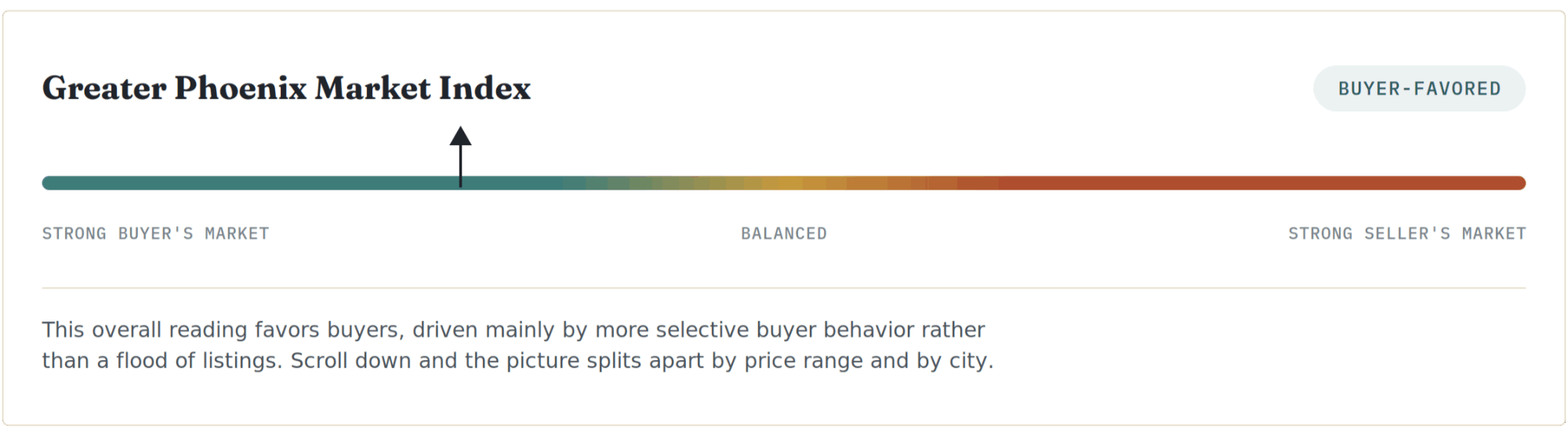
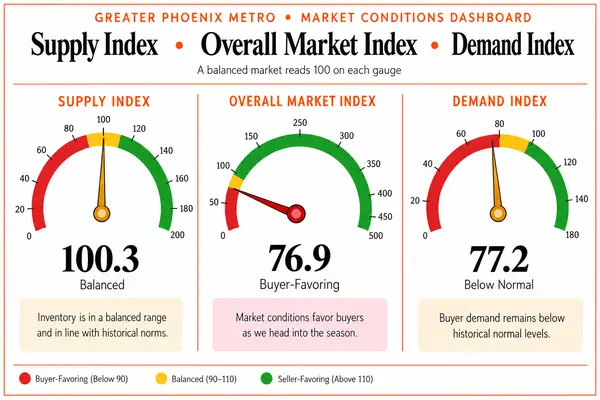
- Overall, Greater Phoenix favors buyers — but that's driven by more selective buyer behavior, not an oversupply of listings.
- Pricing splits by segment: sub-$500K homes are rate-sensitive, the $500K–$1M range is stable, and luxury stays the most resilient.
- Builder incentives now beat purchase price as the smarter way to compare new construction against resale.
- Investors are re-entering, drawn by better leverage, builder incentives, and the return of 100% bonus depreciation.
- Local conditions vary sharply by city — Scottsdale luxury behaves nothing like Buckeye or the Southeast Valley.





Stop looking for "the" Phoenix housing market. Look for yours.
Ask five different real estate questions in Greater Phoenix this month and you'll get five different answers, because prices, mortgage rates, inventory, builder incentives, and employment growth are all moving on separate tracks right now. A buyer shopping in Buckeye is dealing with a completely different set of conditions than one shopping in Paradise Valley, even though they're both technically "buying in Phoenix."
That's the problem with a one-line summary like "it's a buyer's market." It's not wrong, exactly — it's just too small to be useful. It doesn't tell you anything about the specific price range, zip code, or property type you actually care about.
The advantage right now belongs to whoever understands their specific segment of the market, not whoever read the most headlines.
If you want to see how this month's numbers compare to where things stood a few months ago, our archive of Phoenix housing market updates tracks these shifts month over month.
Buyers have leverage again — and it's not because of a glut of listings.
Most people assume a "buyer's market" means there's a flood of homes and nobody to buy them. That's not really what's driving Greater Phoenix right now. Inventory has climbed off its pandemic-era lows, sure, but the real shift is in how buyers are behaving.
Elevated mortgage rates have made buyers slower and more deliberate. Instead of writing an offer after one showing, they're touring several homes, negotiating repair credits, and asking for concessions before they'll commit — the kind of behavior that all but disappeared during the 2020–2022 run.
That changes the job for sellers, too. A home priced to today's conditions and shown well is still moving briskly. A home priced off last year's comps is sitting — sometimes for months — until the seller adjusts. Speed used to win. Now preparation does.
Patient, not passive
Multiple tours, negotiated repairs, and requested concessions are standard practice again.
Prep beats urgency
Accurate pricing and strong presentation now separate a quick sale from a stale listing.
Back on the table
Rate buydowns, closing-cost credits, and repair allowances are a routine part of negotiations.
Inventory is improving. Demand hasn't disappeared.
Buyers across the Valley simply have more to choose from than they've had in years, and that's giving them room to compare instead of settling. At the same time, demand is still healthy — it's just more selective, with affordability keeping a lid on how aggressively buyers will chase a listing.
That's a sign of a market rebalancing, not one that's falling apart. Well-priced homes in good condition are still finding buyers quickly. Overpriced listings are the ones absorbing the slowdown, often needing a price cut or added concessions before they generate real activity.
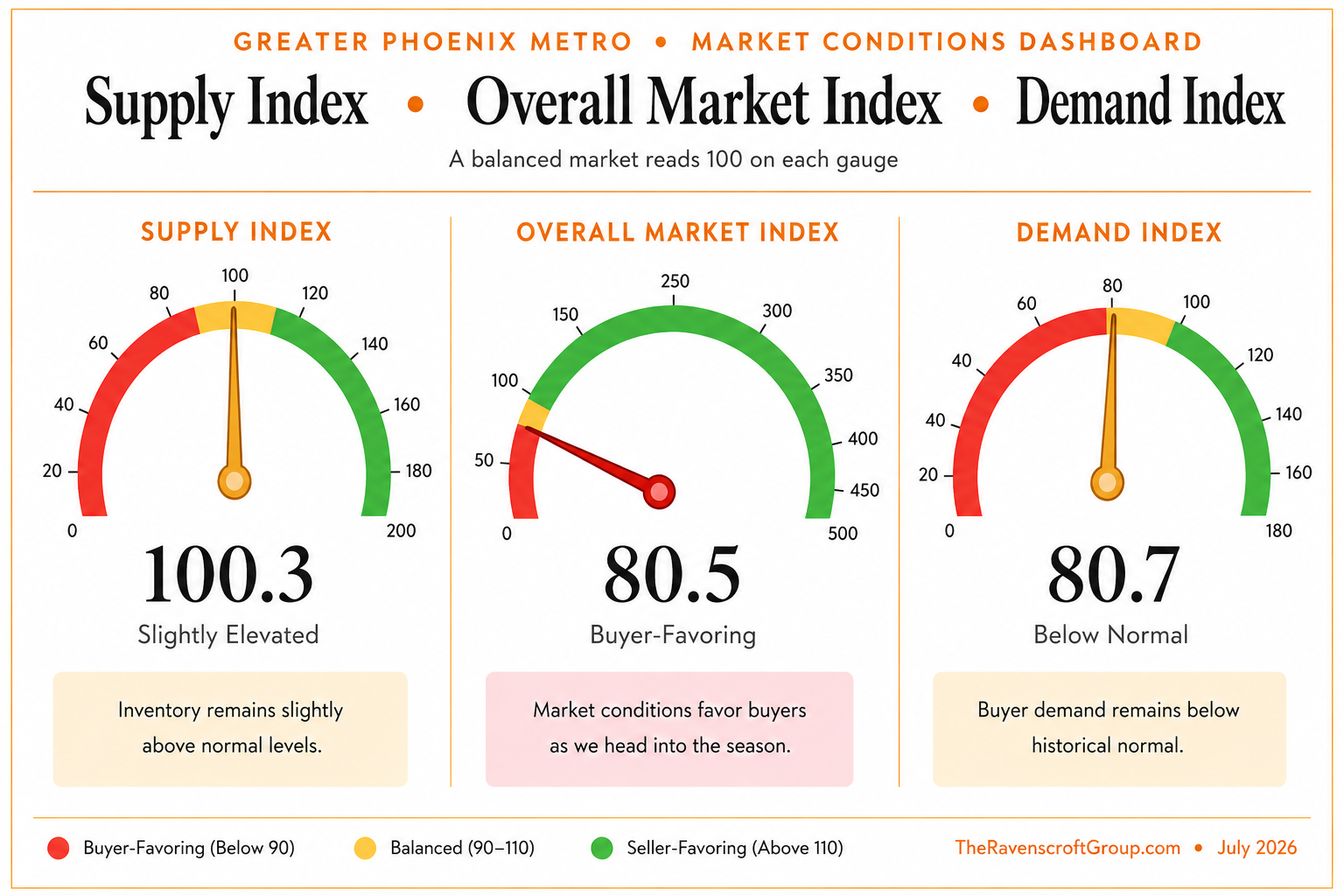
"Are prices up or down?" depends entirely on which Phoenix you mean.
This is the question I get more than any other, and the honest answer is: it depends which price range you're asking about.
Payment-sensitive
This segment lives and dies by the monthly payment, so even a small rate move changes what buyers can — and will — offer.
Steady, but slower
Sales are still happening at a healthy clip here, but buyers are negotiating harder and expecting more for the price than they did a few years back.
Insulated from rate swings
Cash and large down payments dominate here, so financing costs matter far less — which has kept this tier the most resilient of the three.
The mistake I see most often is applying one pricing strategy across every budget. What works for a $450,000 listing rarely translates to a $1.4 million one, and vice versa. If you want to see how a specific price range pencils out for you, our mortgage and affordability calculators are a good starting point.
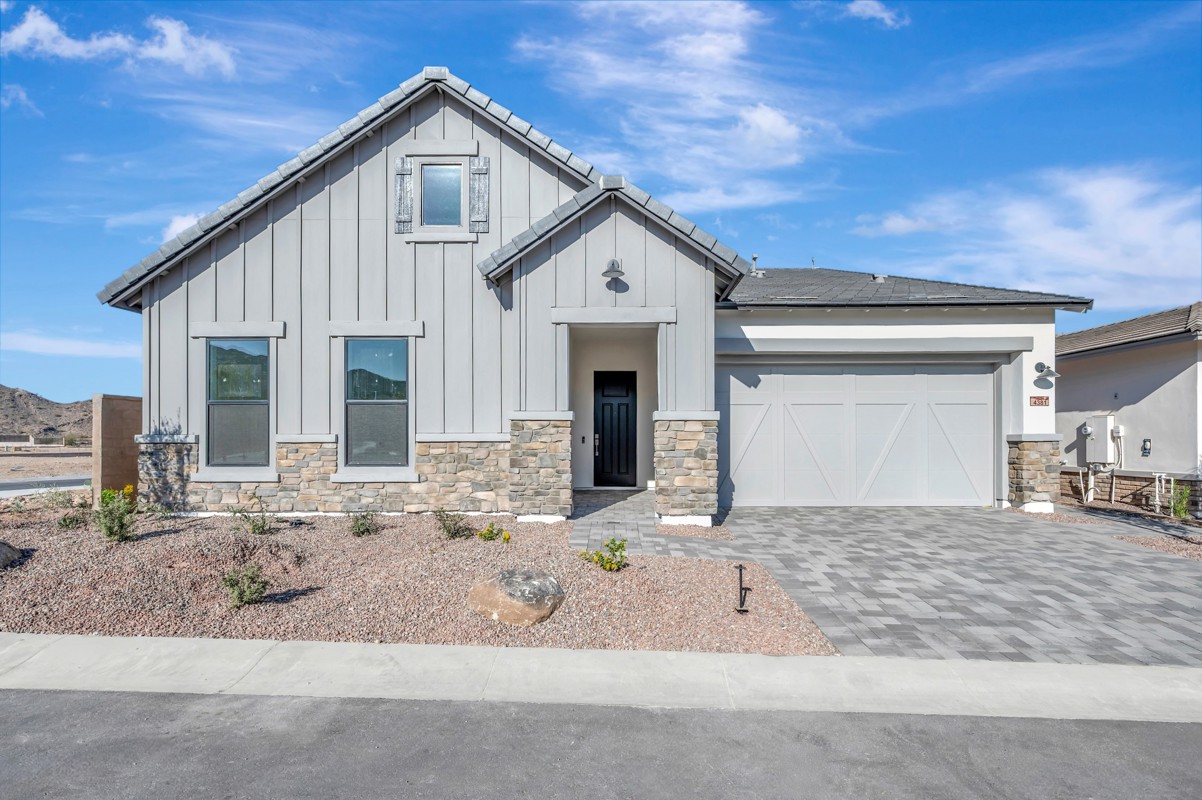
Builders have rewritten the buy-vs-build math.
Builder incentives stopped being a marketing footnote a while ago. Rate buydowns, closing-cost credits, financing programs, and design-package discounts now mean a new-construction home and a resale home can pencil out completely differently than they would have a year ago.
Buyers used to compare homes almost entirely on sticker price. The smarter comparison today is total cost of ownership — factor in a below-market interest rate, a builder warranty, lower near-term maintenance, and better energy efficiency, and a pricier new build can easily out-earn a cheaper resale over the first few years.
I've watched clients who swore they'd never touch new construction switch course once we ran the real numbers — and just as often, clients dead-set on new construction land on resale instead once financing and lifestyle fit are weighed properly. Neither path is automatically right. Both deserve a fair side-by-side comparison, and it's worth browsing current new-construction communities across the Valley before you decide.
Investors have stopped waiting on the sidelines.
For much of the past year, investor conversations centered on one question: should I wait for rates to drop? That question has quietly flipped to "where's the value right now?" Better negotiating room, builder incentives, and the return of 100% bonus depreciation have opened doors that simply weren't open twelve months ago.
What's changed most is discipline. Investors are underwriting cash flow, operating costs, financing terms, and exit strategy far more carefully than during the appreciation-chasing years — and the slower pace of today's market is actually giving them the room to do it right. That's true whether someone is evaluating a first Arizona investment property or adding to an existing portfolio, and it's especially true for those weighing short-term rentals and vacation homes in submarkets where nightly-rate demand still outpaces long-term lease income.

Cash flow, not chasing gains
Fundamentals and disciplined underwriting have replaced the race for quick appreciation.
Worth a second look
Below-market financing and lower upkeep costs have made new builds newly competitive as rentals.
Bonus depreciation is back
A significant factor for higher-income buyers — worth reviewing our real estate tax strategy overview and coordinating with your CPA or tax advisor.
Local Phoenix-area markets are telling six different stories.
Nobody buys "the national housing market." They buy one house, on one street, competing against one specific pool of buyers. Here's how that's shaking out across the Valley this month — and if you're weighing a move here from out of state, our Phoenix relocation resource covers the broader logistics beyond just price.
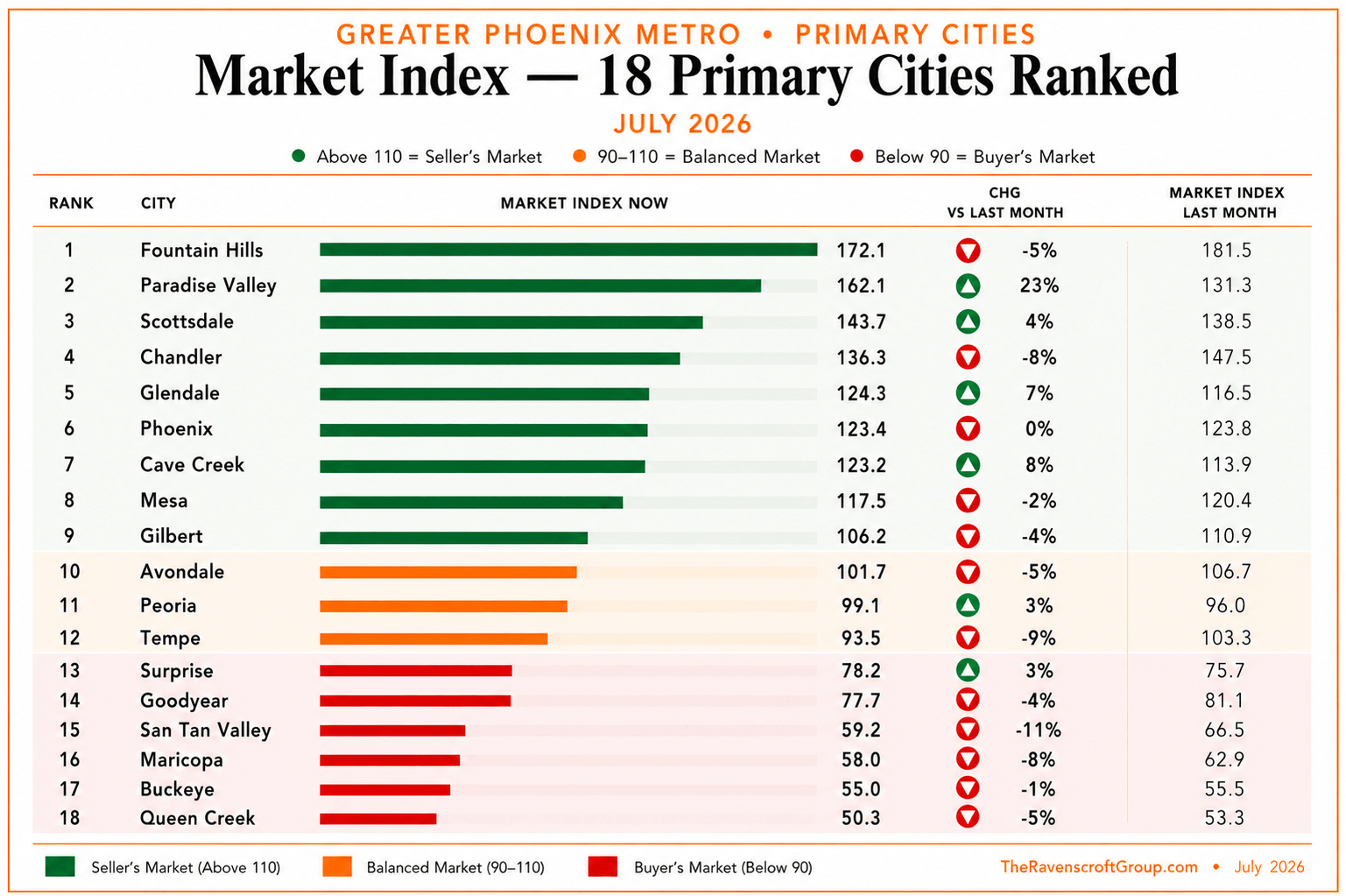
Scottsdale & Paradise Valley
Demand at the top of the market stays strong, since these buyers are far less exposed to rate and affordability pressure.
Chandler
Job growth, strong schools, and tight inventory keep this one of the Valley's steadiest move-up markets.
Buckeye
A magnet for buyers chasing affordability and newer floor plans — though resale sellers are up against aggressive builder incentives.
Goodyear
The Loop 303 job corridor keeps demand humming, but buyers now have far more inventory to sort through than a few years ago.
Southeast Valley
Activity stays healthy, with affordability weighing more heavily on first-time and move-up buyer decisions.
Same zip code, different markets
A $450K home and a $900K home in the same community can face completely different levels of demand.
The real surprise this summer wasn't the data.
Every month I look for the thing the spreadsheet doesn't capture. This time, it's a shift in how buyers are thinking. Nobody's asking me how fast they need to submit an offer anymore. They're asking about financing structure, long-term ownership costs, and whether the neighborhood fundamentals will hold up five years from now.
Investors are making the same shift — less talk about quick flips, more talk about building something that lasts. Preparation is winning over urgency in almost every conversation I'm having right now.
What this actually means for your next move.
For Buyers
Don't let a headline make this decision for you. The real question isn't "buyer's market or seller's market" — it's whether this specific property is a good long-term value.
- Weigh builder incentives against resale options side by side
- Judge total cost of ownership, not just the price tag
- Waiting doesn't automatically get you a better deal — run the numbers now
For Sellers
Buyers will still pay up for a home that's genuinely well-prepared — but they won't overlook the rest anymore. Getting ready matters more than it has in years.
- Price to today's market from day one, not last year's comps
- Handle photography, staging, and deferred repairs before you list
- Know your block-level competition — pricing varies more than people expect
Five things I'm tracking heading into fall.
Where mortgage rates head next
Entry-level and move-up affordability will keep tracking rate movement closely.
How far builders push incentives
Still one of the biggest levers shaping the new-construction-versus-resale decision.
The rental supply picture
Slower apartment construction should gradually rebalance rental supply and demand over the next few years.
Migration into the Valley
It's slowed from the pandemic surge but remains a real, long-term tailwind for Greater Phoenix — see our full guide on moving to Arizona for what's driving it.
How far apart communities drift
Expect the gap between neighborhoods and price points to widen further before year-end.
This market isn't confusing. It's just layered.
Affordability is still tight. Buyers still have more negotiating room than they did a few years ago. Prices in plenty of Valley neighborhoods are still near record highs. Every one of those is true — and none of them, on its own, tells the full story.
The people who make the best real estate decisions aren't the ones who time the market perfectly. They're the ones who actually understand the market they're standing in.
Whether you're buying your first home, selling a luxury property, or adding to an investment portfolio, I hope this update gave you a clearer read on not just what's happening across Greater Phoenix, but why.
Common questions about the Phoenix housing market
Is Phoenix a buyer's market or a seller's market right now?
Greater Phoenix currently leans toward buyers overall, mostly because buyer behavior has gotten more patient and selective — not because inventory is overwhelming. That reading shifts by price point and by city, with luxury areas like Scottsdale and Paradise Valley staying far more competitive than entry-level segments.
Are home prices still rising in the Phoenix area?
It depends on the price range. Homes under roughly $500,000 are the most rate-sensitive and softest on pricing power. The $500,000 to $1,000,000 range has held fairly stable. Luxury homes above $1,000,000 remain the most resilient because fewer of those buyers depend on financing.
Should I buy new construction or resale in Phoenix?
Compare both before deciding. Builder incentives like rate buydowns, closing-cost credits, and warranties can lower the total cost of ownership on new construction even when the list price is higher than a comparable resale home.
Is now a good time to invest in Phoenix real estate?
Many investors are re-entering after sitting out earlier in the year, drawn by better negotiating leverage, builder incentives, and the return of 100% bonus depreciation. The focus has shifted from chasing appreciation toward disciplined cash flow and long-term underwriting.
Go deeper on Greater Phoenix real estate.
What clients say about working with Eric.
"His extensive knowledge of real estate in general and particularly the local market was a huge help. Eric is a class act... 10/10 recommend Eric and the Ravenscroft Group."
"He negotiated an incredible deal on a quick move-in home... his knowledge of the Arizona new construction market and negotiation strategy made a significant difference."
"His patience and professionalism gave us confidence during the whole process. I'd give a 10-star rating if I could, and I really mean it."
"Eric's talents were noticed from the very beginning, showing great interest in identifying our specific home requirements. Truly a 5-star business."
View more 5-star reviews on Google → · See detailed client case studies →
Eric Ravenscroft
Eric Ravenscroft is one of Greater Phoenix's top-ranked real estate advisors, known for pairing hyper-local market data with candid, no-spin guidance for buyers, sellers, and investors across the Valley. A former Director of Wealth Management, Eric brings a financial-planning lens to every transaction. Each month he publishes an in-depth market report built from live transaction data, direct conversations with lenders and builders, and neighborhood-level trend tracking across Scottsdale, Paradise Valley, Chandler, Buckeye, Goodyear, and the Southeast Valley.
- Top 1% REALTOR®, North America
- $100M+ in career sales
- 15+ years, real estate & financial planning
- CRS · GRI · ABR · RSPS designations
- Licensed in Arizona: SA691304000
Trusted by leading financial institutions.
These partnerships aren't paid placements — Eric has been independently vetted and approved by each institution based on performance, ethics, and client outcomes.









Categories
- All Blogs (324)
- Active Adult & 55 Plus Communities (17)
- Arizona Relocation Guides (31)
- Buyers (214)
- Financial Planning (61)
- General Real Estate (141)
- Income From Real Estate (60)
- Market Update (26)
- New Construction (29)
- News, Updates and Coming Soon (57)
- Real Estate Agent Financial Planning (22)
- Real Estate Investing (96)
- Sellers (107)
- Vacation and Short Term Rentals (45)
Recent Posts





About the Author
Eric Ravenscroft is a Top 1% REALTOR® across North America and one of Arizona’s most trusted real estate strategists. With 15 years of experience spanning real estate, wealth management, and investment planning, he helps clients make smarter, financially grounded decisions, from new construction and relocations to STR investments, 1031 exchanges, and long-term portfolio strategy.
Eric’s expertise has earned him industry recognition, Elite status with Real Broker, and features in major publications including the Wall Street Journal, MarketWatch, MSN, and Morningstar. Clients across the Greater Phoenix Metro rely on his clarity, strategic insight, and results-driven guidance.
Ready to make a confident real estate move? Call or text Eric today.