
Scottsdale Short-Term Rental: Bonus Depreciation Turns an Overlooked Lot Into a Fully Booked Airbnb
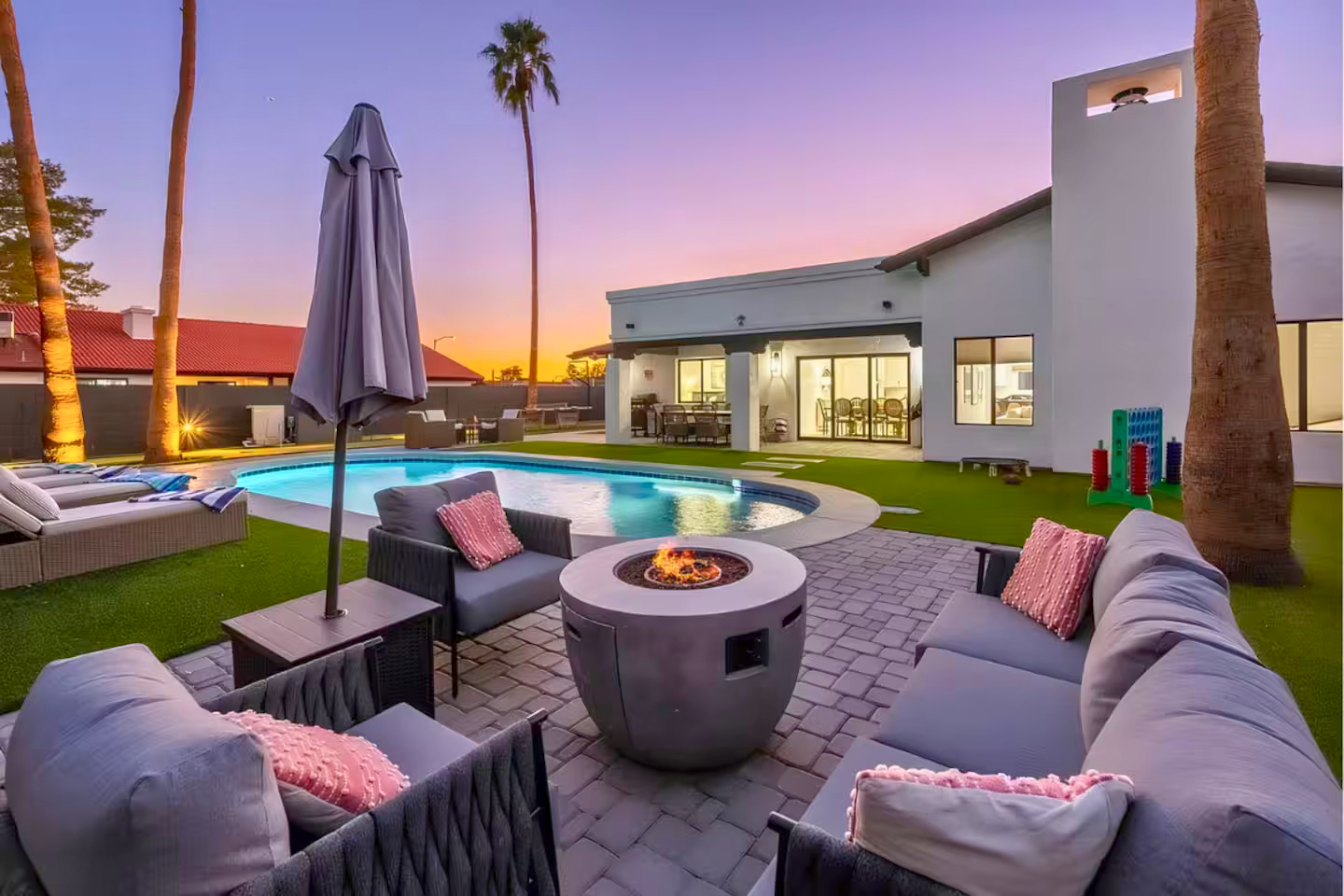
Scottsdale Short-Term Rental: Bonus Depreciation Turns an Overlooked Lot Into a Fully Booked Airbnb
How I helped an out-of-state, high-income buyer find a Scottsdale short-term rental with room to build — and used bonus depreciation and the STR tax exemption to make the numbers work.

Most buyers walked this listing and saw a 1986 single-story ranch with an unremarkable garage and a plain backyard. My client and I walked the same listing and saw 15,682 square feet of raw short-term rental infrastructure sitting on a lot more than a third larger than anything comparable nearby.
My client is a high-income W-2 earner based outside of Arizona who came to me for one specific reason: he wanted a short-term rental that could legitimately qualify for the STR tax exemption — the provision that lets active short-term rental income and its depreciation offset active, W-2 income, rather than being trapped as a passive loss. He found me through my ranking and track record in the Scottsdale/Phoenix STR tax-planning space, and this piece walks through exactly how the search, the deal, and the tax strategy came together. This is one piece of a broader real estate tax strategy I build with clients around short-term rentals and vacation homes.





Trusted By
Scottsdale & Phoenix's Preferred Agent for
Leading Financial Institutions
I'm a preferred real estate partner for USAA, Chase, SoFi, PennyMac, Citibank, Citizens, Huntington, and Fifth Third — institutions that refer clients to me because they trust the strategy behind the property, not just the sale.








What everyone else saw — and what we saw instead
The Scottsdale/North Phoenix short-term rental market is dense with heated pools, hot tubs, and putting greens — that combination has become table stakes, not a differentiator. When 14241 N 54th St came across my desk, most agents would have priced it as a standard 4-bed, 3-bath resale: 2,553 square feet, built in 1986, an unused two-car garage, and a plain, mostly empty backyard on an oversized lot.
What stood out to me wasn't the house — it was the 15,682-square-foot lot, more than a third larger than the typical comparable STR nearby, and a garage that was doing nothing but storing a car. In a market where guests choose between near-identical pool-and-spa listings on price alone, a lot that size is a blank canvas. I keep a full breakdown of what makes a property work — or not — as an Arizona short-term rental, and this lot cleared that bar before we ever wrote an offer.
Scottsdale's short-term rental market doesn't move in isolation from the broader housing market, either — I watch Phoenix housing market data closely for exactly this reason, since a property's resale liquidity matters as much as its rental income if a client ever needs to exit.
"Find me a property most buyers will scroll past — one with room to build something no one else in this ZIP code is offering guests."
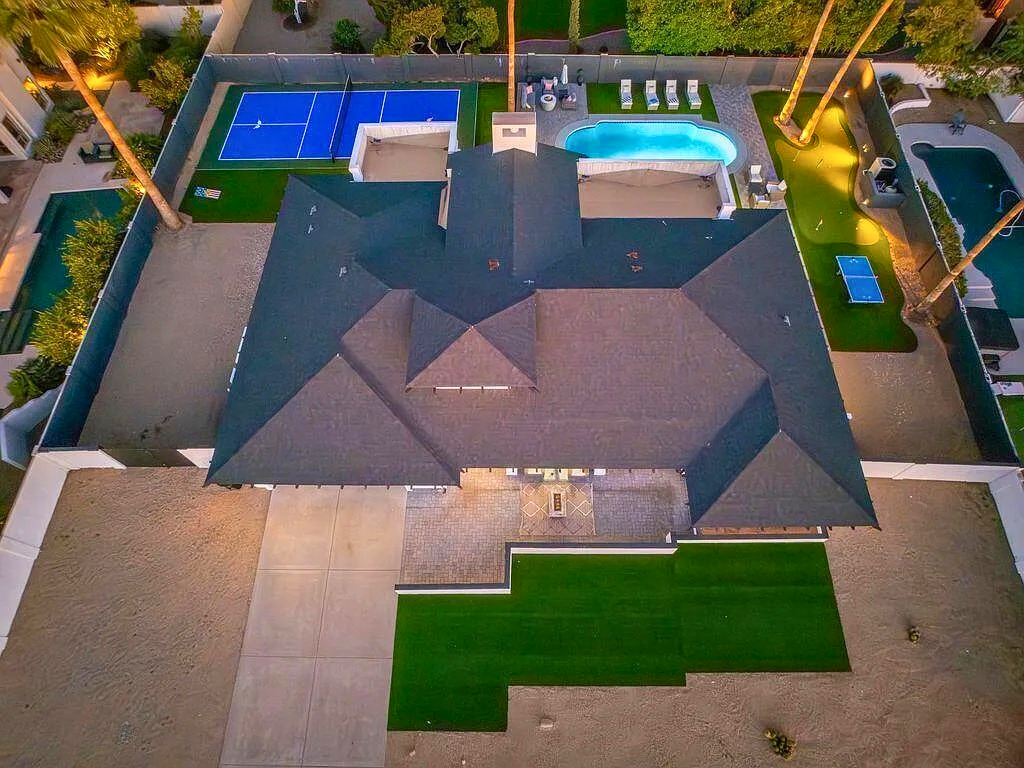
The full 15,682 SF lot — more than a third larger than the comparable STRs nearby.
Structuring the offer around the build-out, not just the price
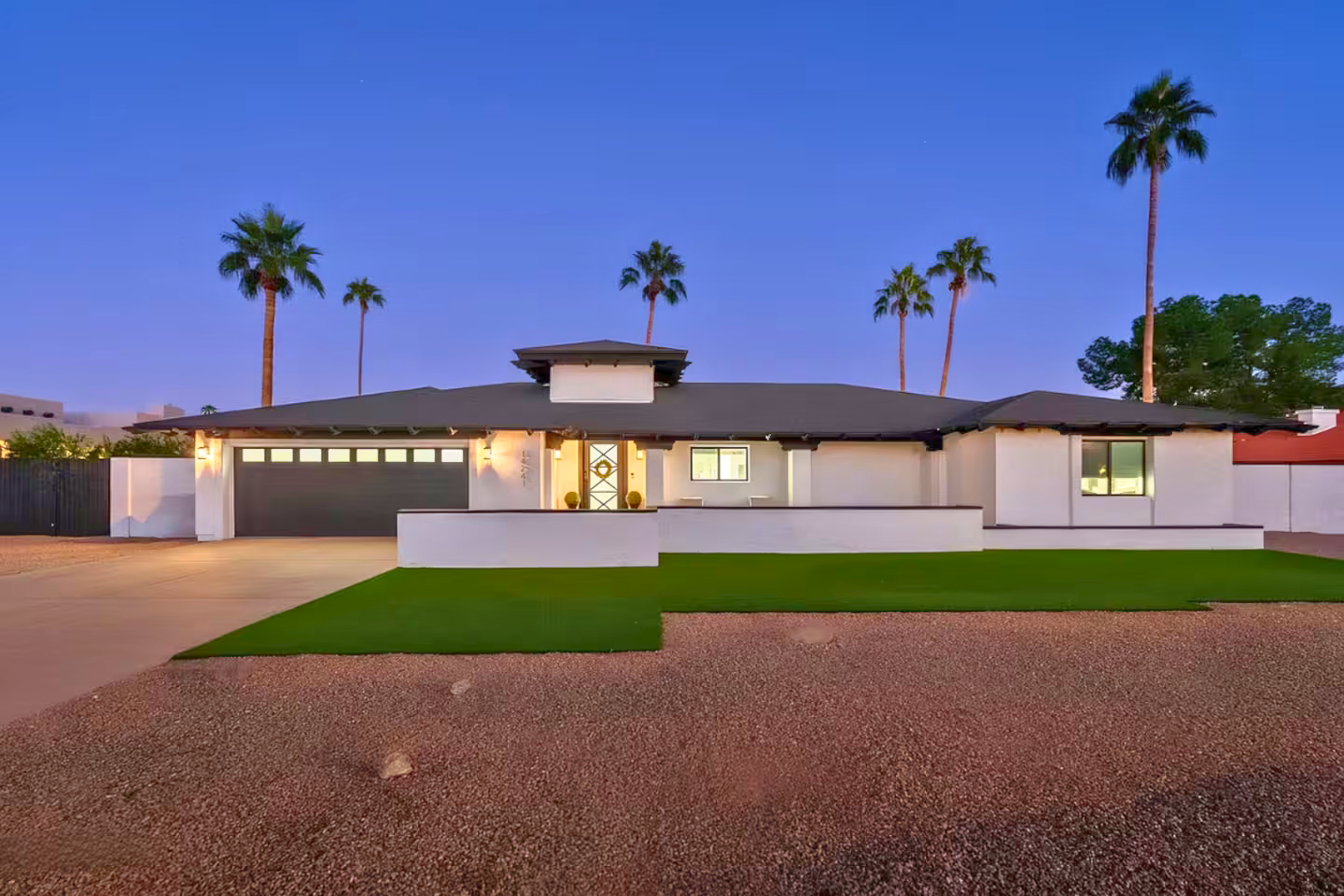
Because the plan from day one was to convert the garage and add amenities, price wasn't the only lever. I negotiated the offer to include a $33,000 seller credit at closing — capital that went straight into funding the hot tub install and the garage-to-game-room conversion, rather than coming out of my client's pocket after close.
The garage, before and after
This is the single clearest before/after in the whole project — an unused two-car garage, reframed as the property's rainy-day and monsoon-season game room.
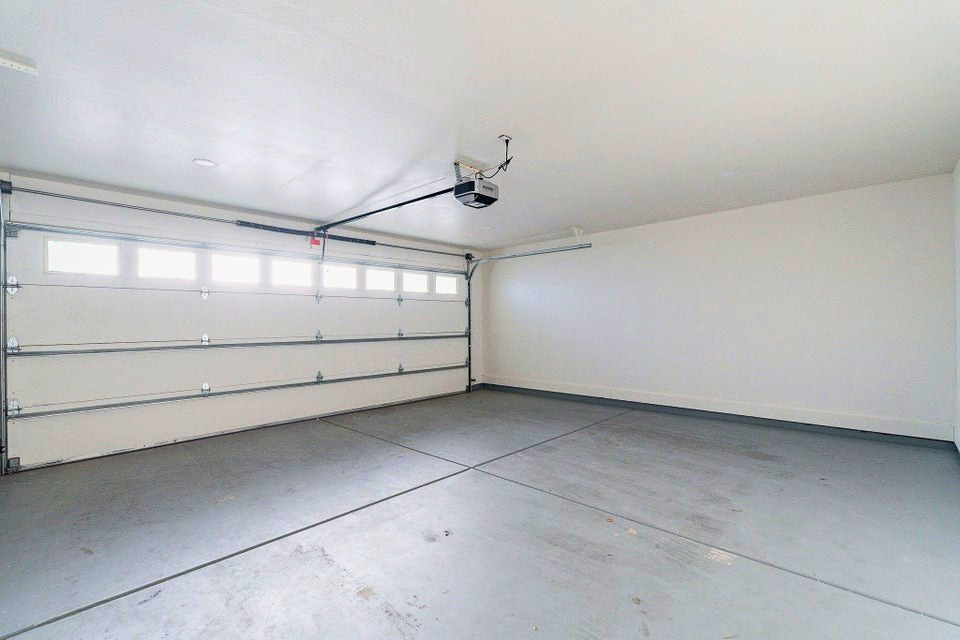
Before — the original two-car garage, doing nothing but storing a car.

After — the finished game room, styled and ready for guests.
Turning square footage into a guest experience
A large lot only matters if you use it. Working with my client, we mapped the yard into distinct activity zones so a group of twelve guests always has somewhere to go — the pool for the afternoon, pickleball on the multi-sport court at sunset, the putting green for the golfers, the game room on a monsoon night. Individually, none of these is rare in Scottsdale. Together, on one property, they are.
We identified the garage conversion and hot tub addition before the offer was written; the physical build-out happened after closing, funded in large part by the negotiated seller credit.
The amenities, in action
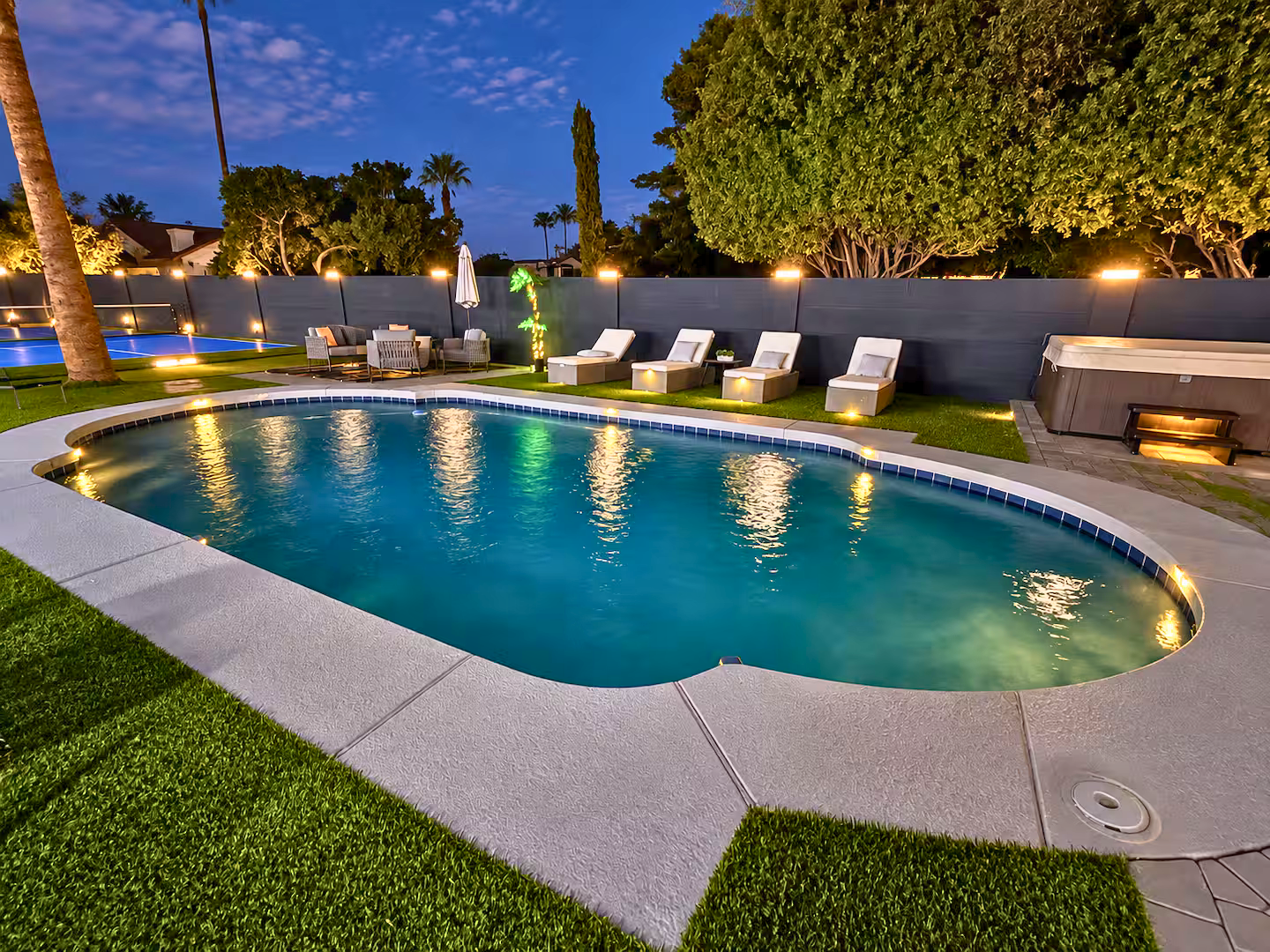
Pool & hot tub — the hot tub funded by the negotiated seller credit.
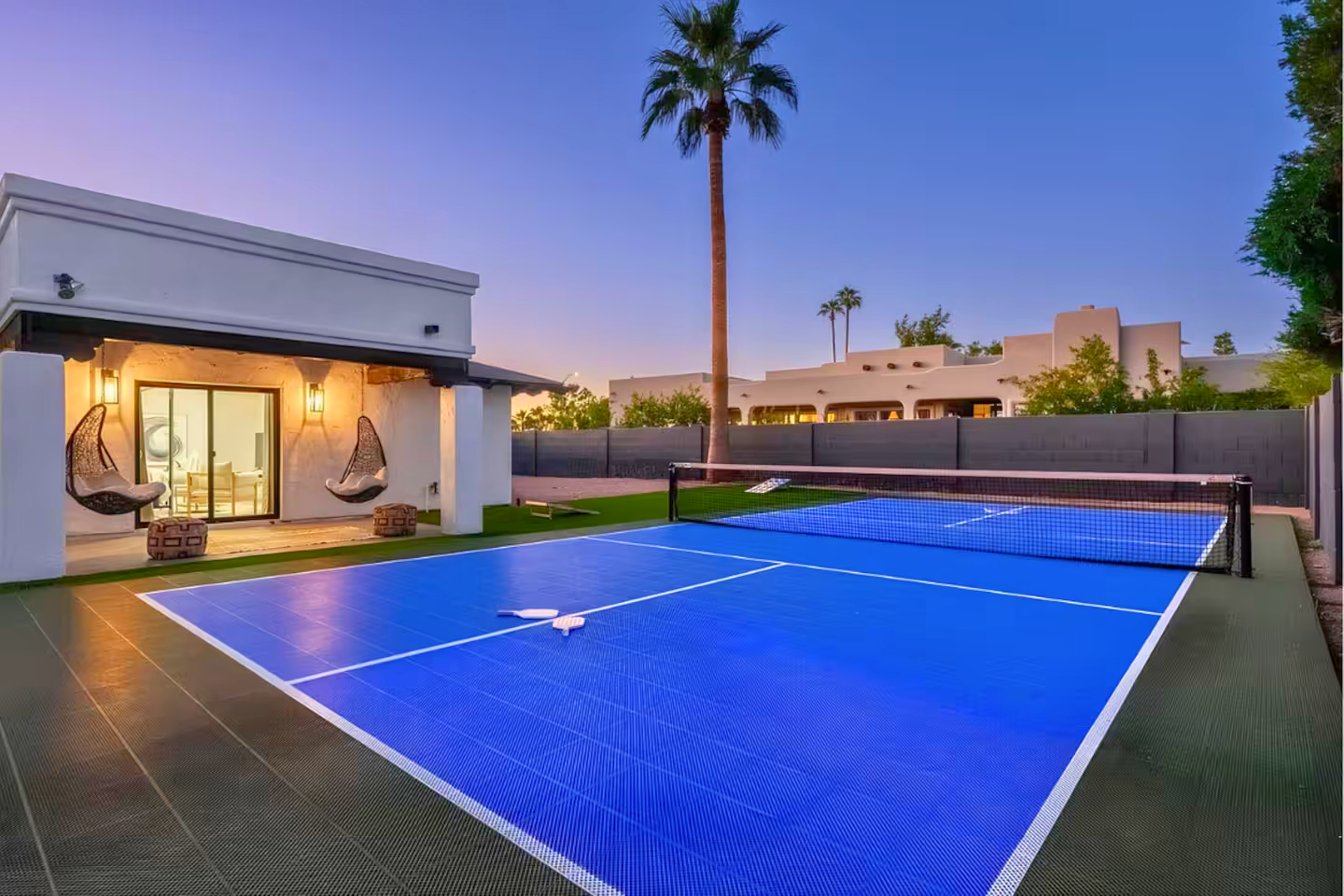
The multi-sport court, lined for pickleball — the fastest-growing amenity search term among Scottsdale STR guests.

Putting green — a direct answer to Scottsdale's golf-driven visitor base.
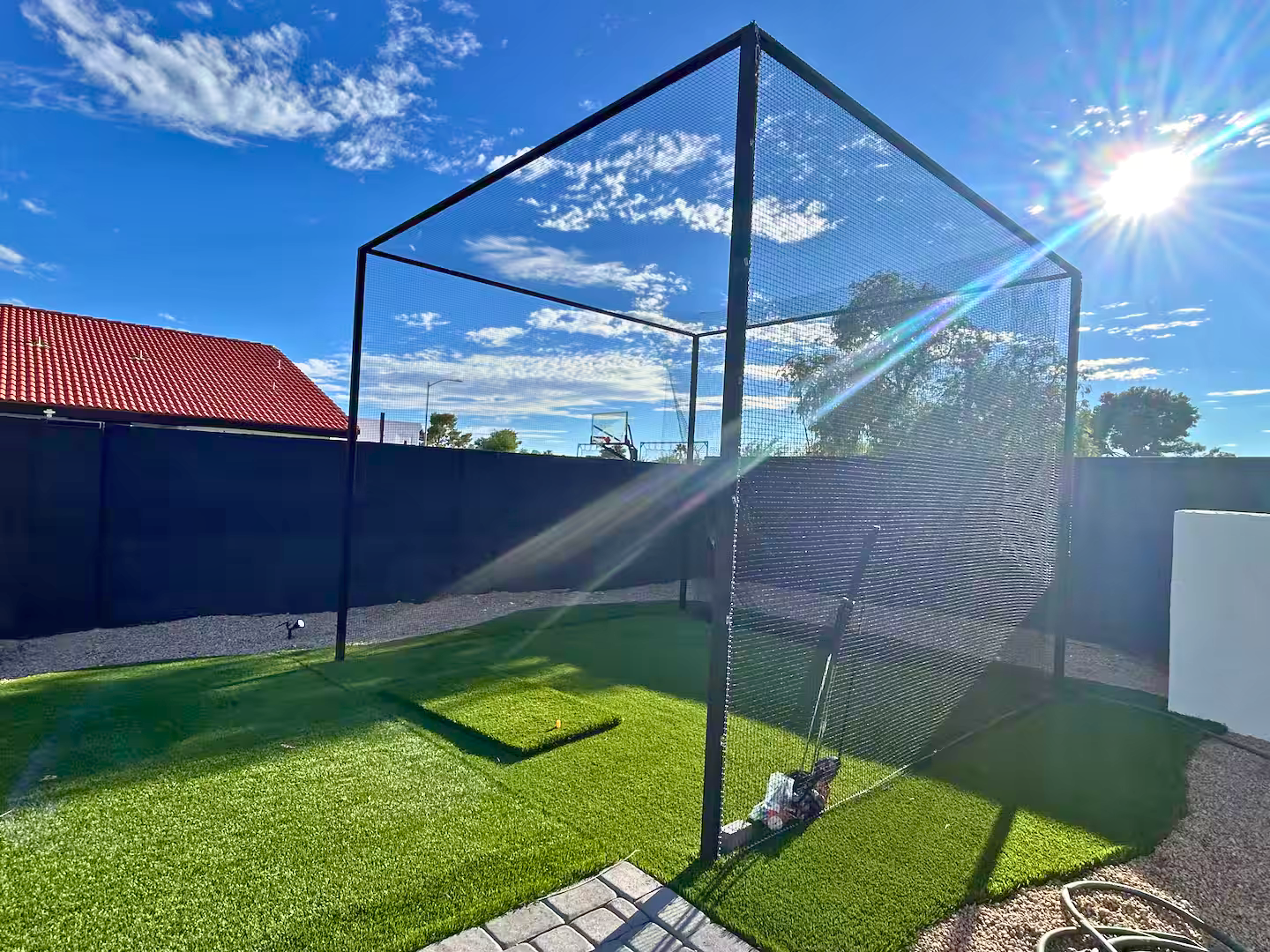
Golf hitting net — a permanent golf simulator is planned for 2027.

The finished game room — the converted garage, funded by the negotiated seller credit.
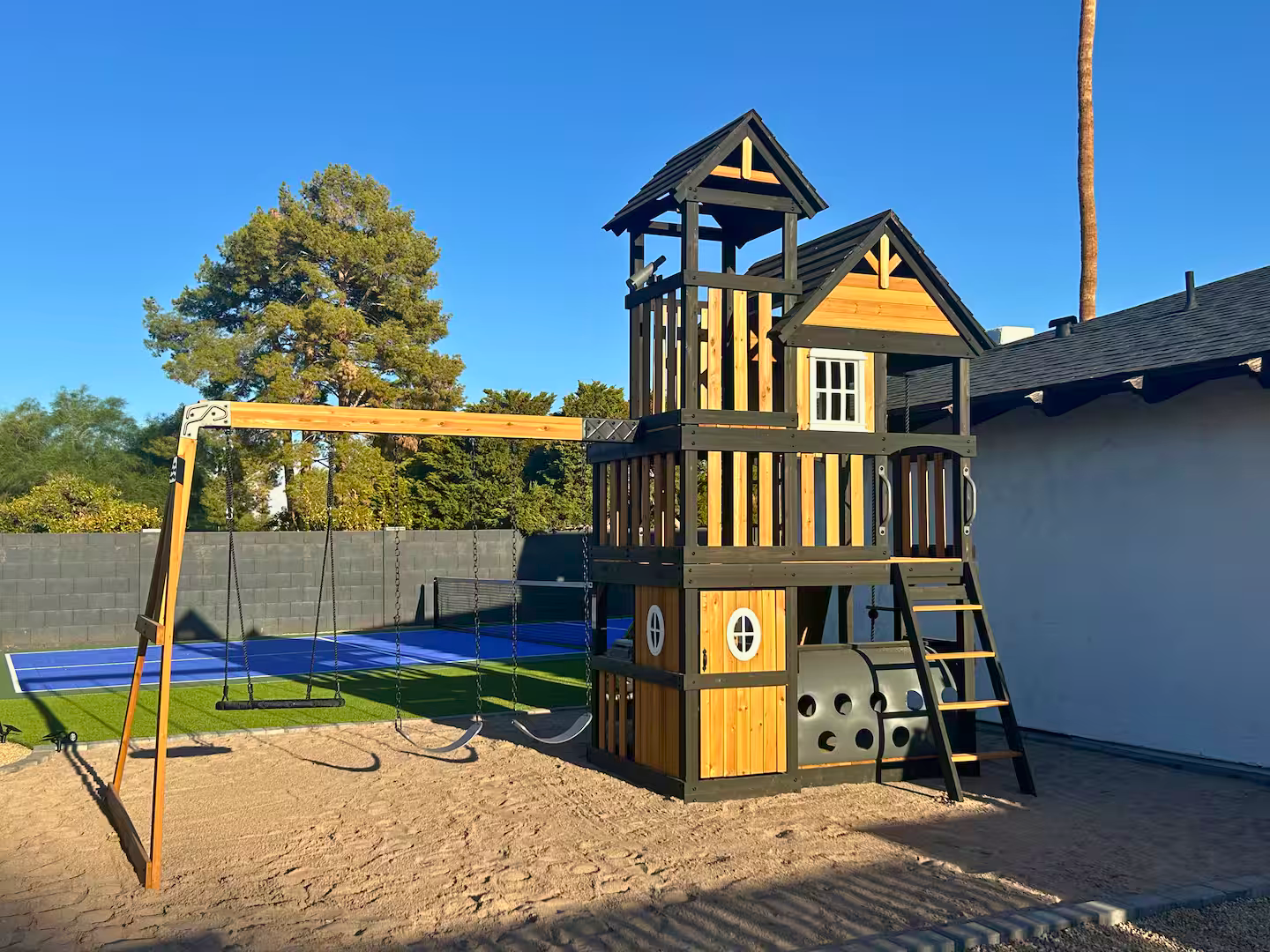
Playground area — widens the buyer pool to multi-generational family bookings.
Inside the home
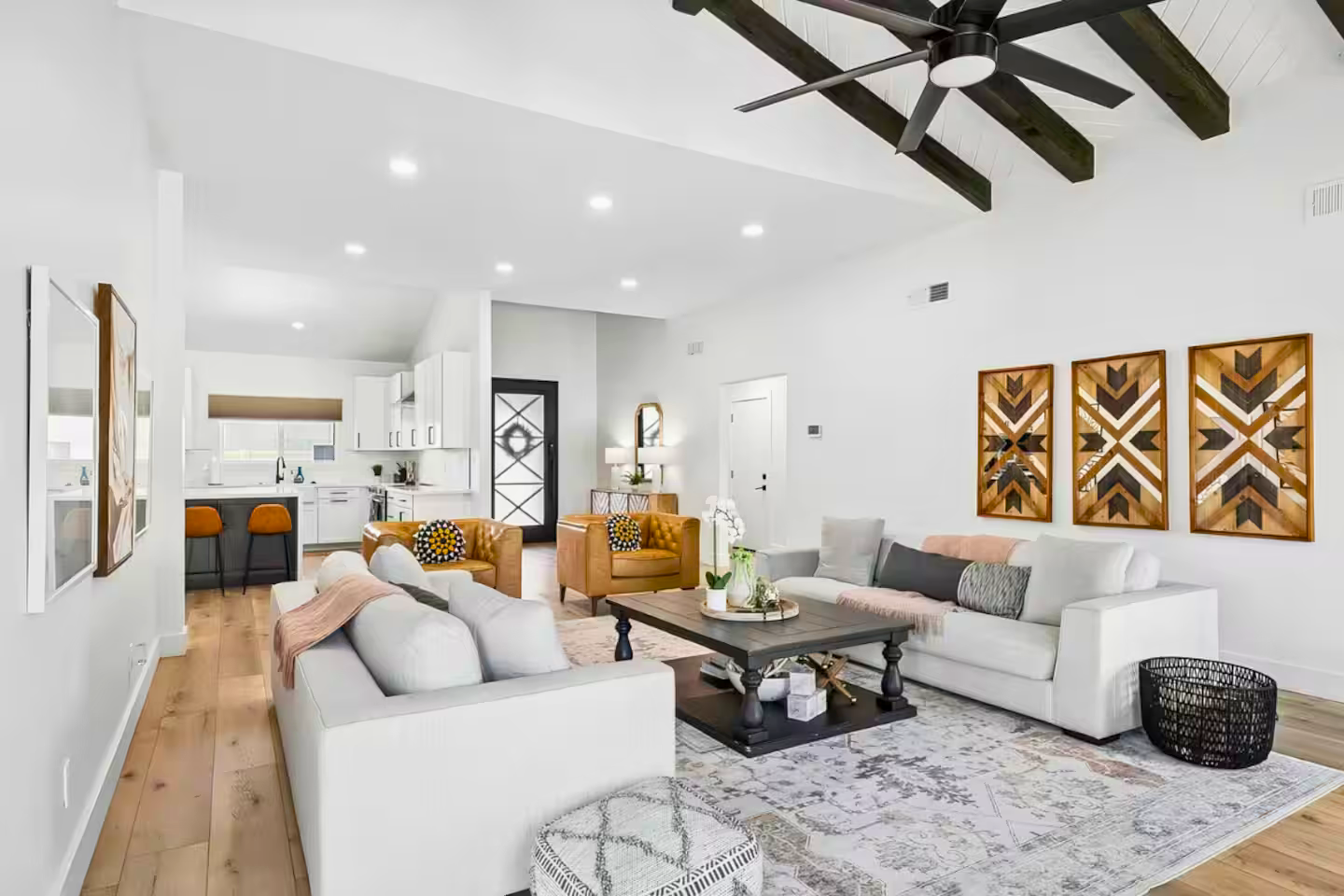
Great room, styled and lit for guests.
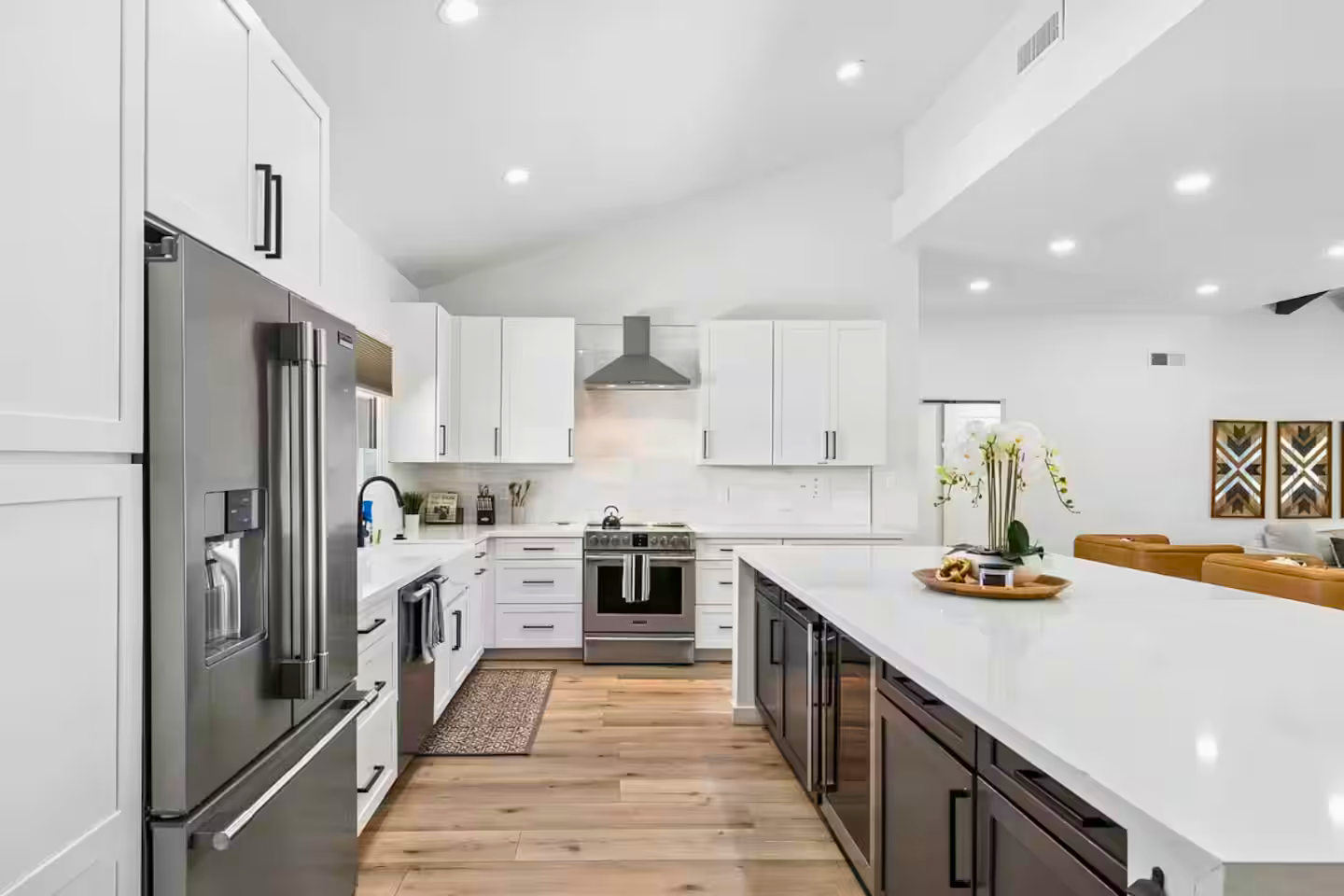
Kitchen — fully equipped for extended-stay and group bookings.
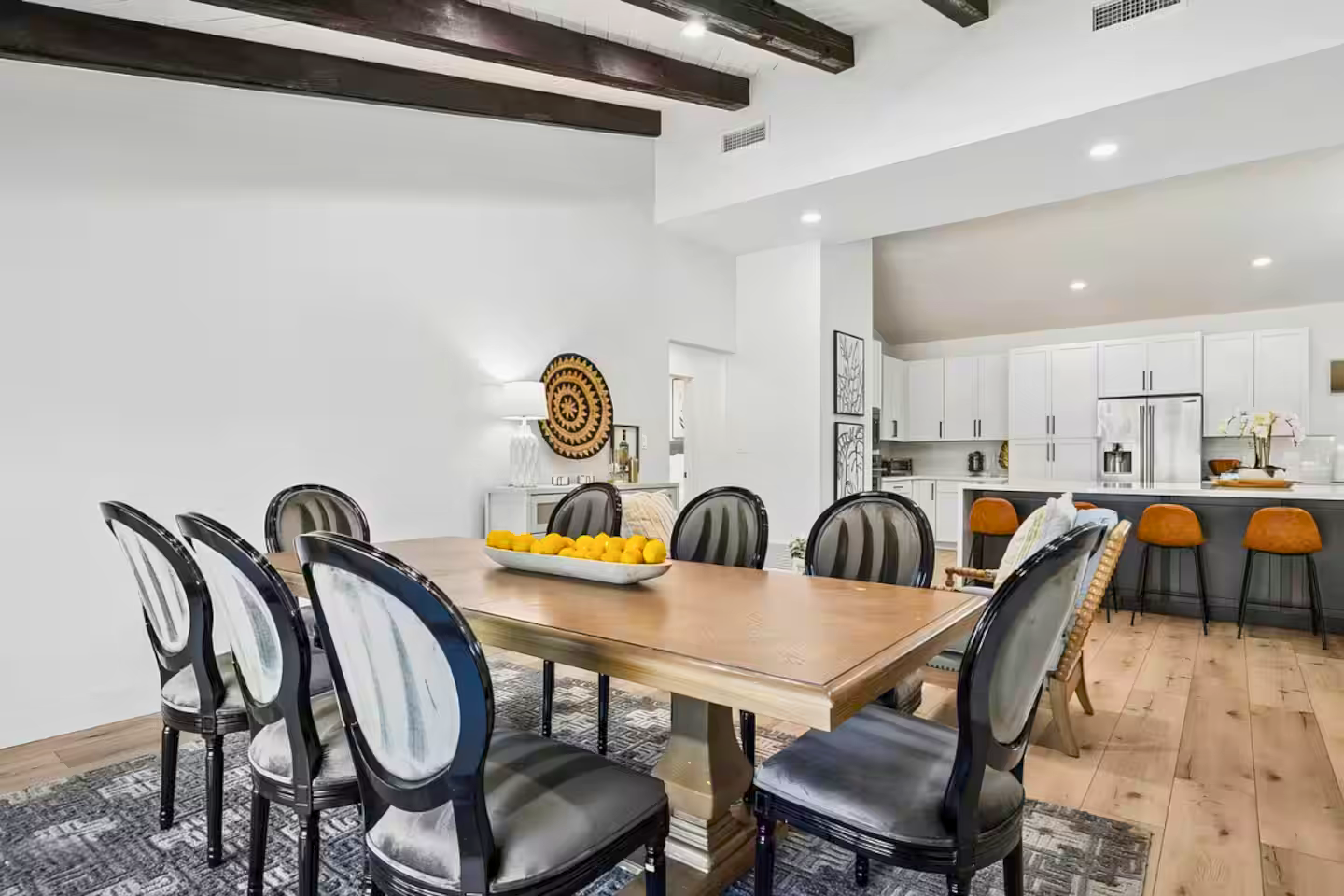
Dining room — seating for large groups and multi-family bookings.
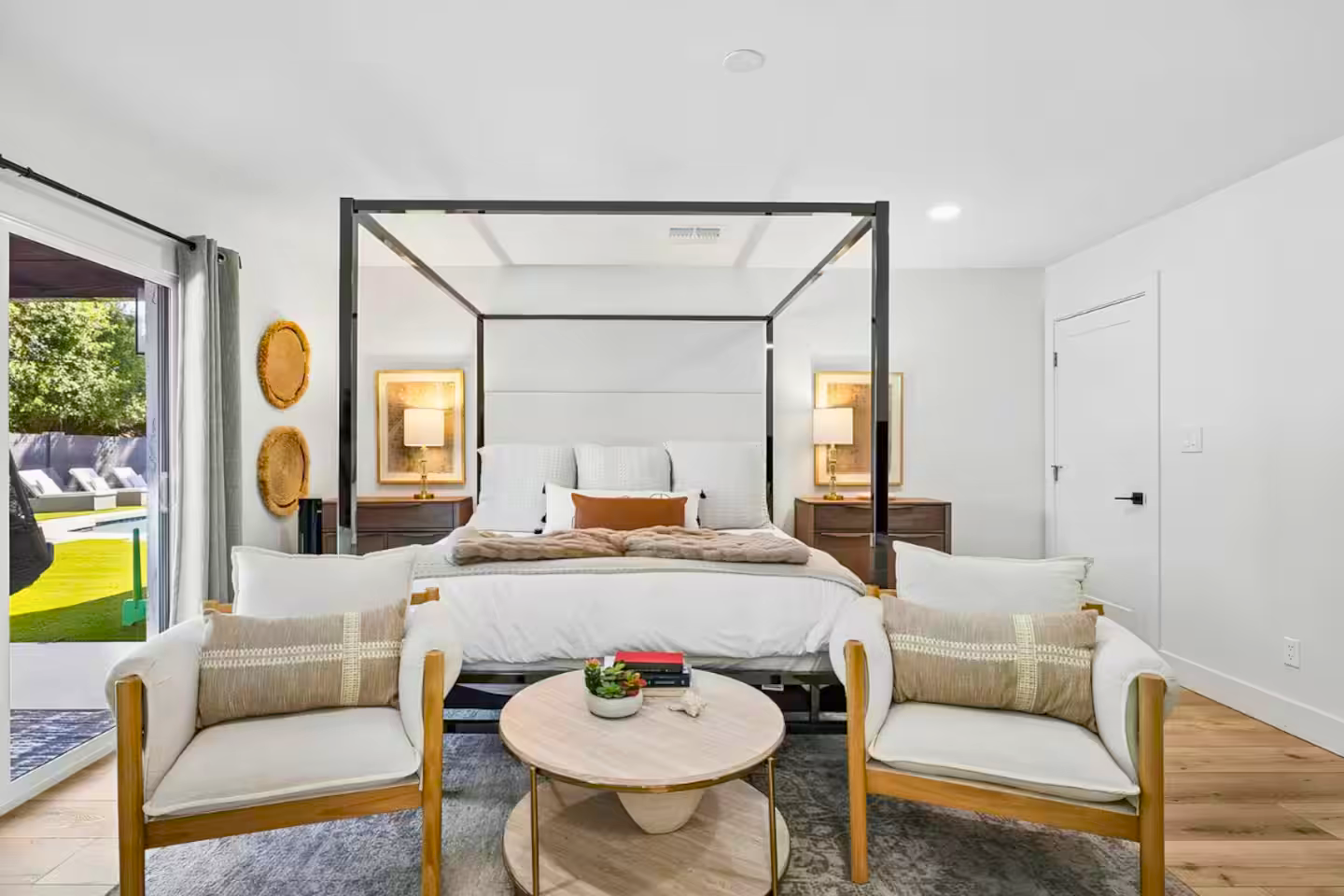
Primary suite.
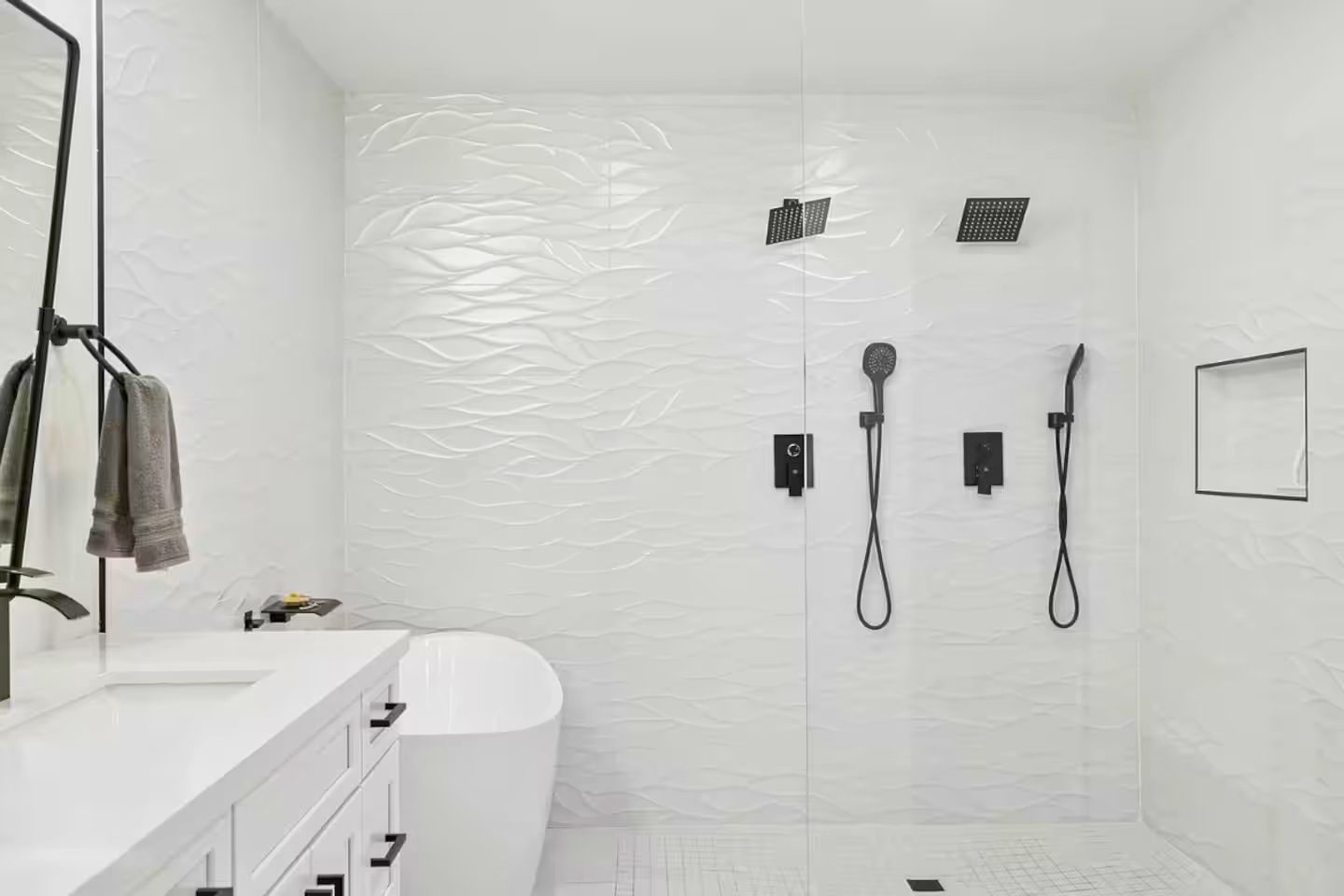
Primary bathroom.
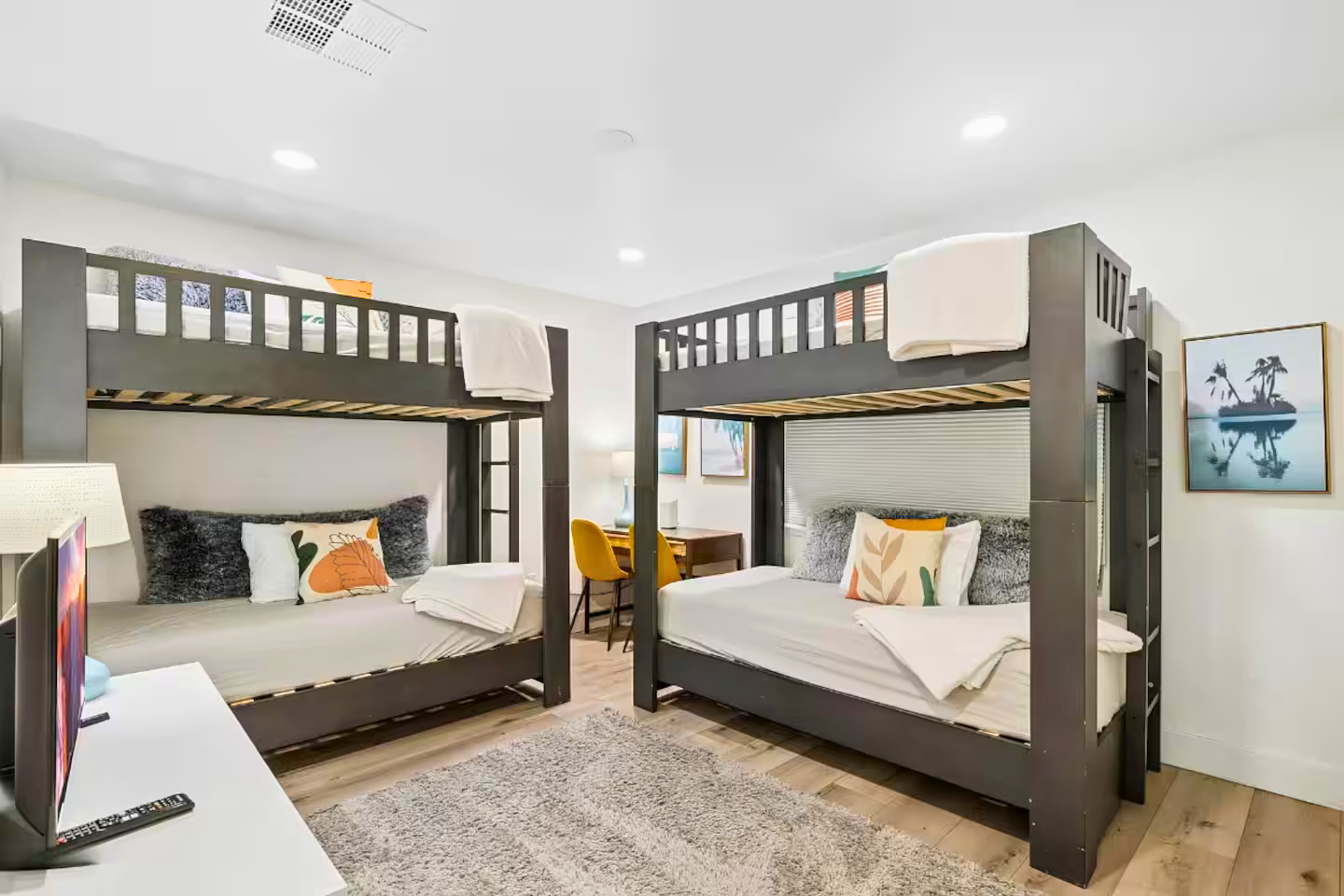
A dedicated room for kids — widens the buyer pool to multi-generational family bookings.
Two months on Airbnb, booked into 2027
The property listed on Airbnb roughly two months ago. It is already booked nearly solid through May 2027 — direct evidence that guests are responding to a listing that offers more activities on one property than anything comparable within a mile.
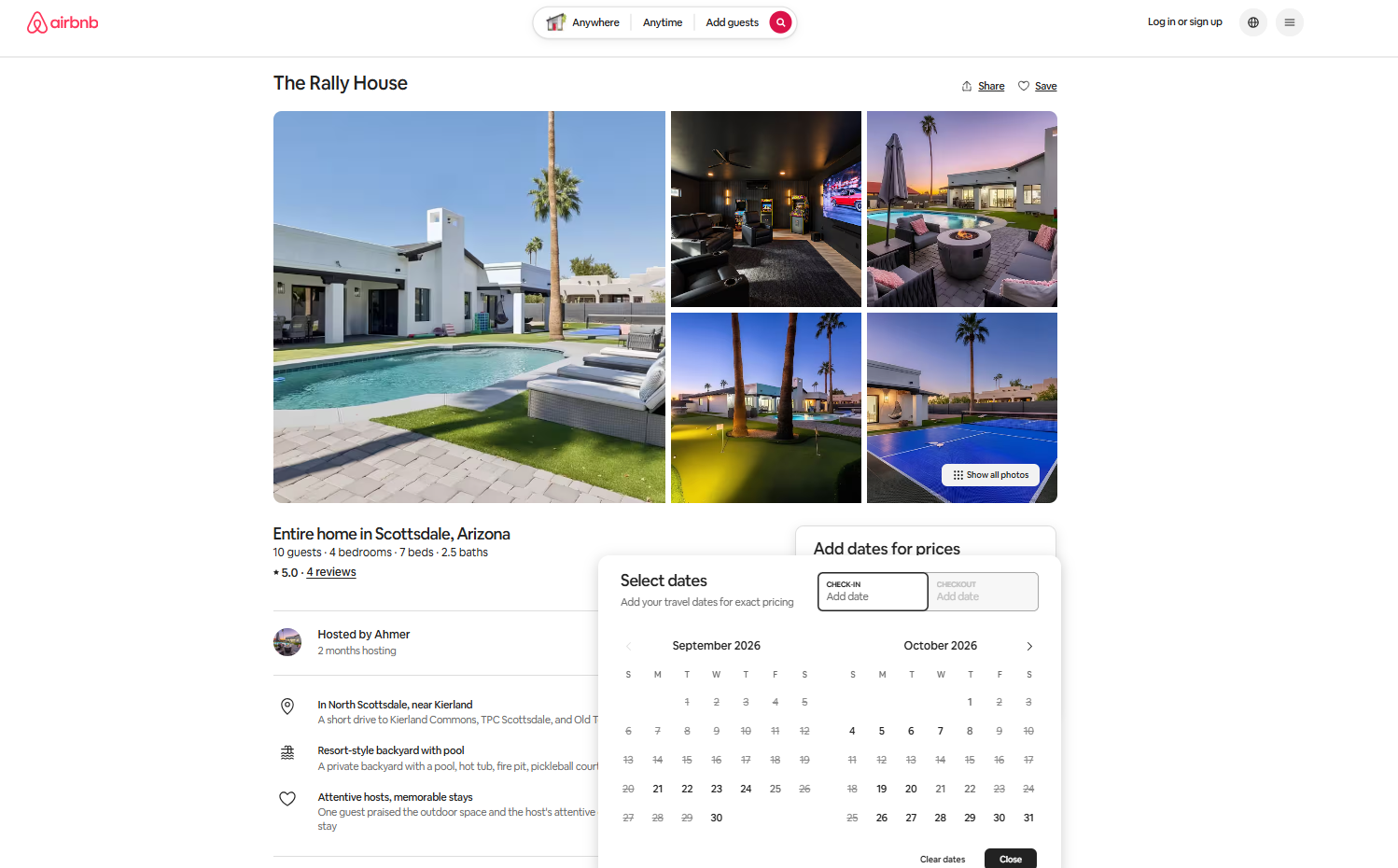
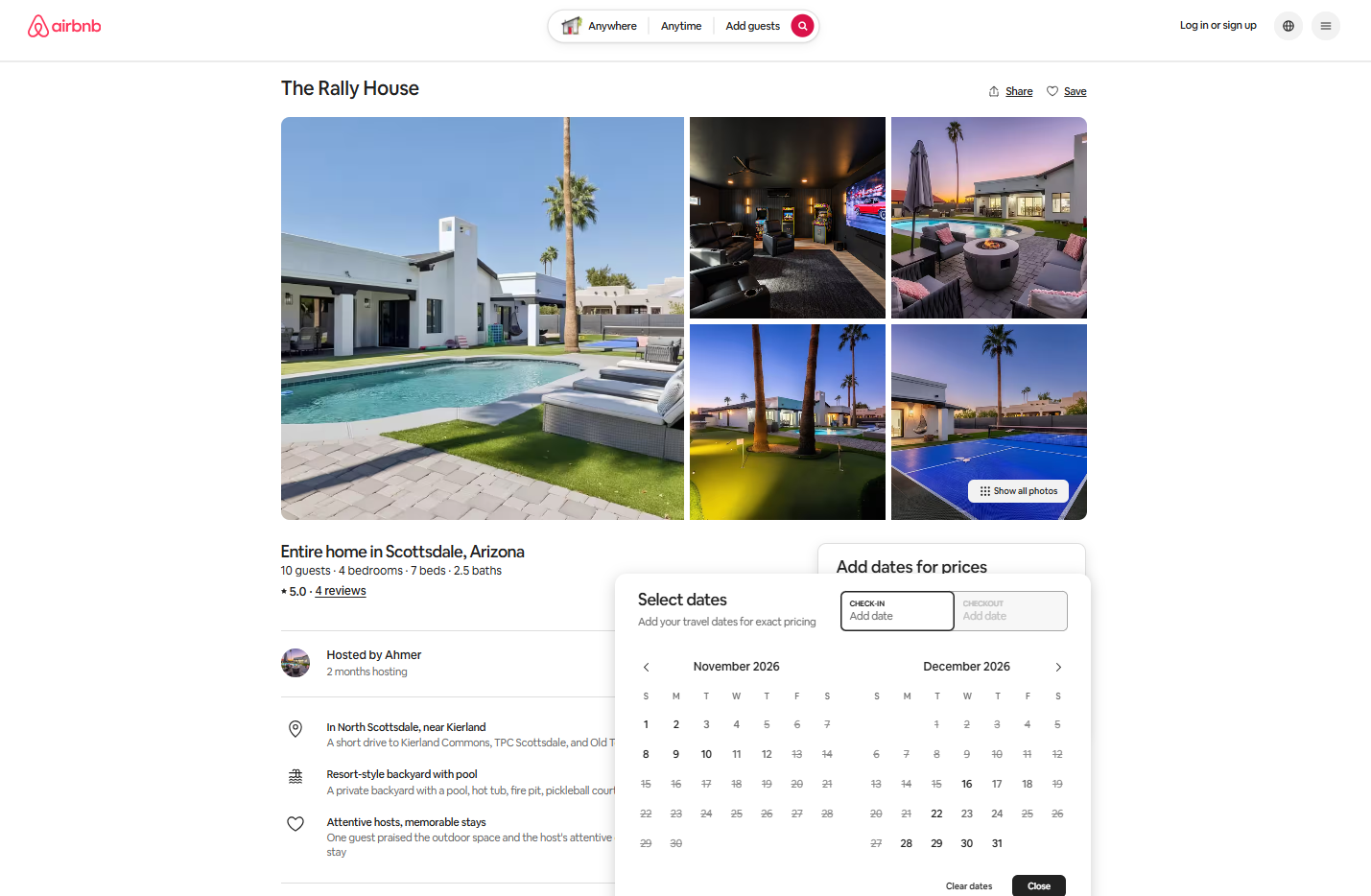
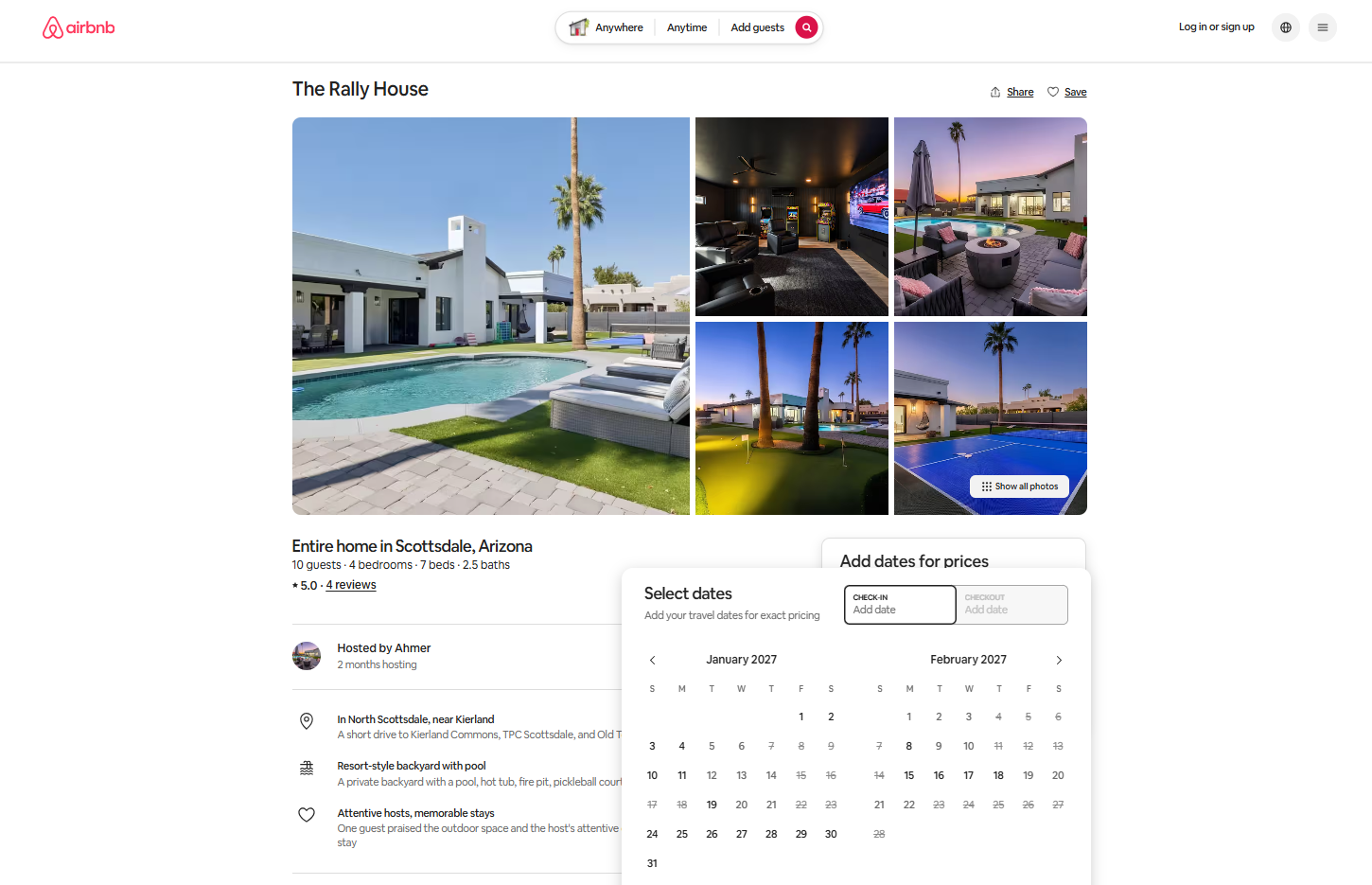
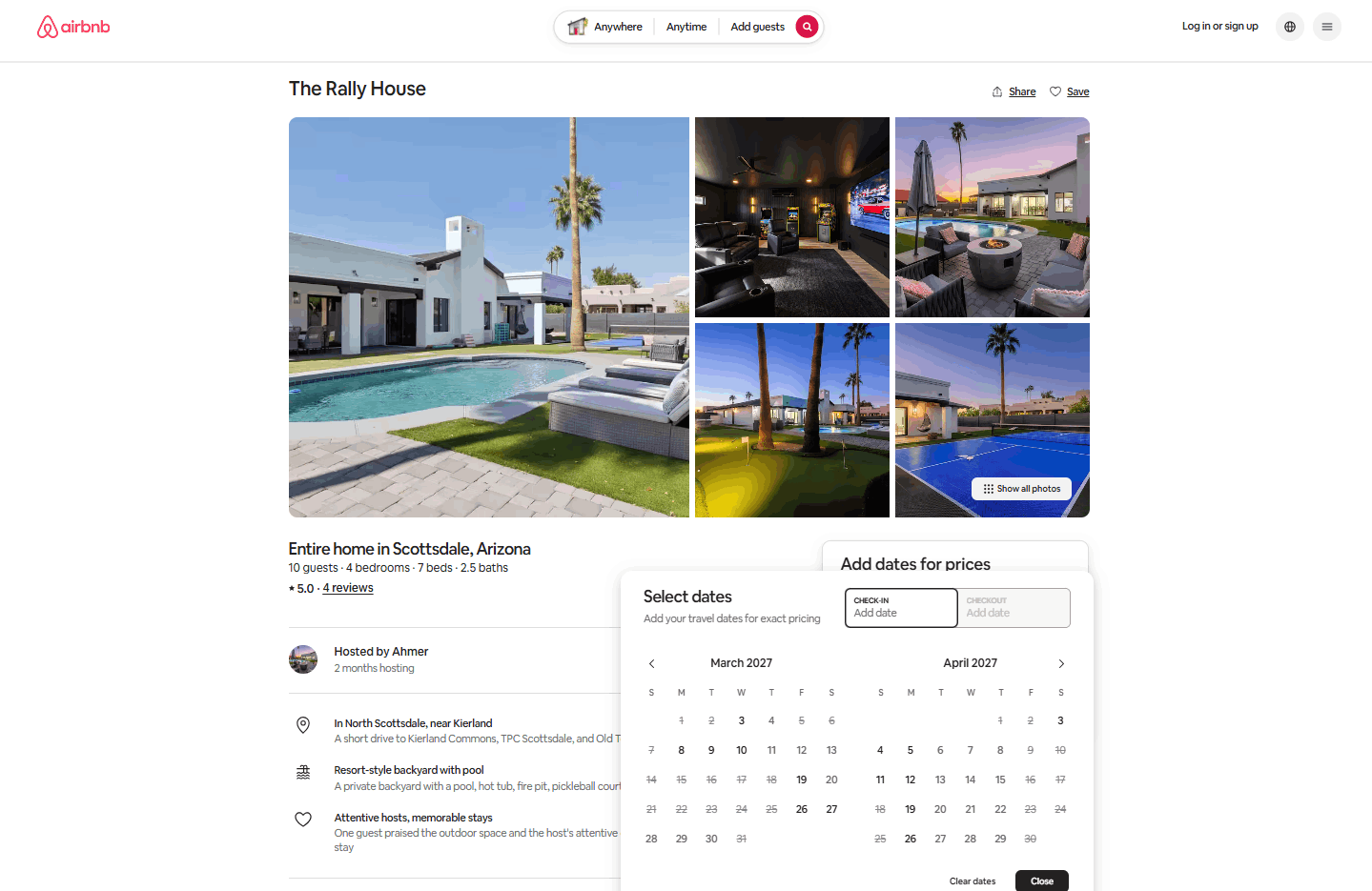
The actual booking calendar, screenshotted month by month through May 2027.
The figures below combine two months of actual Airbnb performance with the underwriting model built at acquisition — the same model used to evaluate the deal before closing, not a retroactive best-case projection.
Within a mile of this property, comparable four-bedroom Scottsdale short-term rentals range from roughly $26,000 to $243,000 in annual revenue — nearly a 10x spread on nearly identical bedroom counts and guest capacity. The single highest performer in that comp set also features pickleball. The spread isn't about the house; it's about what a property gives its guests to do.
Projected total return, compounding
Cash flow, equity, and appreciation, per the underwriting model — the same lens I use whenever I talk with clients about real estate as an asset class rather than a single transaction.
At the Year 30 mark, the same model projects a total return of approximately $6.09M against a $380,000 down payment — shown for illustration of the model's assumptions, not a guarantee of future performance. If you want to run rough numbers on a property you're considering, I keep a set of calculators clients use to sanity-check acquisitions before going under contract.
Client Testimonial: Scottsdale Short-Term Rental Investment Experience
Ahmer's testimonial below echoes over 170 five-star reviews from buyers and sellers across the Phoenix metro. See them all on Google →
Eric took the time to understand exactly what I was trying to accomplish, thoroughly analyzed the opportunities, and was willing to tell me when a property or price didn't make sense. I came to value his opinion enough that his assessment of the investment became one of the most important factors in my decisions.
What stands out even more is his character. Eric follows through on what he says he is going to do, even after the transaction is over. That says a lot about the kind of person he is. He is sincere, extremely good at what he does, and someone I trust with my business 100%.
I look forward to working with Eric on many more investments in the future."
Why an STR — and not just any rental
Tax details below reflect federal rules current as of September 2026 under the One Big Beautiful Bill Act. Depreciation percentages, thresholds, and guidance can change — verify current-year rules with your CPA before acting.
This is the part most buyers skip past, and it's the entire reason my client called me in the first place. Ordinary long-term rentals are taxed as passive activities: their losses and depreciation generally can't offset a W-2 salary, no matter how high that salary is. I walk clients through the full comparison — long-term, mid-term, and short-term rental strategy — but for a buyer in this exact tax position, short-term is usually the only one that changes the math.
When a property is rented short-term — guests averaging seven days or fewer per stay — and the owner materially participates in operating it, the IRS treats that activity as non-passive under the rental activity exceptions in IRC §469 and its regulations. That single classification is what people mean by the "STR exemption" or the "short-term rental loophole": it isn't a loophole in the hidden sense, it's a well-established rule most buyers never structure their purchase to use.
How "average guest stay" is actually calculated
This is where a lot of self-directed attempts go wrong. The 7-day test under Treasury Reg. §1.469-1T(e)(3)(ii) isn't about how most of your bookings look — it's the property's total guest-nights for the year, divided by its number of reservations. A calendar full of short weekend bookings can still fail this test if even a couple of longer monthly stays get mixed in, because those long stays pull the average up disproportionately. On a property like this one, that means tracking the actual reservation log at year-end, not eyeballing the calendar and assuming it qualifies.
Why this works without Real Estate Professional Status
This is the detail that actually makes the strategy relevant to a high-income W-2 earner — I go deeper on this exact question in the short-term rental tax break for W-2 earners. Ordinarily, using rental losses against active income requires qualifying as a Real Estate Professional — 750+ hours a year in real property activities, and more time spent in real estate than any other job. That's essentially unreachable for someone working full-time as an executive, physician, or attorney. The short-term rental exception sidesteps that requirement entirely: a qualifying STR isn't a "rental activity" under §469 in the first place — it's a trade or business, and material participation in a trade or business has always been enough to make its losses non-passive, no REPS status required.
Passive by default
- Losses are trapped as passive losses in almost all cases
- Offsetting W-2 income requires Real Estate Professional Status
- REPS demands 750+ hours a year and more time in real estate than any other job
- Out of reach for most full-time, high-income W-2 earners
Non-passive by structure
- Average guest stay of 7 days or less (or 30 or less with substantial services)
- Owner materially participates — no REPS status needed
- Treated as a trade or business, not a "rental activity"
- Losses can offset W-2 or other active income the same year
What "material participation" actually requires
Non-passive treatment isn't automatic just because a property is listed on Airbnb — the owner still has to clear one of the material participation tests laid out in Treasury Reg. §1.469-5T, and this is where a lot of buyers get tripped up. The most commonly used test for STR owners is the "100-hour test," and it has two parts that both have to be true.
100+ hours, personally, during the year
Guest communication, booking coordination, restocking, scheduling and overseeing repairs, sourcing and directing vendors — logged contemporaneously, not reconstructed at tax time.
More hours than anyone else — including paid staff
If a cleaner, co-host, or property manager spends more hours on the property than the owner does in a given year, this test fails, no matter how many hours the owner logged.
Alternative: 500+ hours, on its own
A higher, unambiguous bar that satisfies material participation regardless of anyone else's time — often the safer test for an owner who also uses a property manager.
Time logs matter here as much as the hours themselves — the IRS can and does challenge material participation claims, and "reasonable estimates" made after the fact carry far less weight than a contemporaneous log.
Why the bonus depreciation number is this large right now
A cost segregation study reclassifies everything in the property that isn't the structural shell — pool equipment, landscaping, decking, fixtures, appliances, and, on this property, the new hot tub and the garage-to-game-room build-out — into shorter-lived asset classes. Bonus depreciation is what allows a large share of that reclassified value to be deducted immediately instead of spread out over a decade.
| Asset Class | % of Building | Life |
|---|---|---|
| Structural components | 70–80% | 27.5 yrs |
| Land improvements (pool, court, landscape) | 8–15% | 15 yrs* |
| Personal property (appliances, furnishings) | 8–18% | 5 yrs* |
| Equipment | 0–3% | 7 yrs* |
*Eligible for 100% bonus depreciation in year one (post Jan 19, 2025). Verify with your CPA — Arizona state conformity may differ.
That percentage isn't fixed: it phased down to 40% for property placed in service in 2025 under prior law, before the One Big Beautiful Bill Act restored 100% bonus depreciation for qualifying property placed in service after January 19, 2025, with implementation guidance following in IRS Notice 2026-11. That restoration is the direct reason a study on a property like this one can front-load such a large share of total depreciation into Year 1 rather than spreading it across a decade or more.
Against a projected first full year of rental income near $182,804 — the shortfall is what can potentially be applied against other active income, subject to the buyer's individual tax situation. I walk through a few more scenarios like this — different income levels, different property sizes — in real numbers, real situations, if you want to see how this plays out at a different price point than this property. For the fuller picture of how depreciation fits alongside the other levers available to real estate investors, my 2026 real estate tax savings guide covers the strategy end to end.
- Every acquisition I structure this way still has to hold up as an Arizona investment property on its own — the tax treatment is the enhancement, not the thesis.
- This is a timing strategy in part; recapture applies on sale unless the asset is held until death (step-up in basis) or continually exchanged via 1031 — I cover both in depreciation, 1031 exchanges & step-up in basis.
- Your CPA makes the bonus depreciation election and reports the STR activity correctly. Not a self-filed move at this income level.
- A qualified, engineering-led cost segregation study — not a rough estimate — is what substantiates every dollar reclassified.
- W-2 earners in the 32%+ marginal bracket with capital for a down payment
- Clients who can realistically clear material participation hours — or whose spouse can
- Investors comfortable with hands-on ownership; STRs run heavier than long-term rentals
- Buyers who'd want the asset even without the tax benefit
- Anyone looking for a fully passive investment
- Anyone unwilling to track hours and keep real records
- Anyone whose only reason for buying is the write-off
This is general, educational information about how short-term rental tax treatment can work, based on this property's underwriting model — it is not tax or legal advice, and it isn't a guarantee of any individual outcome. Anyone considering this strategy should work with a qualified CPA who has experience with short-term rental and cost segregation rules before purchasing.
Questions I get on every call about this deal
Can a W-2 employee actually use bonus depreciation like this?
Yes — but only if the passive loss rules are cleared first. My client cleared them through the short-term rental structure: a property with an average guest stay of 7 days or less, paired with genuine material participation, rather than Real Estate Professional status, which requires 750+ hours a year.
Why did the garage conversion happen after closing instead of before?
We identified the garage-to-game-room conversion and the hot tub as the two highest-leverage additions before the offer was written, and structured the $33,000 seller credit specifically to fund them. Building them out after closing let us move quickly to close, then execute the build-out on our own timeline.
Does this property still work if it doesn't hit the projected 65% occupancy?
The underwriting includes low and high estimates, not just the midpoint — this property's model shows a range of roughly $155K to $210K in annual revenue. Two months of live booking data through May 2027 is already tracking toward the higher end of that range.
Is this strategy specific to Scottsdale, or does it apply elsewhere in Arizona?
The STR tax treatment itself is federal, but Scottsdale, North Phoenix, Sedona, and select Phoenix-metro submarkets are where I focus this strategy because they combine STR-friendly permitting with the guest demand to actually hit the occupancy assumptions the tax strategy depends on.
Does Scottsdale require a permit or license to operate a short-term rental?
Yes. Arizona short-term rentals need a Transaction Privilege Tax (TPT) license through the Arizona Department of Revenue, and Scottsdale requires its own local STR registration, plus proof of liability insurance and a 24/7 local contact. I walk every client through this registration process as part of closing, and it's a firm requirement before the first guest ever checks in — not optional paperwork to get to later.
How much does a cost segregation study cost, and who pays for it?
For a property at this price point, a professional cost segregation study typically runs a few thousand dollars, paid by the property owner directly to the engineering or accounting firm performing it — it's separate from closing costs. On a deal generating a $319,200 personal-property deduction in Year 1 alone, the study pays for itself many times over; the real work is making sure it's done by a firm your CPA trusts, since a sloppy study is exactly the kind of documentation gap that draws IRS attention.
What happens to this depreciation benefit if my client sells the property later?
Depreciation taken now reduces the property's basis, so more of the sale price becomes taxable gain later — that's the recapture trade-off covered above. Clients planning to exit eventually often structure that sale as a 1031 exchange to defer the recapture entirely by rolling the proceeds into another investment property, rather than triggering the tax bill in a single year.
The advisor behind the search
I'm the founder of The Ravenscroft Group at Real Broker — a Top 1% REALTOR® across North America and Top 100 in the Greater Phoenix Metro. I hold the CRS designation, the highest credential in residential real estate, alongside GRI, ABR, MRP, SRES®, and RSPS.
Before real estate, I served as a Director of Wealth Management, advising physicians, executives, and business owners on tax planning and long-term wealth building. That background is why my process starts before a single showing: a permit and zoning screen so we never waste a tour on a property that can't legally operate as an STR, revenue and downside underwriting on every serious candidate, and a due diligence network — inspectors, lenders, property managers, and vendors — already lined up by the time we're under contract.
What separates the properties I find from the properties most buyers find on their own is simple: I'm not just filtering for pools and bedroom counts. I'm looking for lots, layouts, and overlooked features that can be turned into a guest experience the rest of the market isn't offering. 14241 N 54th St is exactly that kind of find — and it isn't the only one in this ZIP code; I ran a similar turn-key STR acquisition in Scottsdale 85254 the same year. You can read more about my background, or how I approach broader financial planning alongside real estate.
"Most agents can tell you about a neighborhood. Very few can tell you what a property will do to your 1040. I built my practice around closing that gap."
If this kind of breakdown is useful, I send out ongoing newsletters and guidance on Scottsdale/Phoenix investment strategy — no charge, no obligation to work together.
Looking for your own overlooked property?
This only works when the property, the participation, and the paperwork all hold up together — matched to your income, your bracket, and a Scottsdale/Phoenix market that actually supports the structure.
Book a Strategy CallKeep exploring
A few other resources clients use alongside this strategy.
Categories
- All Blogs (321)
- Active Adult & 55 Plus Communities (16)
- Arizona Relocation Guides (30)
- Buyers (211)
- Financial Planning (60)
- General Real Estate (139)
- Income From Real Estate (59)
- Market Update (26)
- New Construction (28)
- News, Updates and Coming Soon (57)
- Real Estate Agent Financial Planning (22)
- Real Estate Investing (94)
- Sellers (106)
- Vacation and Short Term Rentals (45)
Recent Posts





About the Author
Eric Ravenscroft is a Top 1% REALTOR® across North America and one of Arizona’s most trusted real estate strategists. With 15 years of experience spanning real estate, wealth management, and investment planning, he helps clients make smarter, financially grounded decisions, from new construction and relocations to STR investments, 1031 exchanges, and long-term portfolio strategy.
Eric’s expertise has earned him industry recognition, Elite status with Real Broker, and features in major publications including the Wall Street Journal, MarketWatch, MSN, and Morningstar. Clients across the Greater Phoenix Metro rely on his clarity, strategic insight, and results-driven guidance.
Ready to make a confident real estate move? Call or text Eric today.