
The Complete Arizona Short-Term Rental Guide: How to Buy, Optimize, and Scale Your STR in 2026
Arizona Short-Term Rental Guide 2026
The Complete Arizona Short-Term Rental Guide: How to Buy, Optimize, and Scale Your STR in 2026
The complete guide for STR owners who want to stop competing on price and start commanding premium rates—and for investors who want to buy right the first time.
 By Eric Ravenscroft, CRS, GRI, ABR · The Ravenscroft Group at Real Broker · ~25 min read · Last Updated: April 2026
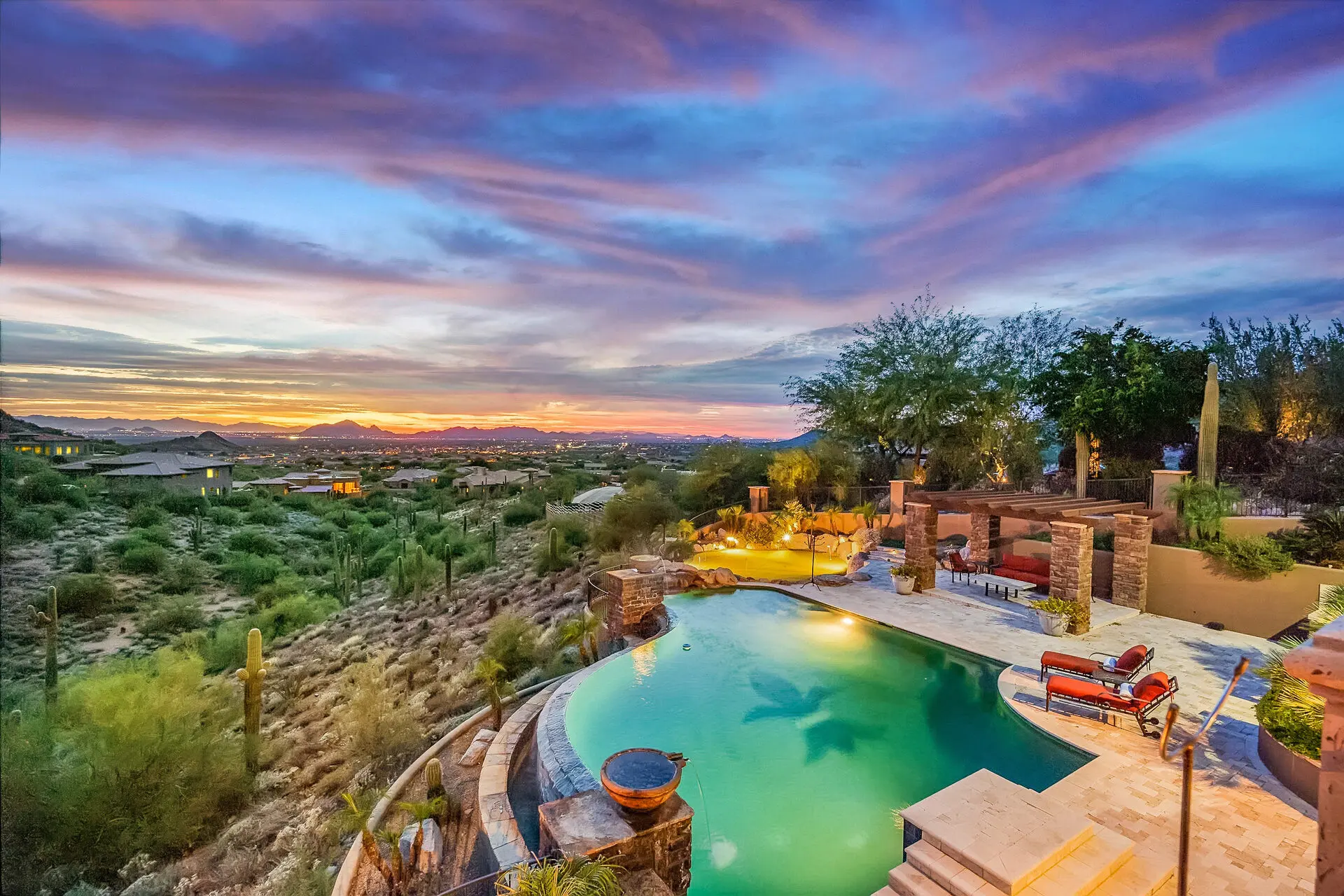
What's Inside This Guide
- The Market Reality
- Buying an STR: What Most Agents Miss
- Design & Buildout That Books
- Photography & Listing Optimization
- Pricing Strategy & Dynamic Tools
- Multi-Platform Distribution
- Operations & Guest Experience
- Marketing Your STR Like a Brand
- Metrics That Actually Matter
- Tax Strategy & Wealth Building
- The 90-Day Audit System
- Superhost: The Algorithm Multiplier
- AI & Automation (2026 Edge)
- Mid-Term Rental Hybrid Strategy
- Scaling from One to Many
Part One — The Market Reality
The STR Boom Is Over. The STR Profession Has Begun.
"The hosts winning right now aren't luckier than you. They're more intentional. They treat their rental like a business—and they built it that way from day one."
From 2020 to 2022, you could list almost anything on Airbnb and make money. Post-pandemic travel demand was insatiable, supply was thin, and even mediocre listings booked solid. Those days are gone.
Today's short-term rental market looks very different. Airbnb alone lists over 7 million properties globally. In high-demand Arizona markets—Scottsdale, Sedona, the West Valley, Tempe—traveler expectations have risen sharply. Guests aren't comparing your listing to a hotel anymore. They're comparing it to the best STR they've ever stayed in.
The result: a bifurcated market. The top tier—well-positioned, thoughtfully designed, professionally operated—is booked out at premium rates. The bottom tier is discounting aggressively and still sitting empty. The middle is getting squeezed.
This guide is your path to the top tier—whether you already own an STR and want to optimize it, or you're looking to buy your first one and get the fundamentals right from the start.
Let's get into it.
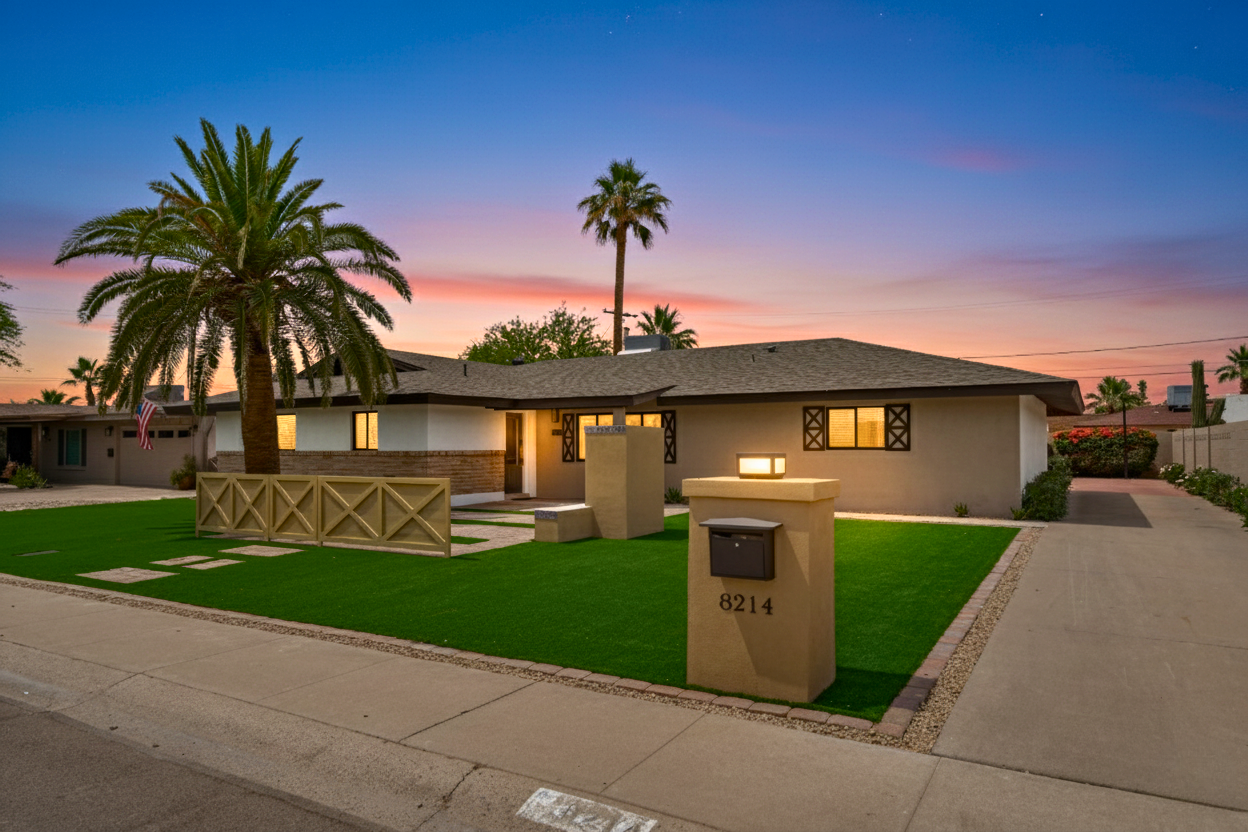
A top-performing Scottsdale STR — the type of well-positioned, curb-appeal-forward property that commands premium nightly rates year-round.
Arizona STR Market Snapshot — 2025
Where to Buy: Submarket-by-Submarket Breakdown
Not all Phoenix Metro markets perform equally. Here's how Arizona's top STR submarkets stack up across the metrics that actually drive returns.
| Submarket | Est. ADR | Occupancy | Competition | Top Demand Driver | Best For |
|---|---|---|---|---|---|
| Scottsdale (85251–85262) | $285–$420 | 75–82% | High | Nightlife, golf, events | Luxury, adult groups |
| Sedona | $320–$600+ | 72–80% | Medium | Red rocks, wellness, hiking | Couples, retreats |
| Tempe / Mesa | $145–$220 | 68–76% | High | ASU, Spring Training, concerts | Budget travelers, sports fans |
| West Valley (Goodyear, Surprise) | $160–$260 | 62–72% | Lower | Spring Training, new builds | Families, snowbirds |
| Chandler / Gilbert | $155–$240 | 63–70% | Medium | Corporate travel, tech corridor | Remote workers, mid-term |
| Flagstaff | $200–$360 | 60–72% | Medium | Skiing, NAU, summer escape | Families, Phoenix drive-to |
| Lake Havasu / Parker | $195–$340 | 58–68% | Lower | Boating, spring break, summer | Adventure, party groups |
| Apache Junction / Queen Creek | $145–$210 | 58–66% | Lower | Hiking, new builds, affordability | Value-buy investors |
Estimates based on 2024–2025 AirDNA market data and comparable STR performance. Individual property results vary based on amenities, positioning, and management quality. Contact Eric for a property-specific analysis.
Part Two — Acquisition Strategy
Buying an STR: What Most Buyers (and Their Agents) Get Wrong
Most real estate agents will help you find a house you like and then tell you to "check with a CPA about the STR stuff." That's not a strategy—that's a liability.
Buying an income-producing STR is a fundamentally different transaction than buying a primary home. The property needs to be evaluated across four dimensions simultaneously: location economics, physical STR-suitability, regulatory viability, and financial performance modeling. Most buyers only look at one or two. The ones who look at all four are the ones who build wealth.
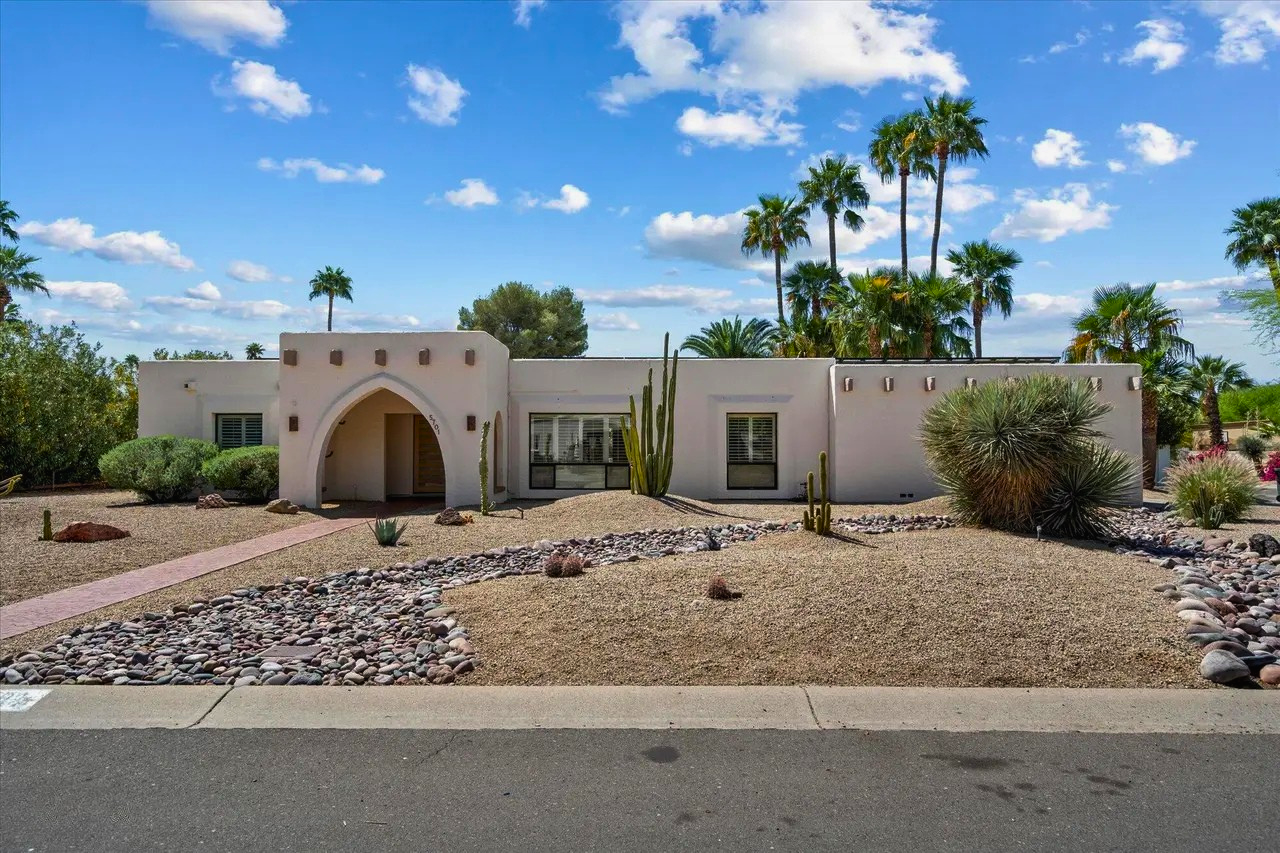
A high-performing STR in North Scottsdale — acquired through strategic due diligence across location, regulatory, physical, and financial underwriting.
Market & Location Selection
Not all Phoenix Metro submarkets are created equal for STRs. Before you fall in love with a property, understand the demand drivers for that specific area:
- Tourism anchors: Proximity to Sedona, Scottsdale nightlife, Camelback Mountain, Spring Training stadiums, golf courses, or Lake Pleasant dramatically affects nightly rates and occupancy ceilings.
- Business travel & events: Markets near convention centers (Phoenix Convention Center, WestWorld of Scottsdale) benefit from year-round corporate demand that smooths seasonal dips.
- Snowbird season: The October–April window is Arizona's golden period. Properties that attract snowbirds can command monthly stays at premium rates, dramatically lowering turnover costs.
- Supply saturation: Before committing to a submarket, analyze the competitive density on AirDNA or Rabbu. A neighborhood with 400 competing listings requires a significantly different strategy than one with 40.
- Drive-to vs. fly-to markets: Sedona, Flagstaff, and Lake Havasu serve Phoenix-metro drive-to guests. This creates consistent weekend demand with lower average stays—higher nightly rates, more turnover costs. Plan accordingly.
Regulatory Due Diligence
Arizona passed STR preemption legislation (ARS §9-500.39) that limits local municipalities from outright banning STRs—a major advantage over states like California or New York. However, cities can still regulate:
- Noise ordinances and quiet hours
- Occupancy limits and parking requirements
- License and registration requirements (Scottsdale, Tempe, and others require STR permits)
- HOA restrictions—which Arizona law cannot override
Arizona City-by-City STR Regulatory Quick Reference
| City / Area | Permit Required? | TPT License? | HOA Risk | Key Notes |
|---|---|---|---|---|
| Scottsdale | Yes | Yes | High | Requires STR registration + noise compliance plan |
| Tempe | Yes | Yes | High | Active enforcement; guest limits apply |
| Phoenix | Yes | Yes | Medium | Online registration portal; 2-occupant/bedroom rule |
| Chandler | Notify | Yes | Medium | Neighbor notification required within 300 ft |
| Gilbert | Notify | Yes | Medium | Similar to Chandler; verify HOA before purchase |
| Goodyear / Surprise | Minimal | Yes | Low–Med | Less regulated; more STR-friendly new construction |
| Mesa | Yes | Yes | Medium | Permit + annual renewal; noise/party ordinances active |
| Sedona | Yes | Yes | Low | Permit required; fewer HOA communities = more flexibility |
| Flagstaff | Yes | Yes | Medium | STR overlay zones; some neighborhoods prohibited |
| Apache Junction / Queen Creek | Minimal | Yes | Low | Among the most STR-permissive areas in Greater Phoenix |
Regulations change frequently. Always verify current requirements with the city's planning or licensing department before closing. All STR operators must register with the Arizona Department of Revenue for TPT. Eric's team conducts regulatory due diligence as part of every STR acquisition.
Critical buyer warning: Arizona HOA CC&Rs can and do prohibit short-term rentals—even in otherwise STR-friendly markets. This is the single most common and expensive mistake I see buyers make. Always pull the full CC&R document and have it reviewed before submitting an offer on any property within an HOA-governed community.
Physical Property Evaluation
An STR-optimized property isn't just a livable home—it's a machine designed to generate five-star reviews and repeat bookings. When evaluating a potential acquisition, think like a guest and a business owner simultaneously:
- Private outdoor space: Pools, hot tubs, covered patios, and fireplaces are the highest-ROI amenity additions in Arizona. Properties with private pools command 30–50% higher nightly rates in most markets.
- Bedroom-to-bathroom ratio: Guests expect at least one full bathroom per two bedrooms. Ensuite primary baths are a strong differentiator.
- Layout for privacy: Multi-generational groups and friends traveling together prefer split bedroom floor plans where master is separated from secondary rooms.
- Parking: Two-car garage or driveway that can accommodate the number of guests your occupancy limit allows. Street parking in STR-heavy areas can be a constant guest complaint.
- Laundry: Full-size in-unit washer/dryer is non-negotiable for stays of 3+ nights. Shared laundry is a booking killer.
- Outdoor lighting & ambiance: String lights, landscape lighting, and fire features photograph exceptionally well and contribute directly to five-star outdoor experience reviews.
Financial Underwriting
Never buy an STR based on projected gross revenue alone. Model the full pro forma:
- Gross Revenue: AirDNA, Rabbu, or Mashvisor projections for comparable comps in the immediate area (same bedroom count, similar amenities, 0.5-mile radius minimum)
- Platform fees: Airbnb charges hosts 3% (split-fee model) or up to 14–16% (host-only fee). VRBO is 5% + payment processing.
- Management: Self-managed saves 20–30% of gross revenue but requires real time. Professional co-hosts and management companies typically charge 15–25%.
- Utilities: STRs use significantly more utilities than owner-occupied homes. Budget 40–60% higher than typical residential utility costs.
- Furnishing & setup: Budget $15,000–$40,000+ for initial furnishing depending on size and design level. This is a capital expense, not a recurring cost—but it affects your Year 1 returns significantly.
- Maintenance & restocking: Plan 8–12% of gross revenue for ongoing consumables, repairs, and seasonal maintenance.
- Debt service: Lenders typically require 10–20% down for STR investment properties. Conventional, DSCR, and portfolio loans all have different underwriting requirements.
The number that matters: Net Operating Income ÷ Purchase Price = Cap Rate. In Arizona's current STR market, well-positioned properties achieving 6–9% cap rates are strong performers. Anything above 9% warrants scrutiny—verify the revenue projections independently. Anything below 5% needs to pencil on appreciation and tax strategy, not cash flow alone.
Free STR Strategy Call
Want a real underwriting analysis on a specific property—before you make an offer?
Part Three — The 15-Strategy Playbook
How Elite STR Operators Stay Booked at Premium Rates
These aren't tips from a travel blogger. They're the strategies I've seen work firsthand across Arizona's most competitive short-term rental markets—documented through client wins, competitor analysis, and a decade of observing what separates the top 10% from everyone else.
🏠 Arizona STR Annual Revenue Reference
Estimated annual revenue ranges by submarket and bedroom count, based on 2024–2025 Arizona market data. Assumes good photography, dynamic pricing, and active management. Add 15–25% for elite optimization; subtract 20% for professional management fees.
| Submarket | 1 BR | 2 BR | 3 BR | 4 BR | 5+ BR |
|---|---|---|---|---|---|
| Scottsdale | $28–38K | $44–62K | $58–82K | $74–105K | $90–140K+ |
| Sedona | $32–44K | $50–70K | $65–92K | $82–118K | $100–160K+ |
| Tempe / Mesa | $18–26K | $28–40K | $36–52K | $46–66K | $56–80K |
| West Valley | $14–20K | $22–32K | $30–44K | $38–56K | $46–68K |
| Chandler / Gilbert | $15–22K | $24–34K | $32–46K | $40–58K | $48–72K |
| Flagstaff | $20–28K | $30–44K | $40–58K | $50–72K | $62–88K |
| Lake Havasu | $18–26K | $28–40K | $36–52K | $46–66K | $56–78K |
| Apache Jct / Queen Creek | $12–18K | $18–26K | $24–34K | $30–44K | $38–54K |
Ranges based on 2024–2025 AirDNA and Rabbu market data. Properties with private pools add 25–40% to these estimates. Want a property-specific projection? Book a free analysis call →
✅ Is Your Property STR-Ready?
Use this checklist to identify where your STR stands — and where the biggest opportunities are. The more boxes you can check, the stronger your competitive position.
Not checking most of these boxes? That's where the revenue gap lives. A 30-minute strategy call will identify your highest-leverage fixes in order of ROI.
Book a Free Strategy Call →Design & Buildout That Earns Five Stars Before Check-In
Guests book with their eyes. Design is your silent salesperson.
The single biggest lever most STR owners leave untouched is intentional design. Not expensive—intentional. Guests don't need custom cabinetry; they need a cohesive story. They need to look at your photos and think: this place gets it.
Start with a design concept before you buy a single piece of furniture. Arizona's most successful STRs aren't decorated—they're styled around an identity. "Modern Desert Retreat." "Mid-Century Oasis." "Luxury Minimalist." "Boho Canyon Escape." Your concept dictates your palette, your furniture silhouettes, your textile choices, your art—and ultimately, your review language.
- Cohesive palette: Three colors maximum throughout the home. One dominant neutral (warm white, warm gray, or sand), one secondary tone (terracotta, sage, navy, charcoal), one accent (natural wood, brass, or black hardware).
- Textiles matter more than furniture: High-thread-count sheets, quality duvet inserts, euro shams, throw pillows, and textured blankets communicate luxury at a fraction of furniture cost.
- Kitchens convert skeptics: A well-stocked, clean kitchen with matching dishes, real cookware, filtered water, a decent coffee setup, and organized pantry staples generates disproportionate five-star mentions in reviews.
- Outdoor = bookings: Arizona weather is the amenity. A backyard with a firepit, string lights, quality outdoor seating, a grill, and a private pool makes your listing virtually recession-proof in the Scottsdale/Phoenix market.
- Lighting is everything: Swap builder-grade light fixtures throughout. Add dimmer switches. Layer ambient lighting with table lamps. This costs less than $500 and transforms how your property photographs.
Real Result
A Goodyear 3/2 saw a 3x increase in repeat guest bookings after the owner invested $8,000 in backyard landscaping, string lights, a gas firepit, and an outdoor sectional—transforming a plain yard into an outdoor living room. The pool was already there. The ambiance was the upgrade.
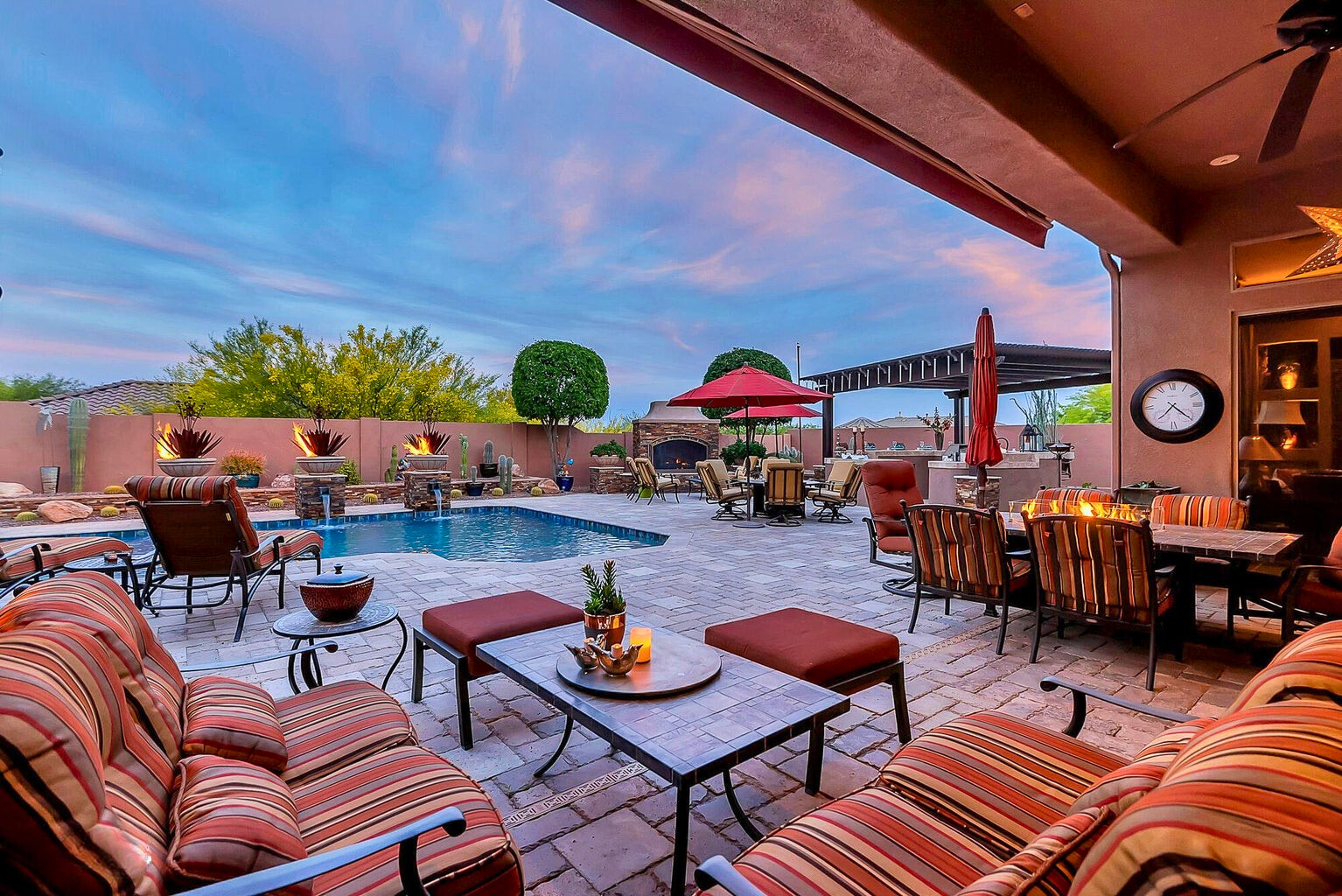
A client STR in a golf course community — pool, spa, and expansive covered patio delivering the outdoor Arizona experience guests pay premium rates for.
Professional Photography Is Not Optional
Your thumbnail is the most important real estate you own.
Airbnb's own data shows that listings with professional photography earn significantly more revenue than those with amateur photos. This is not a soft marketing advantage—it's a hard revenue driver. And yet a startling percentage of active listings still show dark, cluttered, phone-camera photos.
Think of your listing's hero shot the same way you'd think about a storefront window on the busiest retail street in the world. It's what makes someone stop scrolling. Once you have their attention, everything else follows.
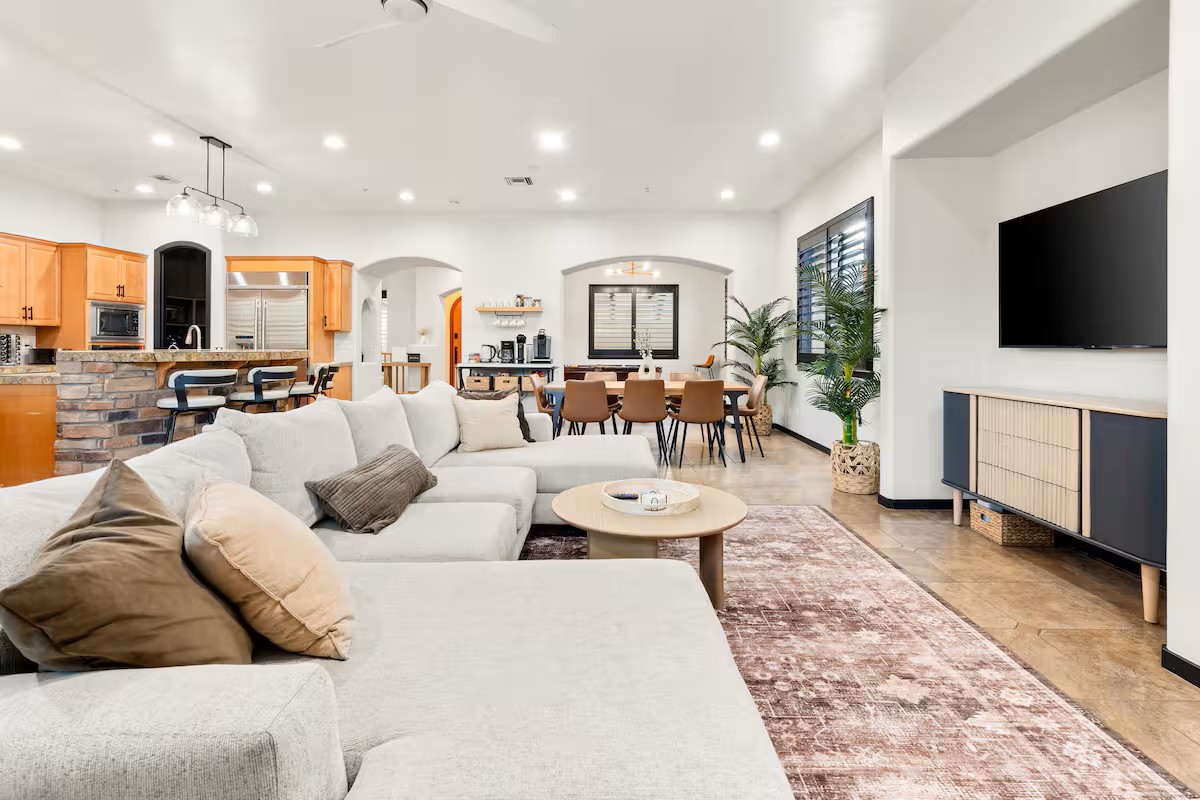
Hotel-quality staging in a client STR — the exact type of photography-ready interior that stops a guest mid-scroll and converts a browse into a booking.
- Hire a real estate photographer with STR or hospitality experience—vacation rental photography is different from MLS listing photography. You want lifestyle, warmth, and aspiration.
- Hero shot selection: Your first photo should be your most dramatic, inviting image—typically the outdoor space (especially pool), living room, or primary suite. Not a kitchen. Not a bathroom.
- Stage everything before the shoot: Fresh flowers, styled countertops, towels folded hotel-style, beds dressed to the nines. Remove personal items, cords, paper clutter.
- Twilight or golden hour shots of the exterior and outdoor lighting dramatically outperform daytime exterior photos for click-through rate.
- Update photos seasonally—especially if you've made upgrades. New photography signals to the algorithm that your listing is active and improving.
The math: A $400 professional photo session that generates 40% more revenue on a $40,000/year property pays for itself in approximately 4 days of incremental bookings. There is no higher ROI spend in short-term rental management.
Listing Copy That Converts: Write for Emotion, Optimize for Search
Most listing descriptions read like a spec sheet. Yours should read like an invitation.
Every booking on Airbnb or VRBO starts with a click. Every click starts with a feeling. Your listing description is where you close the deal—turning a browse into a booking by helping the guest picture themselves in your home.
❌ Loses Bookings
"Spacious 2BR condo in Phoenix. Close to restaurants and shopping. Free parking."
✓ Wins Bookings
"Unwind at this beautifully designed 2BR desert retreat—minutes from Camelback hikes, Old Town nightlife, and Scottsdale's best restaurants. Your private patio and heated pool are waiting."
Write your title and opening paragraph for emotion. Build the body with strategic keywords that improve your placement in Airbnb's search algorithm:
- "Vacation rental with private pool near Scottsdale Old Town"
- "Pet-friendly Airbnb near Spring Training stadiums"
- "Remote work friendly rental with fast WiFi and dedicated desk"
- "Luxury Airbnb near Sedona red rocks"
- "Family-friendly home with game room in Chandler, AZ"
These aren't buzzwords—they're the exact phrases your ideal guests are typing into search. Embedding them naturally into your listing description and amenity tags directly influences how often your listing appears.
Dynamic Pricing: Stop Leaving Money on the Table
Static pricing is the fastest way to underperform in a variable market.
The Arizona STR market doesn't operate at a flat rate. Your nightly price should fluctuate based on demand signals—seasonality, local events, day of week, booking lead time, and competitor availability. Hosts who set a flat rate and walk away are either giving away revenue on high-demand dates or sitting empty on slow ones.
Dynamic pricing tools use machine learning and market data to optimize your rate in real time. The three most widely used in the STR industry:
- PriceLabs — Highly customizable, preferred by professional operators. Strong Arizona market data. Best for hosts managing their own pricing strategy.
- Wheelhouse — Strong analytics dashboard, good for multi-property operators. Excellent reporting.
- Beyond Pricing — Simple to set up, good for newer hosts. Less granular than PriceLabs but effective.
Beyond the tool, understand your Arizona demand calendar:
- Peak: October–April (snowbird season, golf tournaments, Spring Training, Waste Management Phoenix Open)
- Secondary peaks: Memorial Day, Labor Day, major sporting events, Fiesta Bowl weekend
- Slower: June–August (adjust rates down but not catastrophically—Phoenix summer demand from family reunions and value travelers is real)
- Micro-spikes: Barrett-Jackson Auto Auction (January), Cactus League games, Scottsdale Arabian Horse Show, major concerts at Footprint Center
Real Result
A Chandler 3-bedroom using PriceLabs for the first time outperformed the market average daily rate by 22% in its first 90 days—without changing anything else about the listing or property.
Multi-Platform Distribution: Don't Rely on One Algorithm
Platform dependency is single-point-of-failure risk. Diversify your distribution.
Hosting only on Airbnb means one algorithm controls your income. A policy change, a poor review, or a listing suppression event can crater your bookings overnight. Professional STR operators build multi-channel distribution strategies.
- Airbnb — Highest traffic, highest fee. Essential but should not be your only channel.
- VRBO/Expedia Group — Reaches a different traveler demographic (more families, older travelers, longer stays). Lower competition in many Arizona markets than Airbnb.
- Booking.com — Strong for international visitors and business travelers. Underutilized by most U.S. STR hosts.
- Direct booking website — The holy grail. Zero platform fees, full guest data ownership, ability to build loyalty programs. Use Lodgify, Hospitable, or Hostfully to build and sync your direct site with your channel manager.
- Mid-term rental platforms: Furnished Finder, Kopa, and Landing serve traveling nurses, remote workers, and corporate relocators. Mid-term stays (30–90 days) dramatically reduce turnover costs and stabilize income during seasonal dips.
- Corporate housing networks: CHBO (Corporate Housing by Owner) connects STR hosts with businesses needing extended stays for relocated employees.
Channel manager recommendation: Once you're on 3+ platforms, a channel manager (Guesty, Hostfully, or iGMS) becomes essential to prevent double-bookings and centralize messaging. The cost—typically $30–$80/month—pays for itself immediately in avoided double-booking penalties.
Operations & Guest Experience: Run It Like a Franchise
Five-star reviews aren't the result of luck. They're the result of systems built before the first guest checks in.
Your Airbnb rating is your most valuable business asset. A 4.85 performs meaningfully worse than a 4.95 in Airbnb's search algorithm. Every operational decision—from your check-in process to your cleaning protocol to how fast you respond to messages—directly affects your rating and your ranking. But here's what most hosts miss: the operational foundation needs to be built before you list, not after the first bad review.
The best-performing STR operators I work with think about their property the way a franchise owner thinks about their location. The brand standards are documented. The systems are repeatable. Any team member—cleaner, co-host, property manager—can follow the playbook without the owner on the phone. That's what separates a business from a hobby.
Day 1 Business Infrastructure: Before your first guest checks in, have these in place — LLC formation with a dedicated business checking account (not your personal account), Arizona TPT license registered with the Department of Revenue, any required city STR permit (Scottsdale, Phoenix, Peoria, and others each have distinct requirements), and accounting software tracking income, expenses, and depreciation from day one. These aren't optional — they're the foundation that protects your asset and maximizes your tax position.
- Build your vendor network before you need it: Save and organize contacts for your STR-specialized cleaner, backup cleaner, landscaper, HVAC technician, pool service, electrician, plumber, and general handyman. The host who can reach a same-day plumber at 7am on a Saturday when a guest reports a leak is the one who keeps their five-star rating. The one who's scrambling through Google is the one who gets a three-star review for "unresponsive host."
- Write an operations manual: Document every repeatable process — guest communication templates (pre-arrival, check-in day, mid-stay check-in, check-out, review request), cleaning standards with photo checklists, emergency protocols, seasonal maintenance schedule, and restocking procedures. Treat it like a franchise manual. When it's written down, the business runs without you.
- Automated messaging sequence: Set up pre-arrival, day-of check-in, mid-stay, and post-checkout messages via Airbnb's automation tools or your channel manager. Include local recommendations, check-in instructions, WiFi details, and house rules. Guests who feel informed before they arrive review better — and call less.
- Digital guidebook: Use Hostfully, Touch Stay, or a simple Notion page to create a comprehensive property guide — WiFi passwords, appliance instructions, local restaurant recommendations, emergency contacts, check-out instructions. This single asset reduces guest messages by 40–60% and directly improves your response-rate score.
- Hotel-grade cleaning protocol: Hire a cleaning team that specializes in STRs, not general housekeeping. Stage the property after every clean. Inspect with a time-stamped photo checklist before every check-in. A missed hair or soap scum ring in a photo review can cost you Superhost status.
- Starter supplies: Stock coffee, cooking oil, salt, pepper, dish soap, paper towels. These cost $30 and generate unprompted five-star mentions in reviews. Guests remember feeling welcomed.
- Emergency protocols: Have a 24/7 contact number, a backup cleaner, and a same-day maintenance contact. Nothing destroys a rating faster than an unresolved issue the guest felt was ignored.
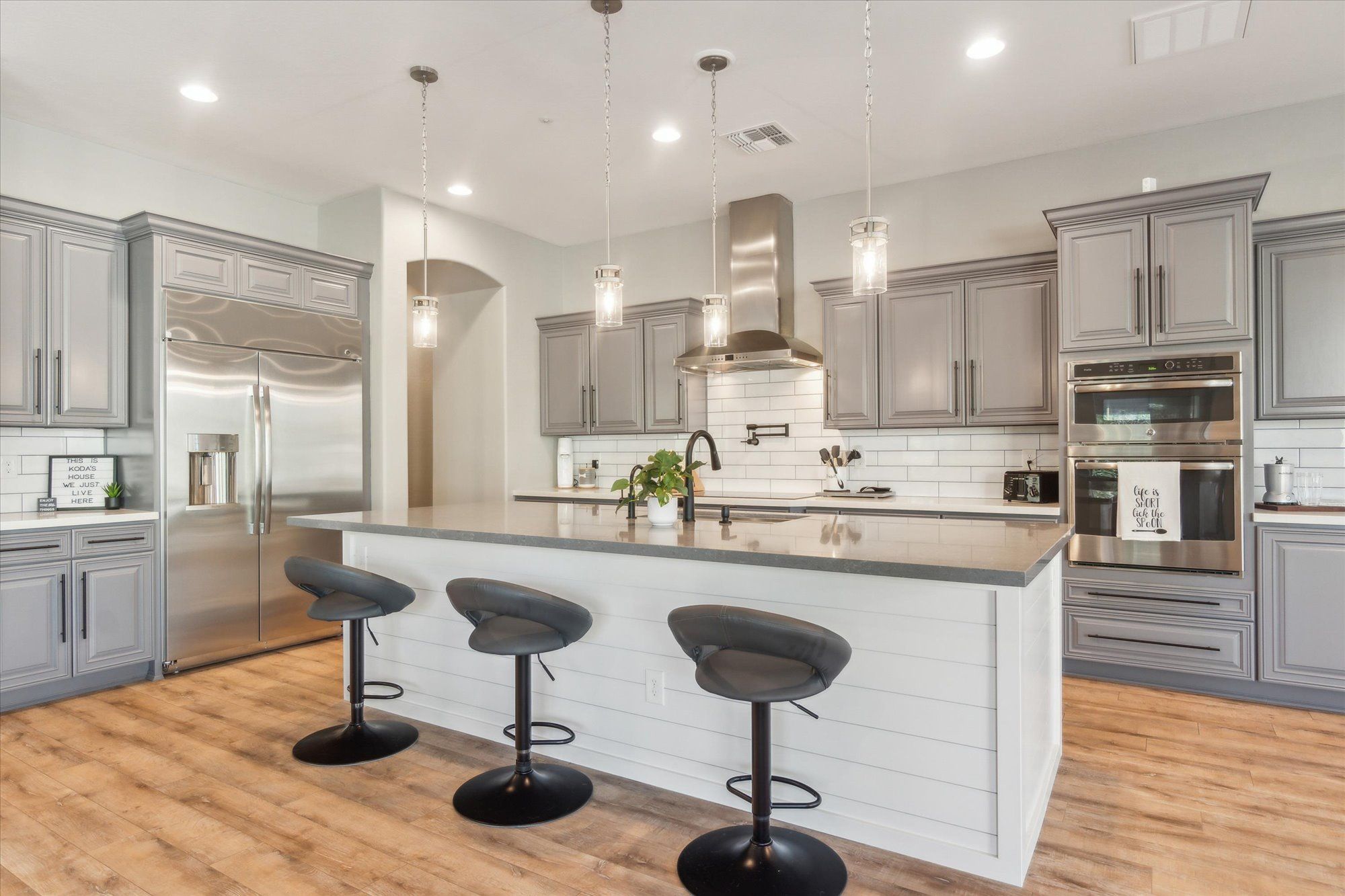
A client STR kitchen — matching cookware, organized pantry staples, and hotel-quality presentation. Small details like this generate disproportionate five-star review mentions.
Build Repeat Guest Relationships — and Capture Every Lead
A repeat guest costs nothing to acquire. A captured email is an asset that compounds forever.
Platform economics favor repeat business. When a guest books directly or returns through a prior relationship, you pay zero platform fees — meaning a $200/night booking keeps $200 instead of $194. At scale, that difference is significant. But the deeper opportunity is this: every guest who walks through your door is a potential long-term marketing asset — a future direct booking, a referral, a review, a word-of-mouth ambassador. Most hosts let them leave without capturing anything.
- CRM for guest data: Build a simple guest database from day one — name, email, stay date, home market, occasion for visit. A Google Sheet works to start. A proper CRM (even HubSpot's free tier) lets you segment past guests by location and preference for targeted outreach. This list is a business asset that grows in value every month you operate.
- Welcome station + QR email capture: Create a small welcome station inside the property — a printed card or framed sign with a QR code that links to your email signup page. Offer a genuine incentive: a local restaurant guide, a discount on a future direct booking, or a curated "hidden gems" map of the area. Guests who opt in become part of your marketing ecosystem permanently — and they already know and trust your property.
- Post-stay outreach sequence: Send a personalized thank-you within 4 hours of checkout, followed by a review request at the 48-hour mark (when guest sentiment peaks), followed by a direct booking invitation 30 days later. Three touchpoints. Fully automatable. Most hosts send zero.
- Loyalty program: Offer a returning guest rate — even 10% off direct — alongside a "stay again" card in your welcome binder. Reach out to your entire past guest list before peak season with a first-look opportunity on preferred dates. Your best guests often want to rebook — they just need the invitation.
- Annual guest survey: Once a year, send a brief survey to every past guest. Ask what they loved, what they'd improve, and what new amenity or experience would make them rebook. This single habit surfaces upgrade ideas you'd never think of yourself, turns past guests into invested stakeholders, and generates marketing-ready testimonial language when guests describe what they loved.
The Compounding Math
An STR with 60 stays per year that captures 30% of guest emails builds a list of 72 new contacts annually. After three years of operation, that's 200+ warm leads who have already experienced the property — each reachable at zero cost for direct booking campaigns. At even a 5% annual rebooking rate, that's 10 guaranteed direct bookings per year with no platform fees. On a $180 ADR, that's $18,000+ in revenue returned at near-100% margin improvement.
Build a Brand Around Your Property
Properties are forgotten. Brands are remembered, shared, and booked again.
What separates the STR operations generating $90,000+ per year from those generating $40,000 is rarely the property itself. It's the brand and the marketing consistency behind it. When a guest has a name to remember, a handle to follow, and a visual identity that feels distinct — and when the host is consistently visible in the right channels — bookings become a system, not a surprise.
- Property name: Give your STR a memorable, searchable name that evokes the experience. "The Sunrise Casa." "The Cactus Loft." "Desert Iron & Glass." Names that are specific to a feeling stick — and they rank better on direct booking searches.
- Visual identity: A simple logo, a consistent color palette used in all guest-facing materials (WiFi cards, welcome notes, property guide), and a unified Instagram aesthetic. Consistency is what turns a rental into a brand.
- Instagram + TikTok presence: Post your best photos, guest experience moments, and local area content. Reels and short-form video consistently outperform static posts. Even 500 followers creates social proof that affects booking decisions.
- Google Business Profile: Claim and optimize your STR on Google My Business with your property name, photos, and direct booking link. This creates discoverability outside of Airbnb's ecosystem entirely.
- Your own property blog: This is one of the most underused — and highest-ROI — marketing tools available to STR owners. A simple blog on your direct booking website with posts like "10 Best Restaurants Near [Your Neighborhood]," "Weekend Itinerary for Scottsdale First-Timers," or "Where to Watch the Super Bowl in the East Valley" puts your property in front of people actively searching for things to do in your area — before they've even started looking for accommodations. Regular content builds Google ranking for your property's direct site and reduces dependence on Airbnb discovery.
- User-generated content: Leave a subtle card at check-out: "If you loved your stay, share it — tag us at @[yourhandle]." UGC from real guests builds trust faster than any ad.
The Marketing Cadence That Compounds: Top-performing STR operators don't market in bursts — they run consistent, layered systems. Daily: one social post (photo, Reel, local event, or behind-the-scenes). Weekly: audit your listing, check competitor pricing, engage in relevant local Facebook groups or LinkedIn communities. Monthly: send an email to your guest list with seasonal highlights, new property upgrades, and a direct booking offer. This cadence takes 20–30 minutes a day and compounds into a booking engine that operates independently of any single platform's algorithm. The hosts I see executing this consistently are the ones who stopped discounting in 2023 and never looked back.
Real Result
A Peoria host branded their property as "The Prickly Pearl"—a chic desert escape with curated merch, a weekly Instagram cadence, and a simple property blog covering Peoria-area restaurants and local events. An influencer stayed, posted organically, and the listing sold out the next three months on waitlist bookings alone. The blog now drives 200+ monthly organic visits to their direct booking site.
Niche Targeting: Stop Trying to Appeal to Everyone
The most booked properties have a specific guest in mind. Be that host.
Generic listings compete on price. Niche listings compete on fit. When a traveling nurse searches specifically for a furnished 30-day rental near Banner Hospital, or when a remote work couple wants a dedicated home office with fiber internet, they're not looking for the cheapest option—they're looking for the right option. Be that option.
- Remote workers: Dedicated desk, ergonomic chair, second monitor, fiber internet (test it and state the speed), and blackout curtains in the bedroom. List your Mbps in the title.
- Pet-friendly: Dog bed, food and water bowls, waste bags, a fenced yard. Pet-friendly listings in Phoenix are scarce and command premium rates. Pet fees are pure margin.
- Families with young children: Pack-n-play, high chair, baby monitor, baby gate at stairs, outlet covers, a basket of toys and games. Parents pay whatever it takes to not pack all of this.
- Golf travelers: Lock-up storage for clubs, a list of nearby courses with booking links, a scorecard holder, pro-shop location guide.
- Couples & romantic retreats: Candles, champagne glasses, a bottle of local wine on arrival (contact-free setup available), romantic lighting, a hot tub or soaking tub.
The Garage Conversion Advantage
One of the highest-ROI amenity upgrades available to Arizona STR owners is converting an attached or detached garage into a premium experience space. Two approaches that consistently outperform the market:
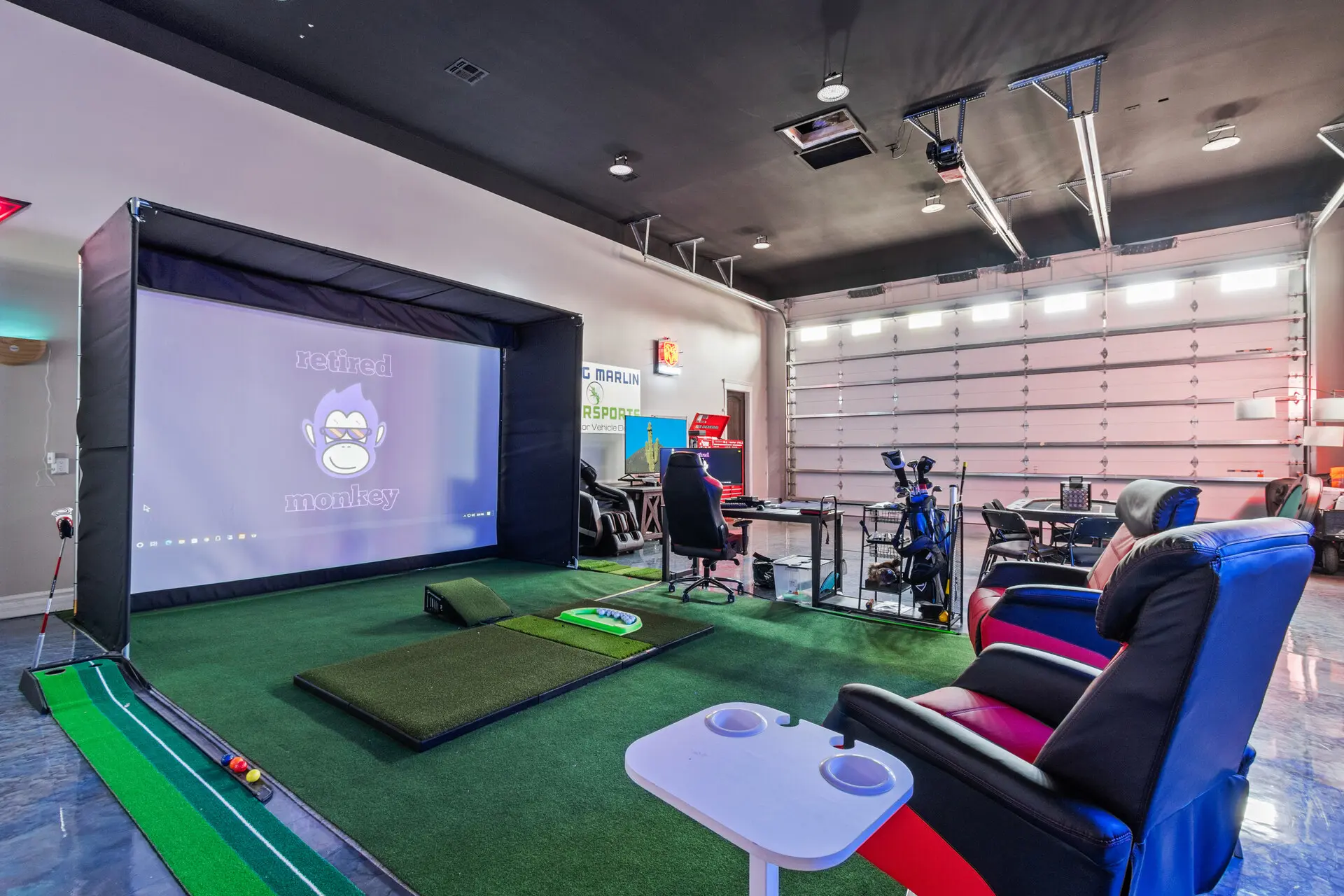
Golf simulator conversion — attracts high-ADR golf travelers year-round
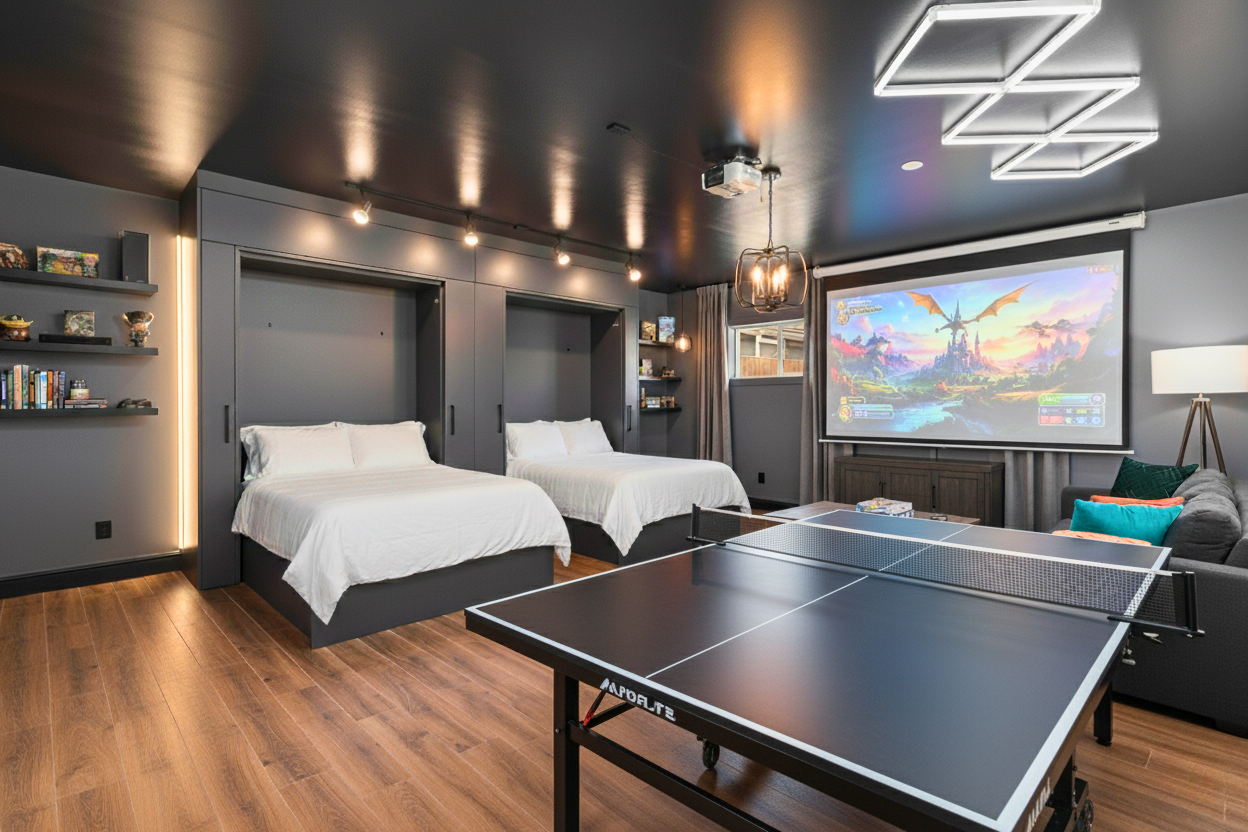
Hybrid sleeping + game room — adds capacity and a unique amenity in one
Track the Metrics That Drive Decisions
You can't improve what you don't measure.
Running an STR without tracking performance metrics is like running a restaurant without reading the checks. You might have a sense that things are going well or poorly—but you can't make strategic decisions without data.
Occupancy Rate
Nights booked ÷ nights available. Target: 65–80%+ in Phoenix Metro peak season.
Nights Booked ÷ Nights Available
Average Daily Rate (ADR)
Total room revenue ÷ total nights booked. Compare to comparable listings monthly.
Total Revenue ÷ Nights Booked
RevPAR
Revenue per available room. The true measure of combined pricing and occupancy performance.
ADR × Occupancy Rate
Net Operating Income
Gross revenue minus all operating expenses. This is what actually builds wealth.
Revenue − Operating Expenses
Cost Per Booking Channel
Platform fees + management fees per booking on each channel. Guides distribution decisions.
Channel Fees ÷ Bookings from Channel
Review Score by Category
Track Cleanliness, Accuracy, Check-in, Communication, Location, and Value separately to identify your weakest link.
Airbnb Category Scores
Video, Social & UGC: The Booking Engine Beyond Airbnb
The algorithm rewards visibility. Social creates bookings the algorithm can't take a cut of.
Airbnb and VRBO are search engines with booking functionality. Social media is discovery engine with unlimited ceiling. The STR operators who are truly winning in 2025 have built parallel traffic channels that drive direct bookings—at zero platform fee.
- Instagram Reels & TikTok: A 30-second walkthrough video with good natural light, a trending audio track, and a compelling caption can organically reach 50,000+ people. One Sedona host's "wake up to red rock views" Reel drove 4 bookings within 72 hours of posting.
- YouTube Shorts: Property tours, "what's near us" guides, and seasonal content build a library of evergreen discovery assets.
- Facebook community targeting: Travel planning groups, Arizona relocation groups, and Phoenix expat Facebook communities are filled with your exact ideal guests. Tasteful, value-first posting in these communities drives direct inquiries.
- Guest UGC strategy: Leave a visible (but not pushy) card in your guest welcome materials asking guests to tag your property. The average Airbnb guest has 500–2,000 followers. A single tagged post to that audience is worth more than any paid ad.
Tax Strategy: The STR Advantage Most Owners Don't Know About
An STR is one of the most tax-advantaged investments in the U.S. tax code. Use it.
This is where my background as a former Director of Wealth Management separates how I help clients from how a typical real estate agent approaches STR purchases. The tax strategy around short-term rentals is genuinely powerful—and genuinely underutilized. And in 2025–2026, it just got significantly more powerful.
🚨 2025 Tax Law Update: 100% Bonus Depreciation Is Back
The One Big Beautiful Bill (OBBA), signed into law in July 2025, restored 100% bonus depreciation for qualifying property placed in service on or after January 20, 2025. This reverses the phase-down schedule that had reduced bonus depreciation to 60% in 2024 and was heading toward zero—and it is the most significant tax development for STR investors in years.
What this means in real numbers: A $600,000 STR acquisition with a cost segregation study identifying $160,000 in 5-year and 15-year property can now generate $160,000 in Year 1 paper losses—up from $96,000 under the 60% schedule. For a high-income earner in the 37% bracket who qualifies for material participation, that's a potential $59,200 federal tax reduction in Year 1 alone.
Critical timing note: The 100% bonus treatment applies to property placed in service on or after January 20, 2025. If you acquired a property and placed it in service before that date in 2025, you may only qualify for the 60% rate for that asset. For 2026 acquisitions, 100% bonus applies from day one of service.
Audit risk is real: Large first-year depreciation deductions—especially when paired with material participation—can trigger IRS scrutiny. Document your hours meticulously (booking management, guest communication, maintenance coordination, vendor oversight). The IRS requires contemporaneous records, not reconstructed logs. Work with a CPA who specializes in STR taxation, not a generalist.
Bonus Depreciation: The Full Strategy
Under the restored provisions, short-term rental properties qualify for accelerated depreciation through a Cost Segregation Study. Instead of depreciating the entire property over 27.5 years (residential) or 39 years (commercial), cost segregation identifies components—appliances, flooring, fixtures, landscaping, personal property, land improvements—that depreciate over 5, 7, or 15 years. With 100% bonus depreciation, those components are fully deducted in Year 1.
The two-phase acquisition strategy some advisors are now recommending: (1) Purchase a "B-level" furnished property now, price it appropriately, and claim 100% bonus depreciation on eligible components this year. (2) In Q1 of the following year, renovate and rebrand with upgraded amenities and professional photography to relaunch as an "A-level" asset—while effectively starting fresh with a stronger listing. This approach captures both the immediate tax benefit and the long-term revenue upside.
This is not aggressive tax avoidance. This is precisely what the code was designed to incentivize: private capital flowing into real property that creates housing supply and economic activity.
- Real Estate Professional Status (REPS): If you or your spouse spends 750+ hours/year in real estate activities—and more hours in real estate than any other profession—paper losses from your STR can offset ordinary income without limitation. This is one of the most powerful tax strategies available to high-income earners and the reason some spouses of high earners strategically transition into real estate roles.
- STR Material Participation Exception: Even without REPS status, if you materially participate in your STR (meeting one of seven IRS material participation tests, most commonly 500+ hours or substantially all hours), rental losses may be deductible against ordinary income. See IRS Publication 925 for the full test criteria. This is why self-management can be worth more than the 20% management fee it saves—it can unlock six-figure annual tax deductions.
- S-Corp Structure for Active STRs: If your STR is classified as an active business (providing substantial services), an S-Corp structure can reduce self-employment tax by separating salary from distributions. Consult a CPA to weigh setup and compliance costs against your specific income level.
- 1031 Exchange: When you sell your STR, defer 100% of capital gains taxes by rolling proceeds into a like-kind replacement property. Note: previously claimed bonus depreciation creates depreciation recapture (taxed at 25%) that is not deferred—only the capital gain portion defers. Properly structured 1031 chains are how STR portfolios compound wealth over decades without tax drag.
- IRC §1014 Step-Up in Basis: Upon death, heirs receive a stepped-up cost basis on inherited property—potentially eliminating decades of embedded capital gains and recaptured depreciation. Paired with a well-structured estate plan, a STR portfolio built with aggressive depreciation can transfer virtually tax-free to the next generation.
Important: Tax strategy is deeply individual. The OBBA changes are real and significant, but proper implementation requires a CPA who specializes in real estate and STR taxation specifically. I work with advisors who live in this space—not generalists. If you want an introduction to a qualified STR CPA or want to model the tax impact of a specific acquisition, book a strategy call and we'll work through the numbers together.
Tax Strategy Consultation
Want to know how much bonus depreciation your next STR acquisition could generate?
Scaling from One STR to a Portfolio
One property builds income. Multiple properties build wealth.
The investors I work with who've achieved real financial independence through STRs didn't do it with one property. They built 3–5 well-positioned assets, each optimized for its specific market and guest profile, with professional operations allowing them to scale without adding proportional time.
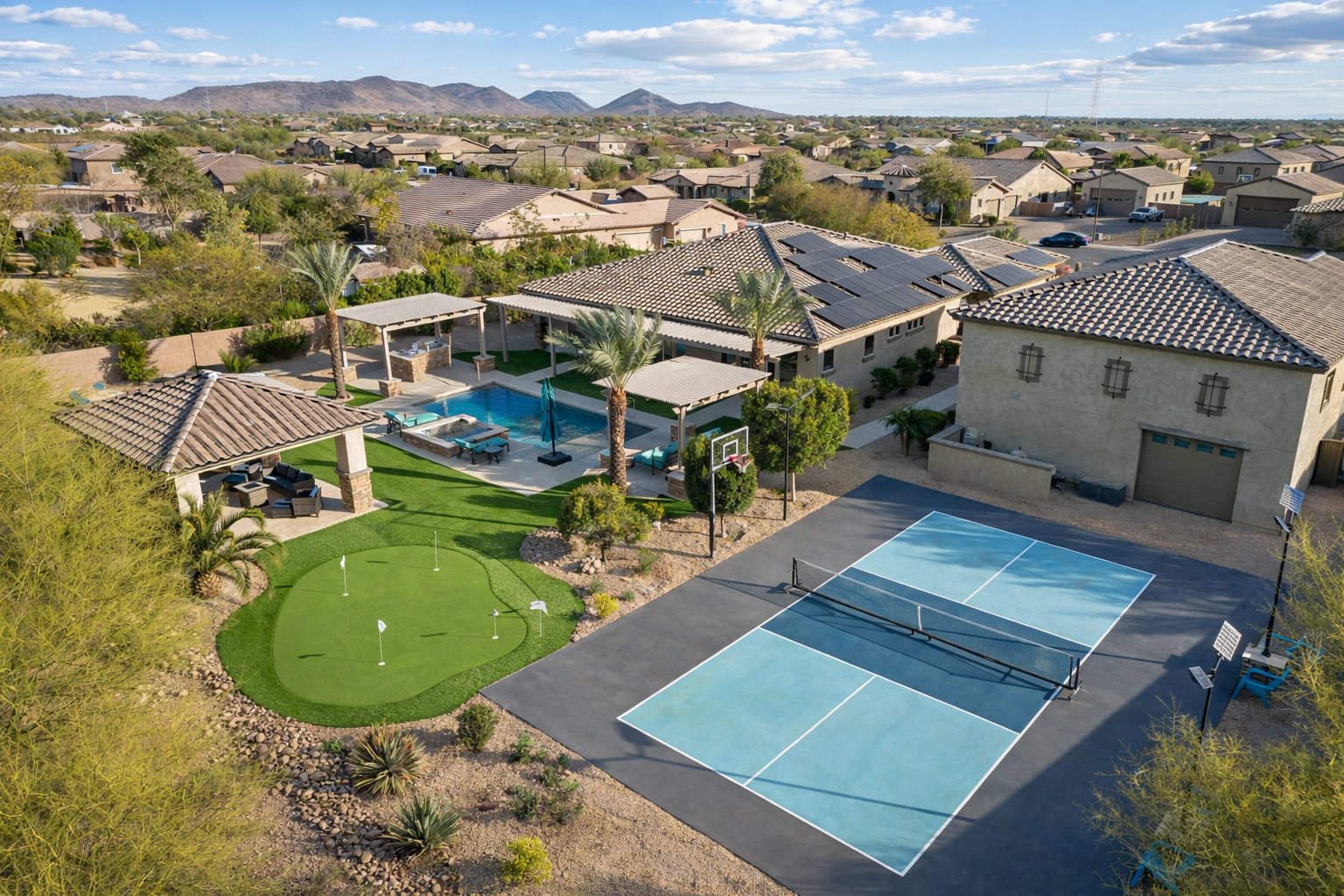
A multi-amenity client STR — sport court, pickleball, basketball, RV garage, pool, and spa. Properties like this represent the portfolio-building tier: higher acquisition cost, significantly higher ADR ceiling, and a guest profile that books longer and returns consistently.
- Standardize your systems first: Before acquiring Property 2, ensure Property 1 runs without you. That means professional cleaning, automated messaging, a trusted maintenance contact, and a channel manager that handles the operational layer.
- DSCR loans: Debt Service Coverage Ratio loans qualify based on the property's rental income—not your personal income or DTI. This is a critical tool for scaling beyond 4–5 properties where conventional financing becomes restrictive.
- Build a local team: The right cleaners, a reliable handyman, a property manager who understands STR (not just traditional PM), and a local photographer who knows your brand. This team is your scalability infrastructure.
- Diversify by submarket: Don't concentrate all properties in one neighborhood. A Scottsdale property + a Sedona cabin + a West Valley family home creates geographic and guest-profile diversification that smooths seasonal income variation.
- 1031 into larger assets: Use the equity from successful STRs to 1031 exchange into larger properties—4+ bedrooms, commercial STR properties, or multi-family assets that serve both long and short-term guests.
Protect Your Asset: Insurance, Legal Structure & Risk Management
The deal that goes wrong without protection is the one that sets you back years.
Most new STR owners don't think about risk management until something goes wrong. The STR that earns $75,000/year can generate a $300,000 liability claim in a single incident. Structure correctly from day one.
- LLC ownership: Hold your STR in a single-member or multi-member LLC to separate personal liability from the property. Arizona LLC formation is straightforward and inexpensive. Consult an attorney on the right structure for your situation.
- STR-specific insurance: Standard homeowner's insurance and even traditional landlord policies typically exclude STR activity. You need a policy specifically designed for short-term rental use. Proper, Safely, and Slice are purpose-built STR insurance products. Airbnb's AirCover is supplemental—not a replacement for a proper policy.
- Security deposit or damage waiver: Airbnb's damage protection helps but has claim limitations. Consider a damage waiver fee (small per-booking charge that creates a pooled reserve) as a complement.
- Noise monitoring: Minut and NoiseAware are STR-friendly noise monitoring devices (they measure decibel levels, not recordings) that allow you to detect parties before damage occurs—and demonstrate compliance with local ordinances.
The 90-Day Audit: How Elite Operators Stay Ahead
The STR market doesn't stand still. Neither should your strategy.
The hosts who consistently outperform the market aren't necessarily smarter—they're more systematic. Every 90 days, block two hours and conduct a full audit of your STR operation. Treat it like a quarterly business review, because that's exactly what it is.
- Review every guest review from the last 90 days for patterns—what did guests love, what frustrated them, what did they mention that surprised you?
- Comp analysis: Search Airbnb as if you're a guest. How does your listing show up against direct competitors? Are there photos, amenities, or pricing strategies you should adopt?
- Update photos: Did you make improvements? Install new furniture? Have seasonal outdoor ambiance to showcase? New photos signal to the algorithm that you're active.
- Refresh listing copy: Update your description to reflect current amenities and seasonal highlights. "Heated pool available through April" or "Fire pits for cool desert evenings—perfect fall escape" signal seasonality and convert hesitant browsers.
- Review your local event calendar: Set your pricing spikes for the next 90 days based on known demand events. Don't let a major golf tournament or concert weekend slip by at your standard nightly rate.
- Supplier and vendor review: Are your cleaners still performing at the level you need? Are your supply costs creeping up? Can you negotiate a volume rate?
Superhost Status: The Algorithm Multiplier Most Hosts Underestimate
Superhost isn't a trophy. It's a search ranking advantage, a conversion driver, and a direct revenue multiplier.
Airbnb Superhost and VRBO Premier Host status are widely misunderstood as recognition badges for good hosts. They're not. They are algorithmic inputs that directly affect how often your listing appears in search, how prominently it's displayed, and how frequently potential guests filter specifically for Superhost properties — which a meaningful portion of Airbnb's most valuable guests do by default.
A Superhost listing appears in a dedicated search filter that removes all non-Superhost competition. It carries a badge that signals trust before the guest reads a single review. Airbnb's own data shows Superhost listings convert at measurably higher rates and command higher nightly rates for equivalent properties. In competitive Arizona markets where dozens of listings fight for the same guest, Superhost status is often the tiebreaker.
The exact Superhost thresholds (Airbnb, reviewed every quarter): A minimum 4.8 overall rating across all stays in the trailing 12 months · 90%+ response rate within 24 hours · 10+ completed stays OR 100+ nights across 3+ stays in the trailing 12 months · Cancellation rate under 1% (no more than 1 cancellation per 100 bookings, excluding extenuating circumstances). Miss any one of these and you lose or fail to achieve status — regardless of how strong your other metrics are.
- Response rate is the most controllable threshold: A 90%+ response rate within 24 hours sounds easy until you're traveling, sick, or simply busy when an inquiry comes in at 11pm. The fix is simple — set up auto-responses in Airbnb's message automation or via Hospitable. An auto-reply acknowledging the inquiry and promising a full response within a few hours resets the response clock and protects your rate. This single setup takes 10 minutes and permanently removes response rate as a risk factor.
- The 4.8 rating is non-negotiable — and tighter than it looks: A single 3-star review among 10 total reviews drops your average to 4.7 — immediately below the threshold. Early in your hosting career, every review carries disproportionate weight. This is why the operational investments (cleaning quality, welcome experience, fast issue resolution) aren't just "nice to have" — they're Superhost infrastructure. A new host who gets to 10 stays with 4.8+ is already ahead of most of the market.
- Protect your cancellation rate obsessively: Cancellations are the hardest threshold to recover from because Airbnb counts them over a full 12-month trailing window. One cancellation early in your hosting history can hold your rate above 1% for months. Never cancel a booking unless Airbnb's extenuating circumstances policy applies. If you need to block dates, do it before they're booked — not after. If a guest needs to cancel, encourage them to initiate the cancellation themselves rather than cancelling on their behalf.
- Hit the night count strategically: If you're approaching a quarterly review period close to the 10-stay threshold, consider temporarily dropping your minimum stay requirement to 1–2 nights to accelerate stay count. The trade-off in per-stay operational cost is usually worth the algorithmic benefit of crossing the Superhost threshold before the next evaluation window.
- VRBO Premier Host follows similar logic: Premier Host requires a 4.8+ rating, fewer than 5% trip cancellations, and responding to 90%+ of inquiries within 24 hours. Achieving both Superhost and Premier Host simultaneously — while running across multiple platforms — requires the same foundational operational habits. Build the system once; it pays dividends across every channel.
- Losing Superhost is a ranking event: If you lose status at a quarterly review, your listing's position in Airbnb search results drops measurably within days. Hosts who track their booking pace report a 15–25% reduction in inquiry volume in the weeks following status loss. This is the hidden cost that makes protecting the thresholds so financially important — it's not just about the badge, it's about the search visibility that comes with it.
The Superhost Conversion Premium
A West Valley 3-bedroom that achieved Superhost status at the 12-month mark saw a 19% increase in booking conversion rate (the percentage of listing views that resulted in a booking) — without changing photos, pricing, or listing copy. The same property, the same market, the same price point. The only variable was the Superhost badge and the search filter visibility that came with it. Annualized, that conversion improvement translated to approximately $8,400 in incremental revenue.
AI & Automation: The 2026 Competitive Edge
61% of STR operators adopted AI tools in 2025. The gap between those who have and haven't is widening fast.
In 2026, the technology layer of your STR operation is no longer optional. According to Hostaway's 2026 Short-Term Rental Report, 61% of professional STR operators adopted AI-powered tools in 2025—and those operators are measurably outperforming those who haven't. This isn't about replacing human judgment. It's about removing the manual tasks that consume your time and making better decisions faster with data you couldn't process manually.
The hosts still doing everything by hand—setting prices manually, writing every message from scratch, manually tracking revenue by month—are competing at a structural disadvantage against operators running streamlined, data-driven systems. Here's where AI and automation deliver the most ROI in 2026:
- AI-Powered Dynamic Pricing: PriceLabs and Wheelhouse now use machine learning models that process hundreds of demand signals simultaneously—forward-looking booking pace, competitor availability, flight search data, event calendars, weather patterns—and adjust your nightly rate in real time. The operators on these platforms consistently outperform static-rate hosts by 18–30% ADR. In Arizona's event-dense calendar, missing a single Barrett-Jackson or Spring Training spike with a static rate is a $500–$2,000 error per night.
- AI Guest Messaging (Hospitable, Smartbnb): Tools like Hospitable use AI to generate contextual, personalized responses to guest inquiries—answering questions about the property, local recommendations, check-in instructions, and troubleshooting—in under 90 seconds, 24/7. Airbnb's algorithm rewards fast response rates. A 2-minute average response time vs. a 2-hour response time has measurable impact on search ranking and booking conversion.
- Automated Review Generation: Tools can now automatically send post-stay review request messages at the optimal time window (typically 2–4 hours after checkout, when guest sentiment is highest). Review volume directly impacts Airbnb search ranking. Hosts who automate review solicitation generate 35–45% more reviews than those who ask manually or not at all.
- AI Listing Optimization: Platforms like Rankbreeze and Optimize My BnB analyze your listing's performance metrics and compare your title, description, photos, and amenity tags against high-performing competitors in your market—surfacing specific, data-backed changes. Many hosts are leaving money on the table with listings that haven't been updated in 12+ months.
- Channel Manager Automation (Guesty, Hostfully, iGMS): Once you're on 3+ platforms, a channel manager becomes non-negotiable. Modern channel managers automate calendar syncing, unified inbox management, automated cleaning assignments triggered by bookings, and financial reporting. The top platforms now integrate AI to predict double-booking risk and flag suspicious inquiries before they become problems.
- Smart Home Technology: Smart locks (Schlage Encode, Yale Assure, Igloohome) eliminate the physical key handoff entirely and auto-generate unique access codes per booking. Smart thermostats (Ecobee, Nest with STR integrations) reduce utility costs by auto-adjusting between guest stays. Noise monitors (Minut, NoiseAware) detect elevated decibel levels before a party becomes a neighborhood complaint—and generate documentation if one does.
- AI-Assisted Financial Reporting: Tools like Hostaway's analytics suite and AirDNA's Market Minder now provide AI-generated market insights—telling you not just what your revenue was, but why it was different from forecast, what comparable properties earned, and what actions the data suggests. This moves STR management from reactive to proactive.
The technology stack that matters most for a single-property Arizona STR owner: Start with PriceLabs ($30/month) + Hospitable for messaging automation ($30/month) + a smart lock (~$150 one-time). That $510 annual investment will reliably generate $3,000–$8,000 in additional annual revenue through better pricing and improved response-rate ranking alone. Everything else layers on top as you scale.
2026 Reality Check
A Scottsdale 3-bedroom owner who had been manually managing pricing and messaging switched to PriceLabs and Hospitable in early 2025. Within 60 days: average response time dropped from 4 hours to 8 minutes, Superhost status was achieved for the first time, and nightly rate performance exceeded the neighborhood average by 26%. Total tool cost: $720/year. Estimated revenue increase: $14,000. That's a 19x return on the technology spend.
Mid-Term Rental (MTR) Hybrid Strategy: Stability Meets Scale
The STR/MTR hybrid isn't a fallback—it's a deliberate strategy that outperforms pure STR in the right markets and seasons.
The mid-term rental market—30 to 90-day stays targeting traveling professionals, remote workers, corporate relocators, and traveling nurses—has matured from a niche workaround into a primary strategy for sophisticated Arizona investors. There are now 18+ million digital nomads in the U.S., Banner Health and Mayo Clinic's Phoenix campuses generate continuous traveling nurse demand, and Arizona's tech corridor (Intel Chandler, TSMC North Phoenix, the ASU Research Park ecosystem) creates steady corporate housing needs that standard STR platforms don't capture.
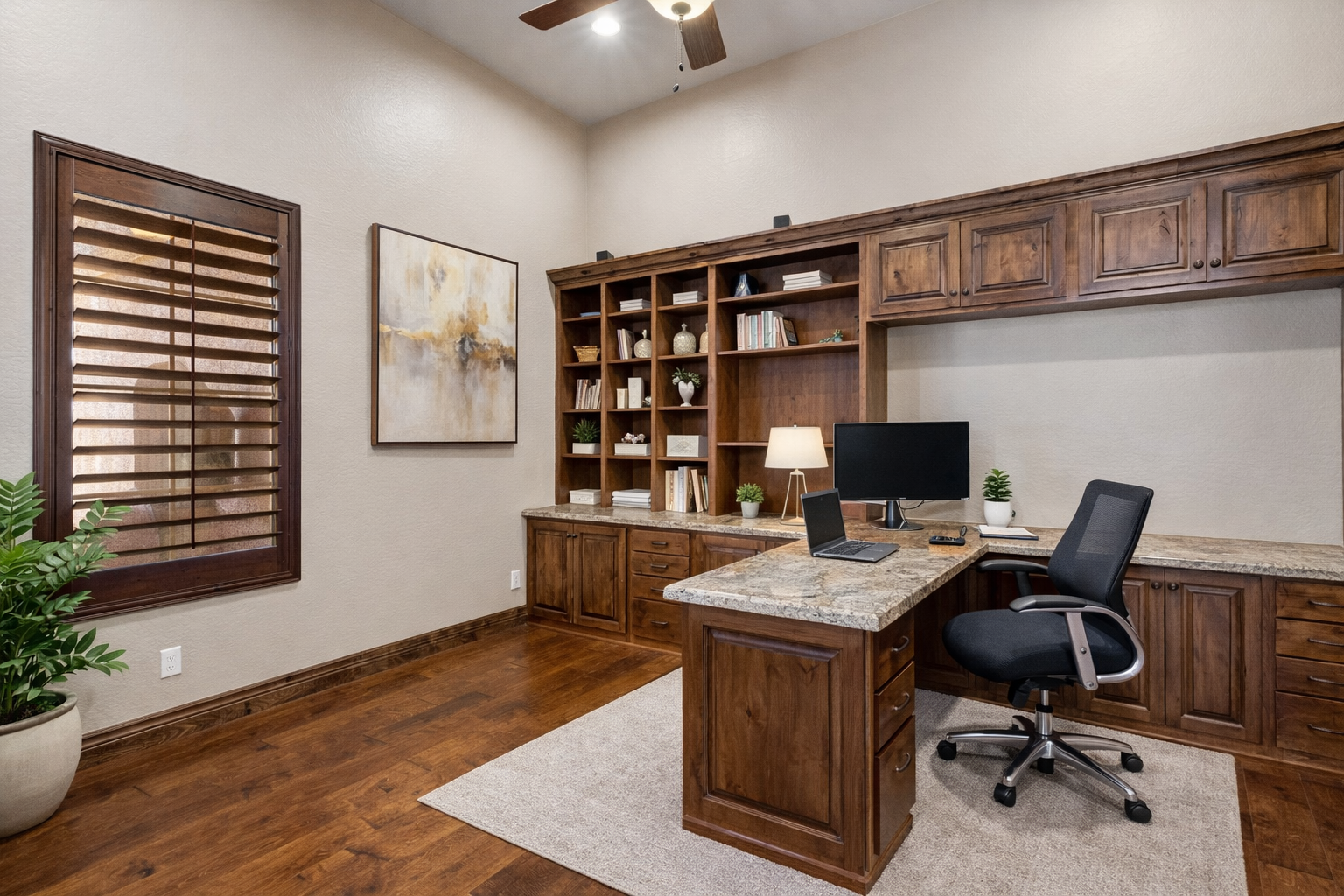
A dedicated workspace in a client STR — ergonomic setup, high-speed internet, and professional environment. This single amenity unlocks the remote worker and traveling professional market segment commanding 30–90 day stays.
The STR/MTR hybrid isn't a single approach—it's a deliberate seasonal or market-driven decision framework. Here's how to think about it:
Seasonal Hybrid — Peak STR, Off-Season MTR
Run as a short-term rental October through April (Arizona's peak demand season), capturing premium nightly rates from snowbirds, Spring Training, and golf traffic. Then pivot to mid-term rental May through September—targeting remote workers, corporate relocators, and traveling professionals during Arizona's slower summer months. This model maximizes revenue in peak season while eliminating the carrying cost and vacancy risk of slow-season STR discounting.
- List on Airbnb and VRBO with a 30-day minimum starting May 1 (not a platform violation)
- Simultaneously list on Furnished Finder, Kopa, and Landing for MTR-specific discovery
- Price MTR at 15–20% below your peak STR nightly rate × 30 — the lower effective rate is offset by near-zero turnover, cleaning, and consumable costs
- Net result: typically comparable or higher NOI than a fully-seasonal STR with significantly less operational load
Full MTR — Stability-First Investors
Some Arizona investors — particularly those with high-value properties in corporate demand corridors — run exclusively as mid-term rentals year-round. The economics: lower nightly rate than peak STR, but dramatically lower expenses (2–4 turns per year vs. 40–80), lower insurance risk, and near-zero consumable costs. The net income per dollar of gross revenue is often higher than STR.
- Best markets for full MTR in Arizona: Chandler (Intel corridor), North Phoenix/Scottsdale (TSMC campus and related supply chain), Tempe (ASU graduate programs, biotech), Scottsdale (healthcare executives, Mayo Clinic), Gilbert (Banner Health, high-income family relocations)
- Target tenant profiles: Traveling nurses (10–13 week contracts), corporate project teams (6–12 week deployments), tech workers on relocation assignments (30–90 days before permanent housing), remote work sabbaticals (30–60 days), professional athletes in Spring Training
- HOA advantage: Many Arizona HOAs that prohibit short-term rentals (under 30 days) do not restrict 30-day minimum stays. MTR can unlock properties that would be off-limits for STR — dramatically expanding the investable universe
Dynamic Switching — Data-Driven Allocation
The most sophisticated approach: use booking pace data and forward-looking demand signals to allocate specific months to STR or MTR in real time. If your STR calendar shows weak forward bookings for August (normal for Phoenix summer), proactively switch to 30-day minimum listing on Furnished Finder 6–8 weeks in advance of the slow period. If a major event emerges (a last-minute Spring Training game package, a tech conference), switch back to STR for that window. This requires a channel manager that supports minimum-stay adjustments across platforms without creating availability conflicts.
The MTR financial case in Arizona: A Chandler 3-bedroom that earns $2,800/month gross as an STR in peak season might only earn $2,200/month as an MTR — but with $400/month in cleaning costs vs. $80, $200/month in consumables vs. $20, and 90% fewer guest-related maintenance calls. The net income difference is often less than $200/month, while the MTR path requires a fraction of the operational time. For investors who want near-passive income without sacrificing too much revenue, Model 1 (seasonal hybrid) is often the answer.
Arizona MTR in Practice
A Surprise, AZ 3-bedroom owner added their listing to Furnished Finder targeting traveling nurses at Banner Boswell Medical Center (4 miles away). Within 3 weeks, a traveling nurse booked a 13-week contract stay at $2,400/month during what had historically been a slow STR period. Total cleaning cost for the 91-day stay: one standard turnover. The owner spent approximately 2 hours managing the entire engagement. Net income for the period exceeded their prior-year STR performance for the same months by 34%.
"The short-term rental market has separated into two tiers. The hosts who treat their property like a business are thriving. The ones who treat it like a hobby are discounting. There is no middle ground anymore."
Part Four — What Not to Do
The 7 Mistakes That Kill STR Returns in Arizona
I've watched investors leave six figures on the table—not from bad luck, but from avoidable errors made before or shortly after acquisition. These are the seven mistakes I see most often, and the ones I work hardest to help clients avoid.
Avoid Costly Mistakes
Seen any of these coming? Let's walk through your specific situation before you close.
Buying in an HOA Without Reading the CC&Rs
This is the single most expensive and heartbreaking mistake in Arizona STR investing. A buyer falls in love with a Scottsdale property, runs the numbers, closes—and then discovers on page 47 of the HOA documents that short-term rentals are prohibited. Arizona law protects STRs from municipal bans, but it does not override HOA restrictions. Every HOA-governed property requires a full CC&R review before submitting an offer. Full stop.
Using Projected Revenue as the Purchase Price Justification
AirDNA and Rabbu projections are useful benchmarks—not guarantees. I've seen buyers purchase properties based on top-of-market projections that assumed full amenities, elite photography, and professional operations they never actually implemented. Model conservatively: use 70–75% of the projected gross revenue as your underwriting baseline, then run the numbers. If it still pencils, you have margin for a learning curve.
Underestimating the Furnishing & Setup Budget
A 3-bedroom STR done right costs $18,000–$35,000 to furnish and equip. Many first-time investors budget $8,000–$10,000 and run out of capital mid-setup, launching with a half-finished property and weak early reviews that damage their algorithm ranking for months. Your furnishing budget is a capital investment, not a line item to cut. The difference between a $12,000 setup and a $25,000 setup is often $15,000–$20,000 in annual revenue.
Setting a Flat Nightly Rate and Walking Away
Arizona's STR demand is one of the most event-driven and seasonally variable in the country. The Waste Management Phoenix Open, Barrett-Jackson, Spring Training, the Fiesta Bowl—each creates demand spikes worth 2–4x your base nightly rate. A host with a static $175/night rate on a Scottsdale property during the Phoenix Open is leaving hundreds of dollars per night on the table. Dynamic pricing tools exist precisely to capture these moments automatically.
Relying Solely on Airbnb
Single-platform dependency is single-point-of-failure risk. Airbnb has suspended accounts, suppressed listings, and changed fee structures with minimal notice. Hosts who built their entire business on one platform had no fallback when problems arose. VRBO, Booking.com, Furnished Finder, and a direct booking website aren't just additional revenue channels—they're insurance against algorithm volatility and platform risk.
Skipping STR-Specific Insurance
Standard homeowner's policies and even many landlord policies explicitly exclude short-term rental activity. If a guest is injured on your property during a booking period and you're holding a standard HO-3 policy, you may have zero coverage for the resulting liability claim. STR-specific policies from Proper, Safely, or Slice typically cost $1,500–$3,000/year—a rounding error relative to your revenue and a critical protection against catastrophic loss.
Treating the STR Like a Passive Investment
Short-term rentals are not passive income. They are actively managed small businesses that happen to be housed in real estate. Hosts who approach STRs expecting fully passive returns without systems, vendor relationships, quality control, and ongoing optimization consistently underperform. The investors I've seen achieve true near-passive results at scale did so by building systems and teams first—not by hoping the bookings would manage themselves.
Frequently Asked Questions
Arizona STR Questions — Answered
These are the questions I hear most often from buyers, first-time STR owners, and investors considering their next acquisition. Straight answers, no fluff.
Is Arizona a good state for short-term rental investing in 2026?
Yes—and here's why it's better positioned than most. Arizona has statewide STR preemption legislation (ARS §9-500.39) that prevents municipalities from outright banning short-term rentals, a major regulatory advantage over California, New York, or Florida markets. The state also benefits from year-round tourism demand (snowbird season, Spring Training, golf, Sedona), a growing tech and corporate relocation corridor that drives mid-term rental demand, and strong appreciation in key submarkets. The market has matured since 2022's gold rush, which is actually a positive: unsophisticated competition is declining, and well-positioned properties are capturing a larger share of quality bookings.
Do I need a permit to operate an STR in Arizona?
It depends on the city. Arizona does not have a statewide STR permit requirement, but many individual municipalities do—including Scottsdale, Tempe, Phoenix, Mesa, and Flagstaff. Beyond local permits, all STR operators in Arizona are required to collect and remit Transaction Privilege Tax (TPT)—Arizona's version of sales tax on rental income—regardless of whether you operate in an area that requires a permit. Airbnb and VRBO collect and remit TPT on your behalf in most cases, but you're still responsible for registering with the Arizona Department of Revenue. See the regulatory table above for a city-by-city breakdown.
Can an HOA prohibit short-term rentals in Arizona?
Yes—and this is the most important due diligence item for any Arizona STR buyer. While ARS §9-500.39 prevents cities and counties from banning STRs outright, it explicitly does not override HOA CC&R restrictions. If a homeowners association's governing documents prohibit rentals of less than 30 days, that prohibition is legally enforceable regardless of state law. I pull and review CC&Rs on every potential STR acquisition before my clients submit an offer. This step has saved multiple buyers from extremely expensive mistakes.
How much does it cost to set up a short-term rental in Arizona?
Budget $15,000–$40,000 for initial furnishing and setup, depending on property size and design level. A 2-bedroom property done well runs $15,000–$22,000. A 4-bedroom with pool-area staging, full kitchen setup, quality linens, and branded guest materials runs $28,000–$40,000+. This is a one-time capital expenditure—not a recurring cost—and it directly determines your revenue ceiling and review quality for years. The ROI on a well-furnished STR vs. a cheaply furnished one is often $15,000–$25,000 per year in additional revenue.
Should I self-manage my STR or hire a property manager?
It depends on your goals, your time, and whether the tax strategy matters to you. Self-management saves 15–25% of gross revenue and—if you're logging the hours—can qualify you for the STR material participation exception that allows rental losses to offset ordinary income. Professional management trades that margin for your time and removes the operational burden, which matters significantly if you're scaling to multiple properties. Many of my investor clients start self-managed to learn the business, then transition to professional management once they scale.
What type of loan do I use to buy a short-term rental?
Several loan types work well for STR acquisitions. Conventional investment property loans (15–20% down) work for borrowers with strong W-2 income. DSCR loans qualify based on the property's projected rental income—not your personal income—making them ideal for self-employed buyers or investors with multiple properties. Some buyers use second-home financing if they plan to use the property personally for part of the year. I work regularly with Zach at Wain Capital and Ryan Gilliam at The Gilliam Team, both of whom specialize in STR financing in Arizona. Happy to make introductions.
What's the best submarket in Arizona to buy an STR right now?
The best submarket depends on your budget, risk tolerance, and investment goals. Scottsdale and Sedona offer the highest ADR and occupancy ceilings but require higher acquisition costs. West Valley markets (Goodyear, Surprise) offer lower entry costs and steady Spring Training and snowbird demand. Chandler and Gilbert are increasingly attractive for mid-term rentals targeting the tech corridor. For pure cash-on-cash return, the value play is often in the East Valley or emerging West Valley submarkets. I do personalized submarket analysis for every buyer client—see the market snapshot table above as a starting framework.
Can I use a 1031 exchange to buy or sell a short-term rental?
Yes—with important caveats. STRs can generally qualify for 1031 exchange treatment as investment property, but they must meet the "held for investment" requirement. The safe harbor generally requires fewer than 14 personal-use days per year. Additionally, any bonus depreciation previously claimed creates depreciation recapture that is not deferred by a 1031 exchange—only the capital gain portion defers. This requires a qualified intermediary and a CPA experienced in STR taxation. I can connect you with both.
For Eric's Clients
The Post-Closing Playbook
Everything in this guide gives you the strategy. Clients of The Ravenscroft Group receive a step-by-step Post-Closing Playbook — a fully operational launch system covering your exact Day 1 setup checklist, operations manual template, vendor contact framework, guest email capture system, marketing cadence, and the quarterly review process used by Arizona's top-performing STR hosts.
Work With Eric to Get the Full Playbook →Work With The Ravenscroft Group
Ready to Buy Smarter, Earn More, and Build Real Wealth?
Whether you're an active STR owner who wants to optimize what you have, or a buyer ready to acquire your first or next investment property—I bring an advisor's mindset to every transaction. That means underwriting, tax strategy, negotiation, and a network of lenders, CPAs, and property managers who specialize in exactly this.
Top 100 Phoenix Metro · Top 1% Nationwide · CRS · GRI · ABR · $100M+ Closed · 150+ Five-Star Reviews · Featured in WSJ · MarketWatch · MSN · Morningstar
Categories
- All Blogs (324)
- Active Adult & 55 Plus Communities (17)
- Arizona Relocation Guides (31)
- Buyers (214)
- Financial Planning (61)
- General Real Estate (141)
- Income From Real Estate (60)
- Market Update (26)
- New Construction (29)
- News, Updates and Coming Soon (57)
- Real Estate Agent Financial Planning (22)
- Real Estate Investing (96)
- Sellers (107)
- Vacation and Short Term Rentals (45)
Recent Posts



About the Author
Eric Ravenscroft is a Top 1% REALTOR® across North America and one of Arizona’s most trusted real estate strategists. With 15 years of experience spanning real estate, wealth management, and investment planning, he helps clients make smarter, financially grounded decisions, from new construction and relocations to STR investments, 1031 exchanges, and long-term portfolio strategy.
Eric’s expertise has earned him industry recognition, Elite status with Real Broker, and features in major publications including the Wall Street Journal, MarketWatch, MSN, and Morningstar. Clients across the Greater Phoenix Metro rely on his clarity, strategic insight, and results-driven guidance.
Ready to make a confident real estate move? Call or text Eric today.