
Phoenix Metro Housing Market April 2026: What Buyers & Sellers Need to Know
Phoenix Metro Housing Market April 2026: What Buyers & Sellers Need to Know
If you're only reading the headlines, you're missing what's actually happening on the ground. The real story is more nuanced — and more localized — than most realize.

- March vs. April: What Changed
- The Real State of the Market
- Why Phoenix Looks Weaker — But Isn't
- Not One Market — Several Markets
- Where Buyers Have Leverage
- Interest Rates: Normalized
- New Construction vs. Resale
- Outbound Migration: The Reshuffle
- Guidance for Buyers
- Guidance for Sellers
- Final Thoughts
- FAQ
This is one of those months where the numbers don't fully explain what's happening. If you're only looking at headlines or year-over-year comparisons, it would be easy to assume Phoenix is underperforming. But once you step into the market — talking to buyers, negotiating deals, and seeing how homes are actually being received — the story is far more nuanced. Homes are still selling. Buyers are still active. Sellers are still entering the market. What has changed is that not everything is working.
March vs. April: What Changed in One Month
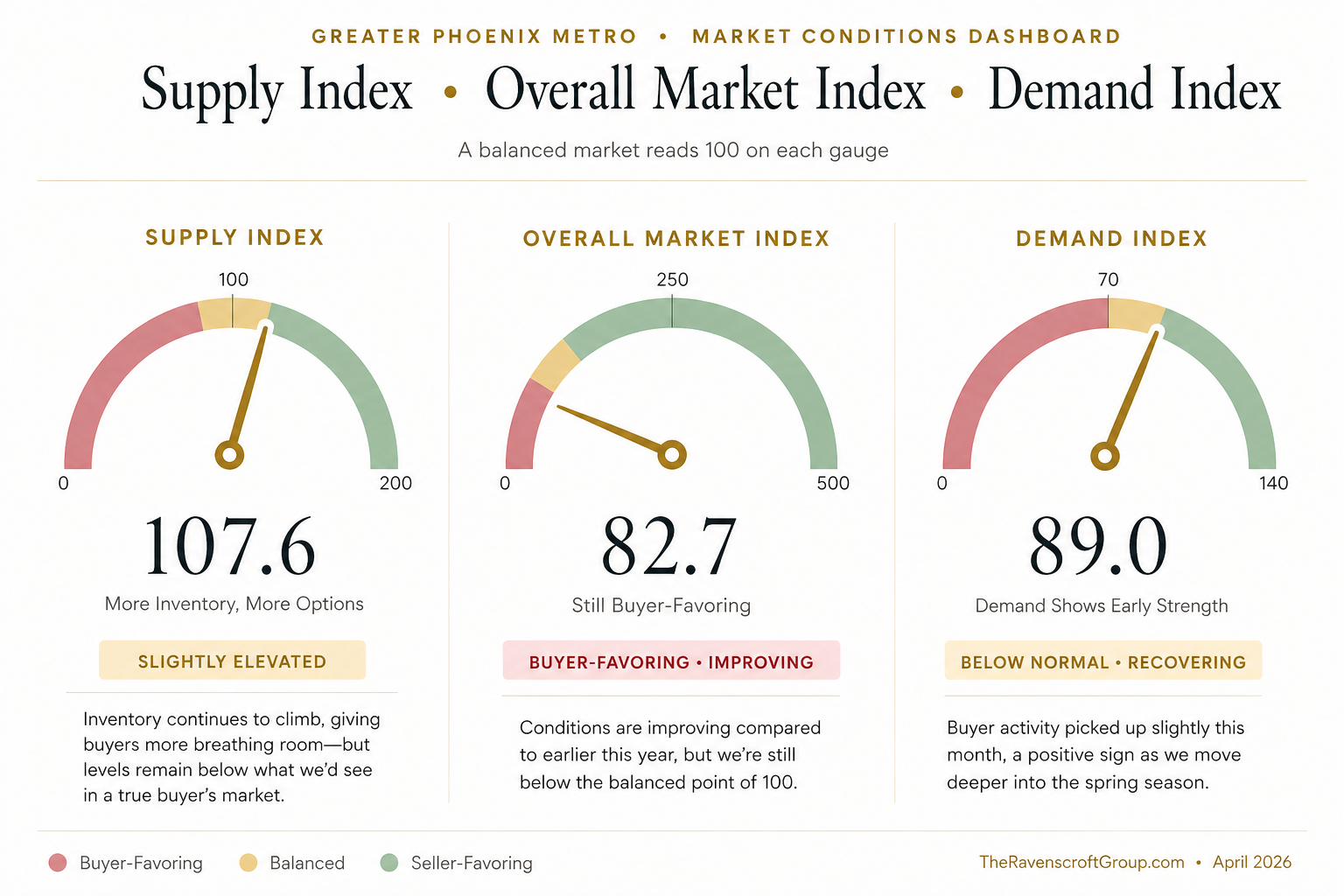
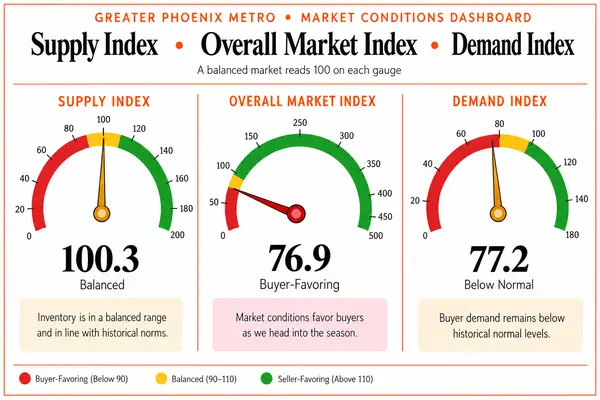
In March, the story was momentum — contracts up 10% year over year, new listings pulling back 7%, and a market index of 82.9 that was clearly improving. The shift I called in March is now showing up in April in a more nuanced form: the momentum has normalized rather than accelerated, and the market has settled into a more measured, selective rhythm.
The urgency that drove buyers to rush in when rates spiked in March has faded as rates stabilized in April. What we're left with is a market that is genuinely balanced — but with wide variation depending on where you look.
The Real State of the Phoenix Housing Market
Looking at the latest data out of Maricopa County, the market appears stable — and in many ways it is — but that stability is highly localized. The median sales price is sitting around $481,370, slightly lower than this time last year, but relatively steady month over month.
That stability matters. It shows that pricing is being supported even with a more cautious and deliberate buyer pool. Transaction volume increased from February into March, which is typical seasonality. But adjusted for working days, overall activity is essentially flat to slightly down compared to last year.
On the supply side, inventory built earlier in the year, but that growth has slowed as demand caught up. New listings and buyer activity have effectively balanced each other out — which is why Phoenix home prices have remained relatively stable despite broader economic noise.
Source: Maricopa County MLS data, April 2026
"Roughly 70% to 75% of homes listed across the Greater Phoenix Metro are selling. That means about one out of every four homes is not. That statistic alone says more about today's market than any single price metric."
Why Phoenix Looks Weaker in the Rankings — But Isn't
According to the latest S&P Case-Shiller Home Price Index, Phoenix has slipped toward the lower end of major metropolitan areas in both month-over-month and year-over-year performance. That data point draws attention — but it requires critical context.
This index reflects contracts that were signed roughly three months ago — a version of the Phoenix real estate market that no longer exists. At that time, rates had recently moved higher, uncertainty was elevated, and buyer activity had pulled back. The market has already adjusted well beyond that moment.
Locally, Phoenix home prices are far more stable than those rankings suggest. Headlines like this need to be taken with context rather than at face value.
Source: S&P CoreLogic Case-Shiller Home Price Index, Q1 2026
Not One Phoenix Market — Several Markets
One of the most important dynamics in the Greater Phoenix Metro right now is that the market is not moving as a single unit. Different segments are behaving in very different ways — and understanding which segment you're in is everything.
Where Phoenix Buyers Have Leverage — and Where They Don't
Across the Valley, the Phoenix housing market is not moving in one clear direction. It is shifting in pockets — and those differences are becoming more noticeable with each passing month.
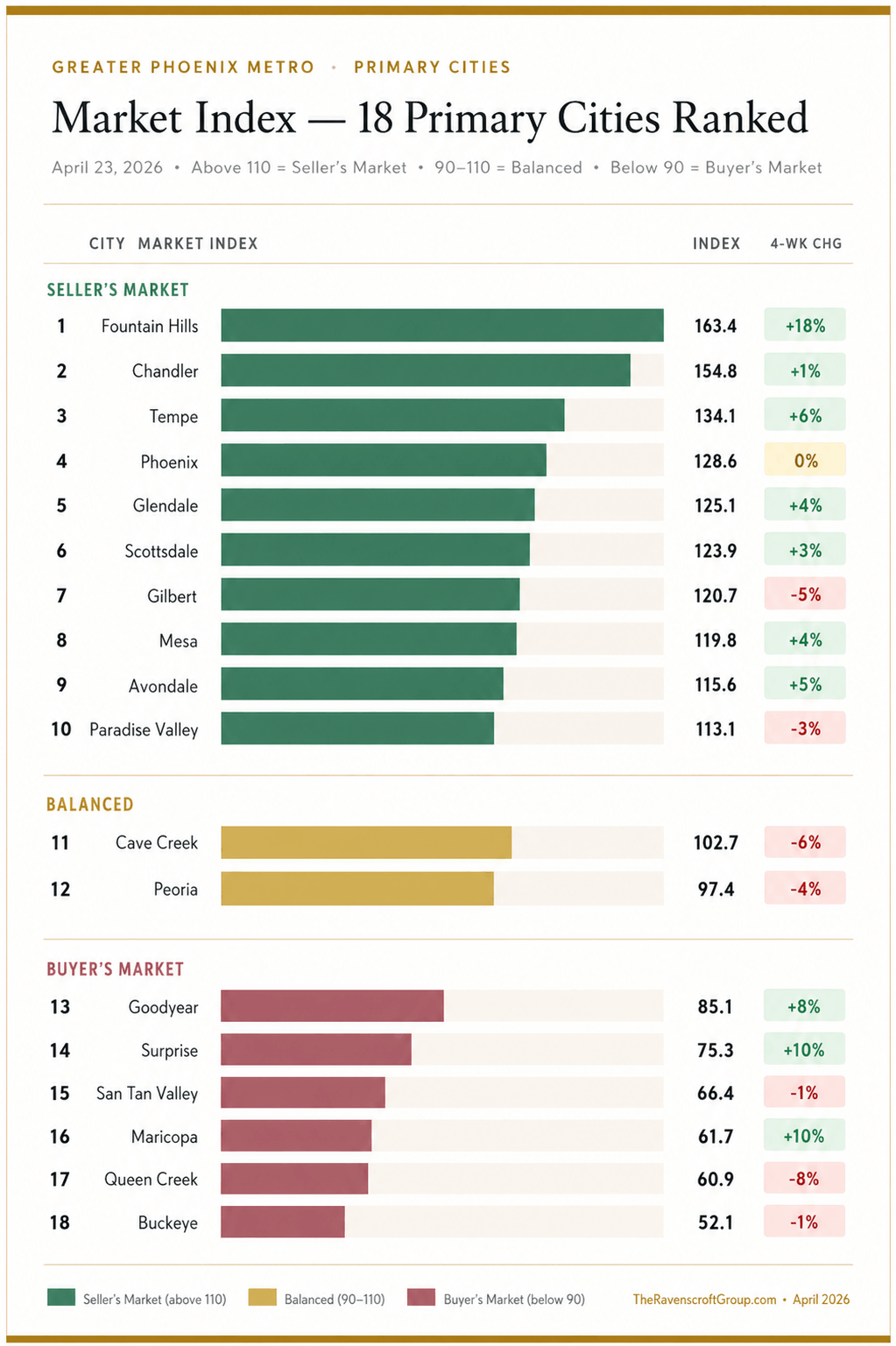
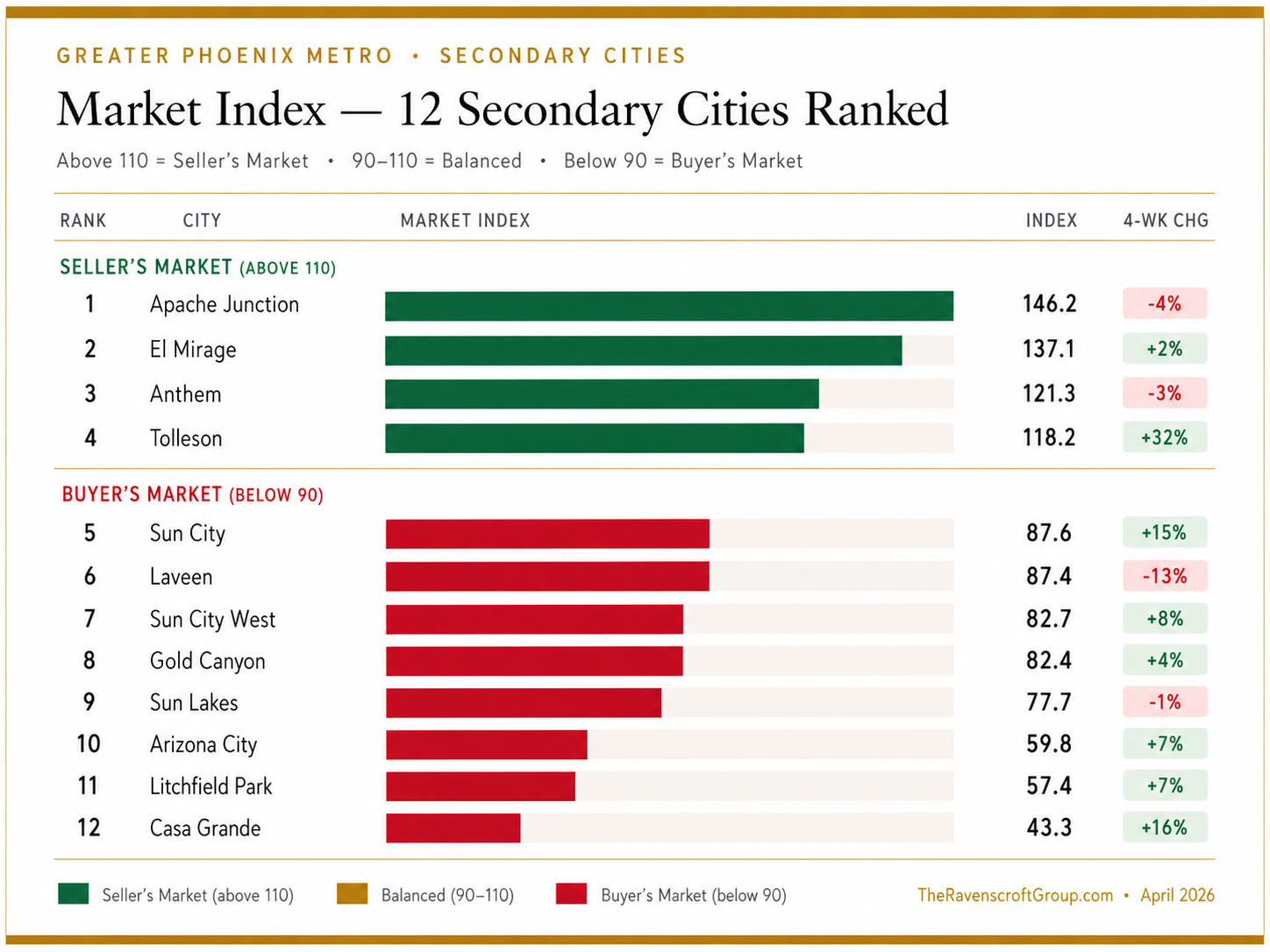
In March, Chandler led all primary cities at a market index of 154.5, with Fountain Hills at 141.3 and Tempe showing the biggest monthly gain at +11%. Those seller-favoring conditions in the established Southeast Valley corridors have held into April. Meanwhile, some areas are providing buyers with genuine leverage — and in smaller secondary markets, conditions can shift quickly in either direction with just a handful of new listings or contracts.
Two homes at the same price point, in different parts of the Phoenix Metro, can experience completely different levels of demand. The real answer to "how is the Phoenix real estate market?" is always: it depends on the area, the city, and the price point.
Phoenix Mortgage Rates in April 2026: No Longer the Shock Factor
In March, rates spiked to 6.43% — the highest point of the year — driven by global bond market pressure. By April, rates have eased back to the 6.3–6.4% range for conventional buyers, and the market's reaction tells the real story: buyer activity initially surged when rates moved higher in March as people rushed to lock in financing. As rates stabilized in April, that urgency normalized.
This is what rate normalization looks like in practice. We are no longer in a shock environment where every rate movement triggers a market-wide reaction. Buyers have made peace with the rate environment and are making decisions based on their personal circumstances — not waiting for a rate catalyst that may not come.
The Builder Incentive Era Is Over — Here's What That Means
In my March report, I noted that builders were beginning to pull back on incentives. That transition has now fully confirmed. Rate buy-down programs that were advertising 30-year fixed financing near 3.99% have moved up to approximately 4.5%. Several builders have ended "build from dirt" promotions and long-running design center credit programs entirely.
Builders offer incentives when they need to. When the market provides enough organic demand to move inventory at acceptable margins, the incentives come off. The pullback is a signal that builders are reading improving conditions — and acting on it before the general public fully recognizes the shift. The calculus for buyers has changed: six months ago, the gap between new construction and resale could be worth $50,000–$100,000 in effective value. That gap has narrowed considerably.
Where builder incentives still exist in meaningful form: Queen Creek, Buckeye, and San Tan Valley — markets where buyers still have more leverage. In Scottsdale, Chandler, and Gilbert, aggressive incentives have largely disappeared from the new construction landscape.
When Phoenix resale properties are priced and presented correctly, they are competing very well — and in many cases outperforming new construction on total value.
Outbound Migration: The Phoenix Reshuffle
There has been increasing attention on the number of people leaving Arizona — and while that movement is real, it is often misinterpreted as a sign that the Phoenix market is weakening.
Roughly 90,000 people leave the Phoenix metro area each year. At the same time, more than 130,000 are moving in — keeping overall population growth positive. In March, I highlighted Colorado as the newest major source of inbound buyers, with Denver equity-holders choosing Phoenix as their top relocation destination. California remains a major driver — particularly investors pursuing 1031 exchanges and retirees exiting high-tax environments. Consistent buyer interest also continues from Chicago, the Bay Area, Seattle, and Minnesota.
Net daily in-migration has cooled from nearly 300 people per day at its peak to about 100 per day today. That is a normalization of migration patterns, not a reversal. Phoenix is not losing population — it is experiencing a high level of turnover. That turnover creates inventory, and inventory creates opportunity.
What This Market Means for You
Opportunities still exist in the Phoenix market — but they are not as obvious as they were in previous years or even a few months ago. The assumption that waiting will always lead to better pricing or better terms simply isn't true right now.
Some properties are sitting and offering real leverage. Others — especially in Scottsdale — are going under contract within days with multiple offers. The difference between buyers who succeed and those who keep missing out comes down to preparation, clarity, and the willingness to act decisively when the right opportunity presents itself.
Those waiting for a broad market shift will likely miss the specific opportunities that already make sense today.
With a Phoenix home success rate in the 70% to 75% range, there is very little margin for error. Pricing, presentation, and initial market positioning all play a critical role in determining how a home performs the moment it hits the market.
Homes aligned with buyer expectations in their specific area are selling. Homes that aren't are sitting — often requiring price adjustments after the fact, which creates stigma and extends time on market. While competition from new construction has eased, that does not eliminate the need for a thoughtful strategy.
The good news: depending on where you are in the Valley, you may find yourself back in a position of strength and able to command a premium. The opportunity is there — but it needs to be approached with intention from day one.
The Phoenix Market Is Becoming More Refined
This market is not making large, dramatic moves. Instead, it is becoming more refined — and that distinction matters enormously for anyone buying or selling in the Greater Phoenix Metro right now.
Prices are stable, interest rates have normalized from their March spike, and demand is still present — but far more selective than in recent years. The gap between properties that perform well and those that do not continues to widen. That is why some homes are generating strong activity and multiple offers while others struggle to gain traction.
The opportunity has not disappeared. It has simply become more specific. In a market like this, success is less about timing and more about positioning — and having the right advisor to navigate the nuances that headline numbers will never capture.
Phoenix Housing Market FAQ — April 2026
Have Questions About Your Specific Area or Price Point?
Every neighborhood in the Phoenix Metro is telling a different story right now. Whether you're buying, selling, or trying to understand what the data means for your situation — let's talk.
Categories
- All Blogs (324)
- Active Adult & 55 Plus Communities (17)
- Arizona Relocation Guides (31)
- Buyers (214)
- Financial Planning (61)
- General Real Estate (141)
- Income From Real Estate (60)
- Market Update (26)
- New Construction (29)
- News, Updates and Coming Soon (57)
- Real Estate Agent Financial Planning (22)
- Real Estate Investing (96)
- Sellers (107)
- Vacation and Short Term Rentals (45)
Recent Posts






About the Author
Eric Ravenscroft is a Top 1% REALTOR® across North America and one of Arizona’s most trusted real estate strategists. With 15 years of experience spanning real estate, wealth management, and investment planning, he helps clients make smarter, financially grounded decisions, from new construction and relocations to STR investments, 1031 exchanges, and long-term portfolio strategy.
Eric’s expertise has earned him industry recognition, Elite status with Real Broker, and features in major publications including the Wall Street Journal, MarketWatch, MSN, and Morningstar. Clients across the Greater Phoenix Metro rely on his clarity, strategic insight, and results-driven guidance.
Ready to make a confident real estate move? Call or text Eric today.