
Equity Mistakes Homeowners Don't Realize They're Making
Equity Mistakes Homeowners Don't Realize They're Making
Five quiet decisions — around timing, cash, and taxes — that determine whether your home equity builds real wealth or slowly leaks value while you're not looking.
Most people think of home equity in one dimension: how much the house is worth minus what's owed. That's the number a Zillow estimate gives you. It's not the number that determines whether your equity actually builds wealth — or quietly leaks value while nobody's watching.
The truth is equity isn't a static asset. It's a decision you're making, or failing to make, every month. In my work with homeowners and investors across the Phoenix metro, I see the same five mistakes surface again and again — none of which show up on a mortgage statement, and none of which show up in the latest market updates, either. They show up years later, as an opportunity cost, a tax bill, or a "wait, I could have done what?" conversation.
Here's what nobody's talking about.
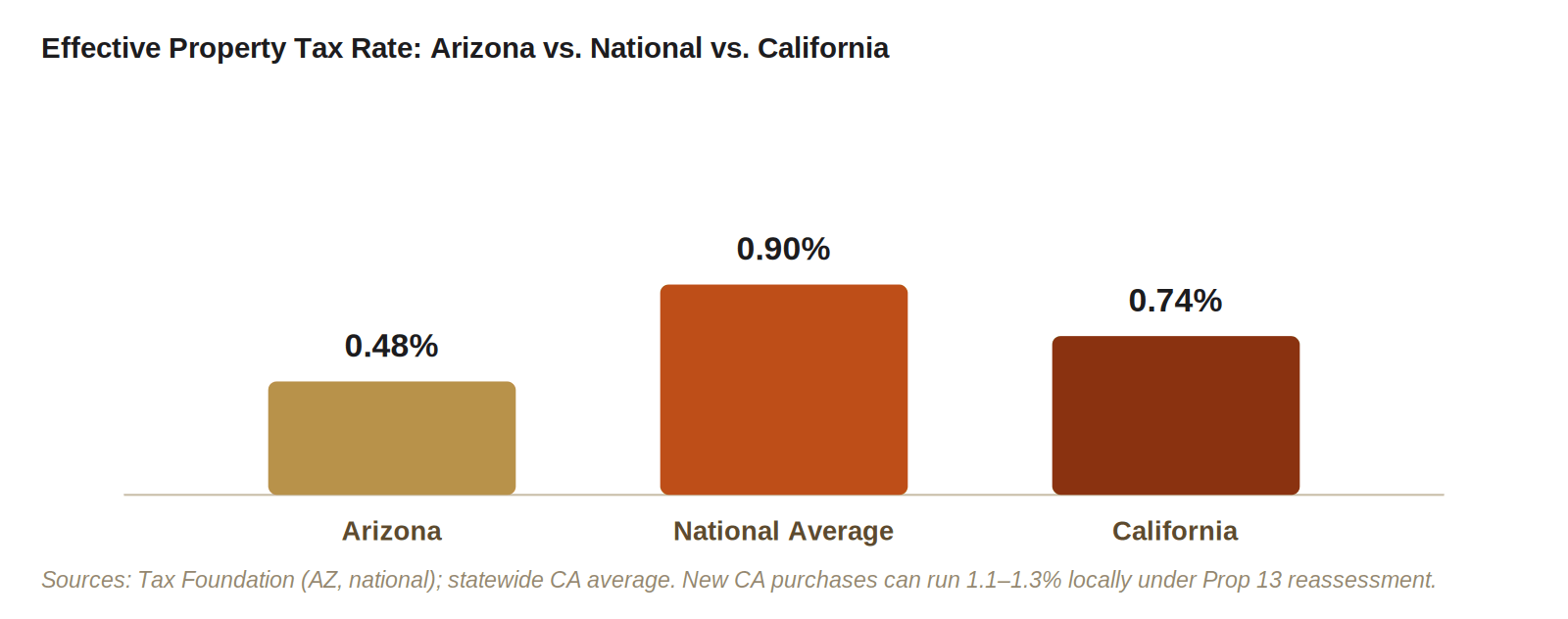
Sources: Tax Foundation (AZ, national); statewide CA average. New CA purchases can run 1.1–1.3% locally under Prop 13 reassessment.
In this article
Key Takeaways
- Refinancing only pays off if you stay past the break-even point — run the math before you lock in a new rate.
- Selling before the 2-year mark can cost you both the capital gains exclusion and thousands in transaction fees.
- Idle cash next to a HELOC balance is a guaranteed, avoidable loss — match savings to their time horizon instead.
- A HELOC is often cheaper capital than a personal loan or credit card, but only with a defined payoff plan.
- Know your adjusted cost basis and projected gain before you list — not after you're already in escrow.
Refinancing at the Wrong Time
Refinancing gets treated like a single question: "Is the rate lower than mine?" That's necessary, but nowhere near sufficient.
Every refinance resets the clock. Closing costs — typically 2–5% of the loan amount — need to be recovered through monthly savings before the refinance actually pays off. Refinance and then sell, move, or refinance again before that break-even point, and you've paid money to lose money.
The less obvious version: refinancing to pull cash out right before a life event that shortens your realistic holding period — a job that might relocate you, a household that's about to merge, a change in income on the horizon. Homeowners lock in a new 30-year amortization schedule without asking whether they'll even be in the house long enough for it to matter.
Refinance Break-Even: Cumulative Savings vs. Closing Costs
Example: $400,000 loan refinanced from 7.5% to 6.15% (the current average 30-year refinance rate as of July 2026, per Bankrate), $10,000 in closing costs, ~$360/month in payment savings — break-even around month 28
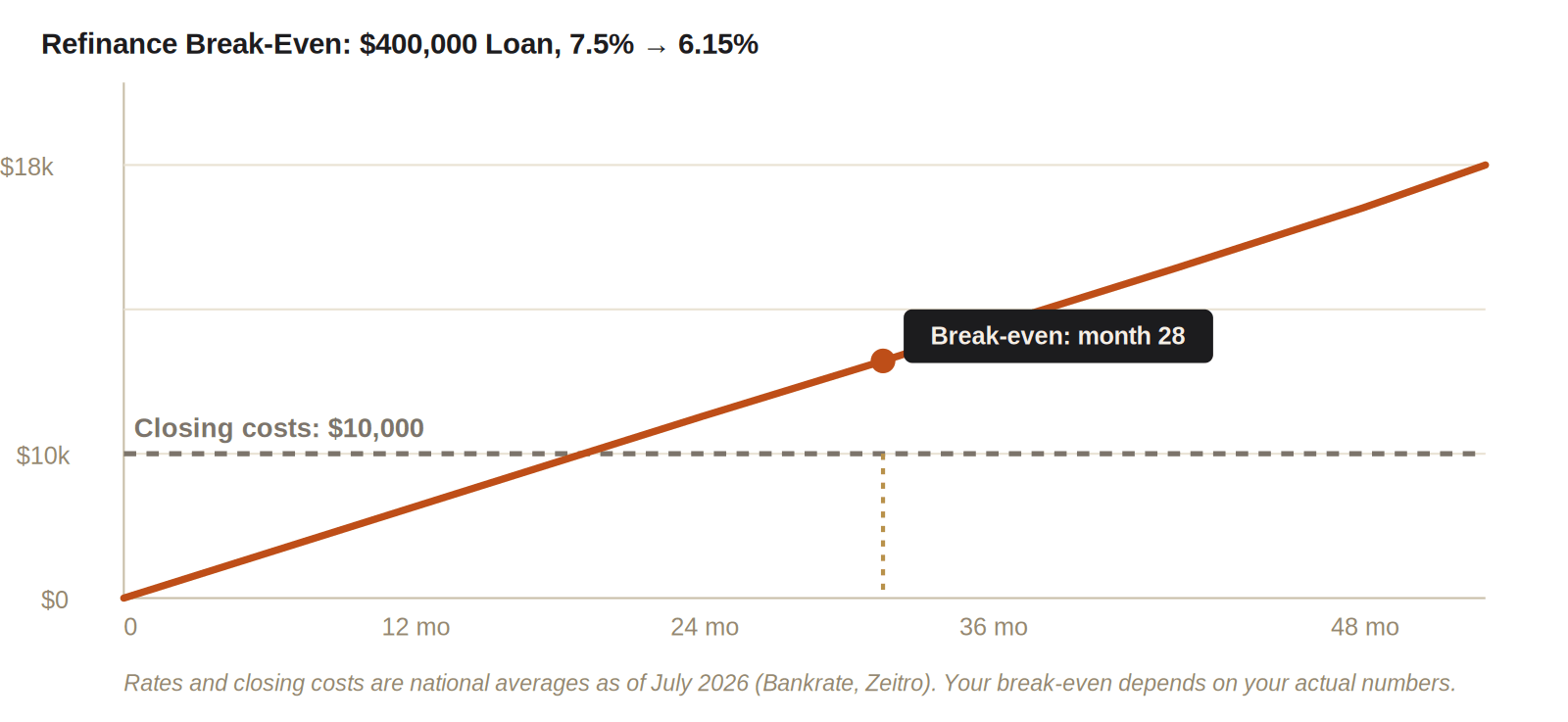
Rates and closing costs are current national averages as of July 2026 (Bankrate, Zeitro). Your own break-even point depends on your actual rate, loan balance, and closing costs.
How to calculate your own break-even in 3 steps
- Get your total closing costs. Ask your lender for the all-in figure — origination, appraisal, title, and recording fees — not just the headline "no closing cost" marketing number.
- Get your monthly savings. Subtract your new estimated payment from your current payment. If you're also shortening or lengthening the loan term, use a lender's amortization comparison rather than eyeballing it.
- Divide the two. Closing costs ÷ monthly savings = the number of months until you've broken even. Compare that number to how long you actually plan to stay in the home.
Example from the chart above: $10,000 ÷ $360/month ≈ 28 months.
Before refinancing, check:
- Your true break-even point (all closing costs ÷ monthly savings — our refinance calculator can run this for you)
- Whether you're resetting your amortization clock and losing years of principal-heavy payments
- Whether your realistic timeline in the home exceeds that break-even window
- Whether rates or your credit profile are likely to improve within 12–18 months, making "now" the wrong now
Saw rates drop and refinanced immediately on a $400,000 balance, paying $10,000 in closing costs. Fourteen months later, a job offer took the family out of state and the home sold.
Saw the same rate drop, but first ran the break-even math and confirmed a 5+ year timeline in the home before refinancing.
Selling Too Early
Equity compounds, but not the way people assume. In the early years of a mortgage, most of each payment goes to interest, not principal — so equity growth in years one through five comes almost entirely from appreciation, not paydown. Sell during that window and you've effectively rented the appreciation upside to your lender in the form of interest paid.
There's also a harder deadline most people don't track: the two-year ownership-and-use test for the capital gains exclusion (more on this in mistake five). Selling at twenty-two months instead of waiting two more can be a five- or six-figure swing in taxes owed.
Then there's the invisible cost: transaction friction. Between agent commissions, closing costs, and moving expenses, selling typically runs 8–10% of the sale price. If your equity gain since purchase doesn't clear that threshold, you're not capturing profit — you're funding a lateral move.
The Danger Zone vs. the Safe Zone
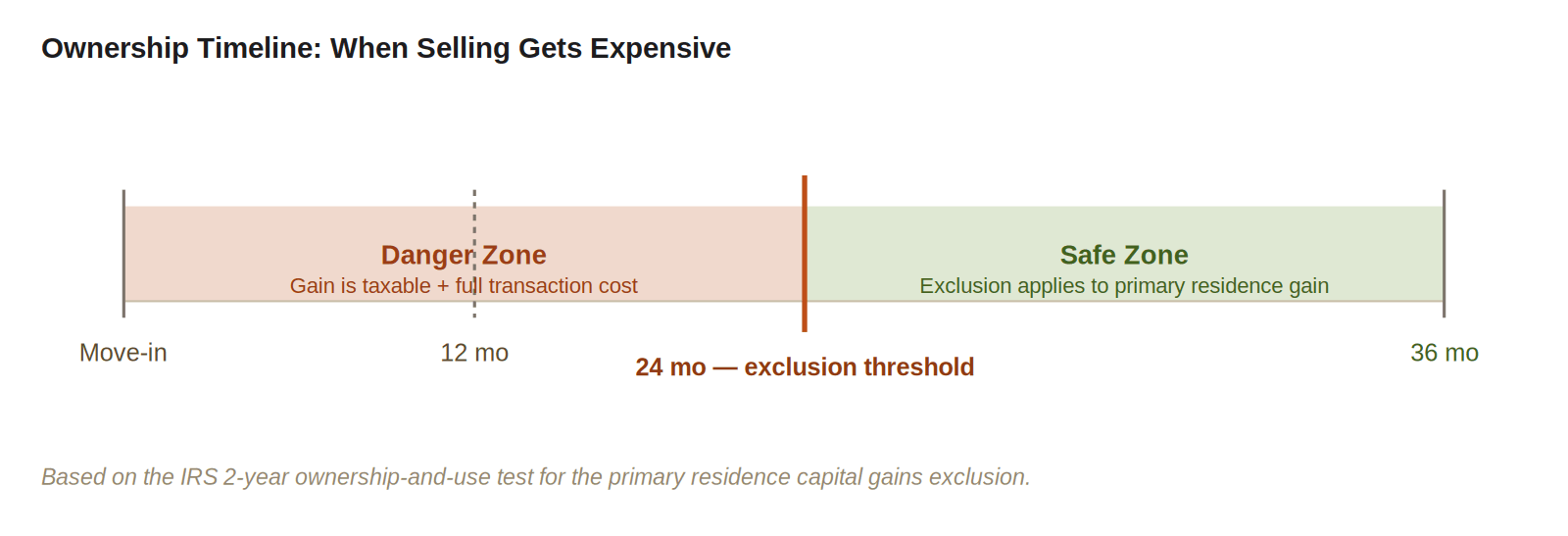
Based on the IRS 2-year ownership-and-use test for the primary residence capital gains exclusion.
Ask before selling:
- Have I cleared the two-year mark for tax purposes?
- Does my equity gain exceed the roughly 8–10% cost of transacting?
- Am I selling because the numbers say so, or because of a life event I could solve another way — a HELOC, a rental conversion, a rate-and-term refinance?
- If I do sell, does my listing strategy and timing actually match what the numbers are telling me?
Accepted a relocation offer and listed right away. The home had appreciated $45,000, but commissions, closing costs, and moving expenses ran close to 9% of the sale price — and the gain was taxable since the two-year mark hadn't been reached.
Faced the same relocation, but rented the home out for six months instead — using our guide on how much income the property could generate to confirm it made sense — bridging the gap to the two-year ownership-and-use mark before listing.
Keeping Cash in the Wrong Place
This one isn't about the house directly — it's about what homeowners do with liquidity once they have equity or savings earmarked for it.
A common pattern: someone has $40,000 sitting in checking "for the house" — a future down payment, a planned renovation, an emergency repair fund — earning next to nothing, while their HELOC or mortgage sits around 7.4% interest, the current national average per Bankrate's July 2026 survey. That's a guaranteed negative arbitrage. Idle cash next to accruing debt is equity being destroyed slowly enough that it doesn't feel like a mistake.
The flip side happens too: homeowners with substantial equity park large reserves in low-yield savings "just in case," rather than a high-yield savings account, money market fund, or short-term treasury ladder — leaving real, avoidable yield on the table for years.
The Gap Compounds Faster Than You'd Think
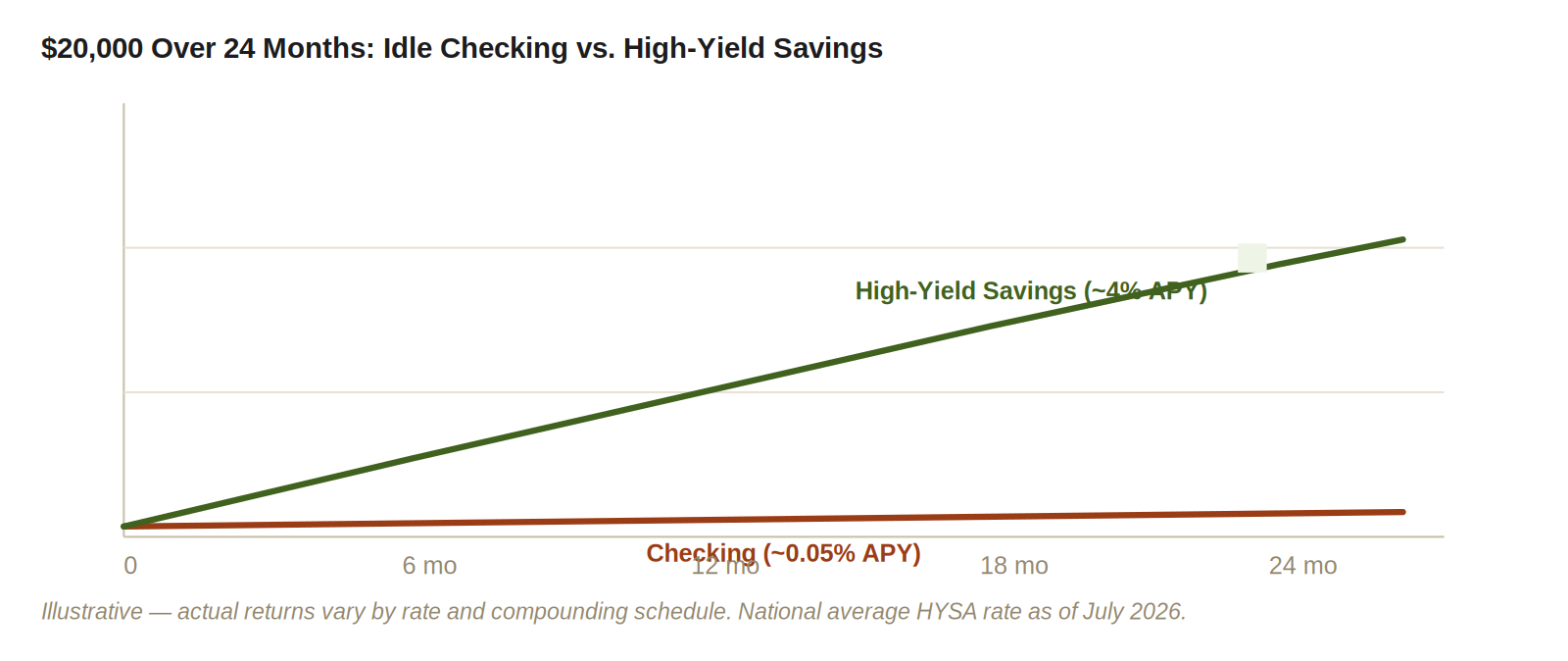
Illustrative — actual returns vary by rate and compounding schedule. National average HYSA rate as of July 2026.
The fix isn't complicated — it's just rarely done
- Match cash to its time horizon: under a year → high-yield savings or money market; a 3–5 year renovation plan → short-term bonds or CDs
- If you're carrying both idle cash and interest-bearing home debt, run the math on paying down debt versus the return you're actually earning on that cash
Kept $40,000 earmarked for a future renovation sitting in a checking account earning close to 0%, while carrying a $40,000 HELOC balance at 7.4%.
Used $20,000 of the same set-aside to pay down the HELOC balance, then moved the remaining $20,000 earmarked for a 2-year-out renovation into a high-yield savings account earning around 4% APY.
Not Using HELOCs Strategically
Most homeowners think of a HELOC as an emergency fund or a renovation loan. Both are valid, but that framing misses what it actually is: a flexible, low-cost lever against an appreciating asset that most people either never pull or pull carelessly.
Typical Cost of Capital: HELOC vs. Other Financing
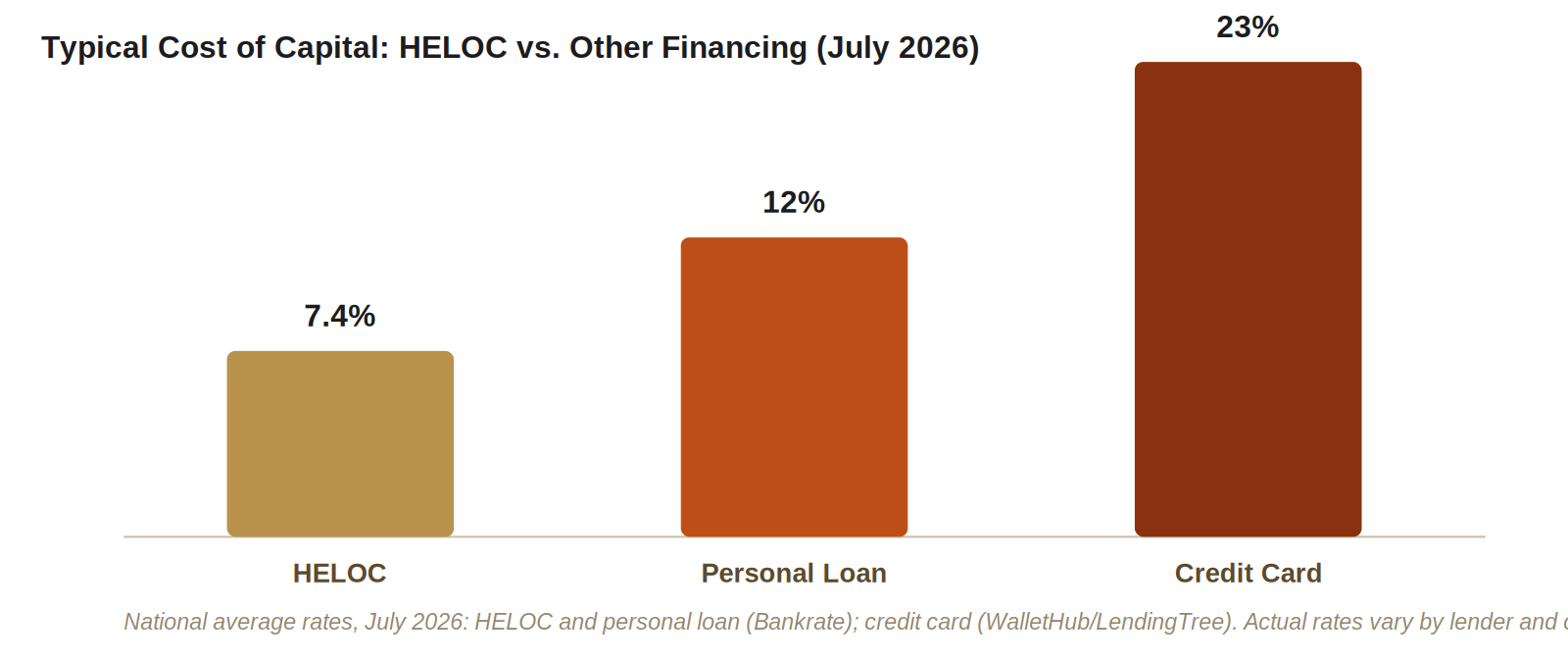
National average rates as of July 2026: HELOC and personal loan figures from Bankrate; credit card figure from WalletHub/LendingTree. Actual rates vary by lender, credit profile, and loan amount.
Under-using it: sitting on six figures of untapped equity while paying higher rates elsewhere — credit cards, personal loans, even some business financing — because "I don't want to touch my house," even though a HELOC is typically far cheaper capital.
Over-using or misusing it: treating a HELOC like found money for discretionary spending rather than a tool for value-additive uses — funding a renovation that increases the home's value, bridging a purchase, or covering a time-limited need with a clear repayment plan.
Before opening or using a HELOC, ask:
- Does this draw preserve or increase my equity position — or erode it? If the goal is rental income, running the numbers on what the property could generate first is worth the extra step.
- What's my realistic payoff timeline, and does it survive a rate increase? Most HELOCs carry a variable rate, as the Consumer Financial Protection Bureau explains.
- Am I stacking this against other debt in a way that raises my total risk if my income changes?
Had over $200,000 in home equity but financed the remodel with a personal loan at around 12% — the current national average, per Bankrate — rather than "touching the house," and made no formal payoff plan.
Opened a HELOC at around 7.4% — the current national average — drew exactly the renovation budget, and set a defined 4-year payoff plan tied to the value the remodel added.
Not Analyzing Taxable Gain Exposure Before Selling
This is the one with the most money quietly attached to it, and it's the least discussed.
Here's the baseline most people vaguely know: own and live in your home as a primary residence for at least two of the last five years, and you can generally exclude up to $250,000 of gain ($500,000 for married couples filing jointly) from capital gains tax, per IRS Topic No. 701. What most people don't do is actually calculate their gain before listing.
Gain isn't just sale price minus purchase price. It's sale price minus your cost basis — which includes your purchase price, certain closing costs, and capital improvements made over the years: a new roof, an addition, major system replacements (see IRS Publication 523 for the full definition of adjusted basis). Homeowners who don't track improvements systematically underestimate their basis and overpay in taxes, because they can't substantiate a higher basis without records.
The bigger blind spot: owners who've held a property a long time, done a cash-out refinance or two, and built substantial appreciation often don't realize they're close to or over the exclusion limit until they're already in escrow — too late to plan around it. Timing a sale across tax years, structuring a partial sale, or simply knowing the number in advance can change the entire decision of when and how to sell.
Before listing, have answers to:
- What is my actual cost basis, including documented capital improvements?
- What is my projected gain, and does it exceed my exclusion amount?
- If it exceeds the exclusion, is there a timing or structuring strategy worth exploring with a tax professional — an installment sale, a 1031 exchange for investment property, or timing the closing across tax years?
- Do I have records — receipts, permits, contractor invoices — to substantiate my basis if asked?
How Your Cost Basis Is Actually Calculated
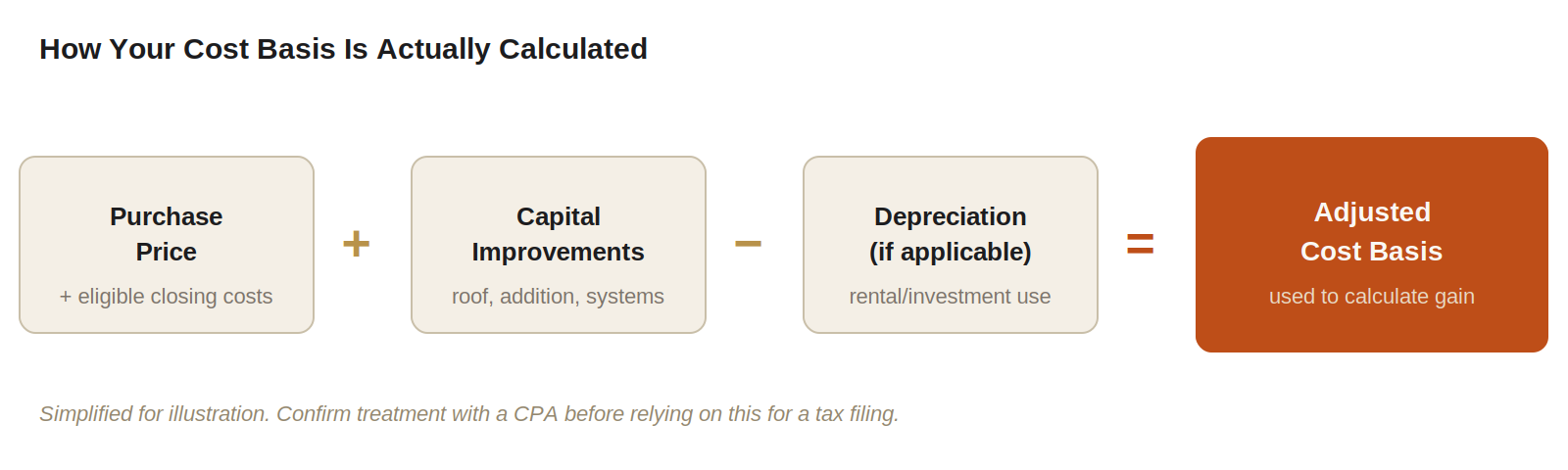
Simplified for illustration. Actual basis calculations depend on your specific facts — confirm treatment with a CPA before relying on this for a tax filing.
Owned a home for 12 years, did two cash-out refinances, and never tracked capital improvements. Listed the home, and the gain came in well above the $250,000 exclusion with no records to support a higher basis.
Kept receipts and permits for a room addition and major system replacements over the years, and calculated projected gain against the exclusion before listing.
This isn't a real estate conversation
None of these five mistakes are about not knowing real estate. They're about treating equity as something that just happens in the background, rather than something that needs active decisions at specific moments — refinance timing, sale timing, cash placement, HELOC strategy, and tax exposure. It's a financial strategy conversation that happens to involve a house — and most homeowners have nobody walking them through it until after a decision is already made. You can see what that looks like in practice in a few real client case studies.
Trusted With the Numbers, Not Just the Sale
"Eric's recommended lender had a better rate and was more responsive than our bank. Eric's extensive knowledge of financial planning also helped in several stages of the process."
Charles Fell · Relocation Client
"His pricing seemed high at first, but his knowledge and experience in the market proved correct — we netted much more on this sale than I thought was possible."
John Furrow · Seller · Fellow REALTOR®
"His financial background gave us confidence that every decision we made was the right one."
Jay Jackson · Buyer
Glossary of Terms Used in This Article
Amortization — the schedule by which your loan payment splits between interest and principal over time. Early payments are interest-heavy; later payments are principal-heavy.
Break-even point — the number of months it takes for a refinance's monthly savings to exceed what you paid in closing costs.
Cost basis — your purchase price plus eligible closing costs and capital improvements, minus any depreciation taken; used to calculate taxable gain on sale.
HELOC (Home Equity Line of Credit) — a revolving credit line secured by your home's equity, typically with a variable interest rate.
LTV (Loan-to-Value) — your loan balance divided by your home's value; lenders use combined LTV to cap how much you can borrow against your equity.
Primary residence exclusion — the IRS provision letting you exclude up to $250,000 ($500,000 married filing jointly) of home sale gain from capital gains tax, if you meet the 2-year ownership-and-use test.
Frequently Asked Questions
How do I know if refinancing is actually worth it right now?
Divide your total closing costs by your projected monthly savings to find your break-even point in months. If you plan to stay in the home longer than that, and your amortization reset doesn't erase years of principal-heavy payments, it's typically worth evaluating further with a lender who can model your specific numbers.
What's a good rule of thumb for how long to stay in a home before selling?
Most homeowners should plan to stay at least five years to comfortably absorb transaction costs (roughly 8–10% of the sale price) and clear the two-year ownership-and-use test for the capital gains exclusion. Selling sooner isn't always a mistake, but it usually means appreciation needs to be strong enough to outpace those costs.
What counts as a capital improvement for cost basis purposes?
Generally, improvements that add value, prolong the home's life, or adapt it to new uses — a new roof, an addition, a major HVAC or plumbing replacement, a kitchen remodel. Routine repairs and maintenance typically don't count. Keep receipts, permits, and contracts for anything you do, and confirm treatment with a CPA.
Is a HELOC or a cash-out refinance better for funding a renovation?
It depends on your existing rate, how much you need, and your timeline. A HELOC preserves a low first-mortgage rate if you have one, while a cash-out refinance replaces the whole loan. This is exactly the kind of comparison worth running with real numbers before committing either way.
How much capital gains tax will I owe when I sell my home?
It depends on your cost basis, your gain, your filing status, and whether you meet the two-year ownership-and-use test for the primary residence exclusion. This article is educational, not tax advice — a CPA can calculate your specific exposure before you list.
Do I have to pay capital gains tax if I buy another house with the profit?
For a primary residence, reinvesting the proceeds into another home doesn't by itself avoid capital gains tax — that "rollover" rule was phased out decades ago. What still applies is the primary residence exclusion (up to $250,000 single / $500,000 married filing jointly) if you meet the ownership-and-use test, regardless of what you do with the proceeds afterward.
Is it ever smart to keep a mortgage instead of paying it off early?
It can be, if your mortgage rate is lower than what you could reasonably earn keeping that cash liquid or invested elsewhere, or if you'd rather keep funds accessible for opportunities or emergencies. It's less about a universal rule and more about comparing your specific mortgage rate to your realistic alternative use of that same cash.
How much of my home equity can I safely borrow against?
Most lenders cap combined loan-to-value (existing mortgage plus HELOC or home equity loan) around 80–85% of the home's appraised value. What's "safe" to actually draw is a narrower question — it depends on what the funds are used for, your repayment timeline, and whether your income can comfortably absorb a rate increase on a variable-rate HELOC.
What happens to my HELOC if interest rates rise?
Most HELOCs carry a variable rate tied to the prime rate, so your payment can increase as rates rise. Before drawing on a HELOC, it's worth stress-testing your repayment plan against a meaningfully higher rate than today's, not just the rate you'd start at.
Where should I keep cash I'm saving for a down payment or renovation?
Match the account to your timeline. Money you'll need within a year generally belongs in a high-yield savings account or money market fund, where it stays liquid and safe while still earning a meaningful return. Money earmarked for something 3–5 years out can typically tolerate a short-term CD or bond ladder for a bit more yield.
Should I talk to a real estate agent or a financial advisor first about my home equity?
Ideally both, and ideally in coordination. A real estate agent can speak to timing, market conditions, and transaction costs; a CPA or financial advisor can speak to tax exposure and how the decision fits your broader finances. The mistakes covered in this article live at the intersection of both, which is why they're so often missed by homeowners only talking to one side — my real estate tax strategy guide digs deeper into that overlap.
Not sure where your equity stands?
I'll walk through your specific numbers — refinance math, sale timing, or projected tax exposure — before you make a move, at no cost. I also break down real numbers like these regularly in my newsletter and podcast, if you'd rather start there.

Eric Ravenscroft, CRS · REALTOR®
The Ravenscroft Group · Real Broker
License SA691304000 · (480) 269-5858
Eric Ravenscroft
REALTOR® · CRS · Owner, The Ravenscroft Group · Real Broker
Eric Ravenscroft is a Top 1% REALTOR® across North America and Team Lead of The Ravenscroft Group at Real Broker, based in the Greater Phoenix Metro. Before real estate, Eric served as a Director of Wealth Management — and that background is the lens through which he still approaches every transaction: not just "what's the home worth," but "how does this decision fit into your broader financial picture."
Over 15 years of combined experience in real estate and financial planning, Eric has closed more than $100 million in residential sales, averages 35 transactions and $15M in annual production, and has helped clients create over $133 million in long-term wealth. He holds the CRS, GRI, ABR, MRP, SRES®, and RSPS designations, and specializes in new construction, short-term rental investment strategy, California-to-Arizona relocation, and 1031 exchange planning — with dedicated resources for buyers at every step.
Eric's market analysis and commentary have been featured in the Wall Street Journal, MarketWatch, MSN Money, and Morningstar, and he's trusted by lending partners including USAA, Chase, SoFi, PennyMac, Citibank, and RBC. He holds an active Arizona real estate license (SA691304000, verify with ADRE).
LinkedIn · Zillow · Realtor.com · Homes.com · Full Bio
As Featured In





Editorial standards: This article was written by Eric Ravenscroft, drawing on his background as a former Director of Wealth Management and 15+ years advising homeowners on the financial side of real estate decisions. The tax and lending concepts referenced reflect principles commonly confirmed with the CPAs, tax advisors, and financial planners Eric collaborates with nationwide on client transactions. It reflects general principles as of July 2026 and is not a substitute for personalized advice from your own tax or financial professional.
About the examples: "Homeowner A" and "Homeowner B" scenarios throughout this article are illustrative composites built from common patterns seen across real transactions — not descriptions of specific, identifiable clients. Dollar figures are simplified for clarity and will vary based on individual circumstances, loan terms, and market conditions.
Disclosure: This content is for general informational purposes only and does not constitute tax, legal, or financial advice. Homeowners should consult a qualified tax professional, financial advisor, or attorney before making decisions about refinancing, selling, or leveraging home equity based on their specific circumstances. Eric Ravenscroft is a licensed Arizona REALTOR® (SA691304000) and is not a CPA or licensed financial advisor; tax and financial guidance referenced here should be verified with the appropriate licensed professional.
Categories
- All Blogs (321)
- Active Adult & 55 Plus Communities (16)
- Arizona Relocation Guides (30)
- Buyers (211)
- Financial Planning (60)
- General Real Estate (139)
- Income From Real Estate (59)
- Market Update (26)
- New Construction (28)
- News, Updates and Coming Soon (57)
- Real Estate Agent Financial Planning (22)
- Real Estate Investing (94)
- Sellers (106)
- Vacation and Short Term Rentals (45)
Recent Posts









About the Author
Eric Ravenscroft is a Top 1% REALTOR® across North America and one of Arizona’s most trusted real estate strategists. With 15 years of experience spanning real estate, wealth management, and investment planning, he helps clients make smarter, financially grounded decisions, from new construction and relocations to STR investments, 1031 exchanges, and long-term portfolio strategy.
Eric’s expertise has earned him industry recognition, Elite status with Real Broker, and features in major publications including the Wall Street Journal, MarketWatch, MSN, and Morningstar. Clients across the Greater Phoenix Metro rely on his clarity, strategic insight, and results-driven guidance.
Ready to make a confident real estate move? Call or text Eric today.