
Best Areas to Buy in Phoenix in 2026: Top Neighborhoods, Zip Codes & Investment Guide
Best Areas to Buy in Phoenix in 2026: Top Investment & Value Opportunities in North Phoenix, Scottsdale, East Mesa & Buckeye

Where opportunity, infrastructure, and long-term value converge in the Greater Phoenix Metro — and how to identify which area aligns with your goals in 2026.
The Greater Phoenix Metro is entering 2026 at an inflection point. The frenzy years of 2020–2021 created distorted pricing. Short-term rental speculation pushed premiums well above intrinsic value. Builders expanded aggressively. Interest rates forced discipline back into underwriting.
Now, we are in a strategic phase of the market.
As we move through 2026, four areas stand out across the Greater Phoenix Metro. Each represents a different type of value opportunity: appreciation positioning, builder-driven math, school-driven stability, and premium market recalibration. The right one depends on what you are trying to accomplish.
Where the Phoenix Market Stands in 2026
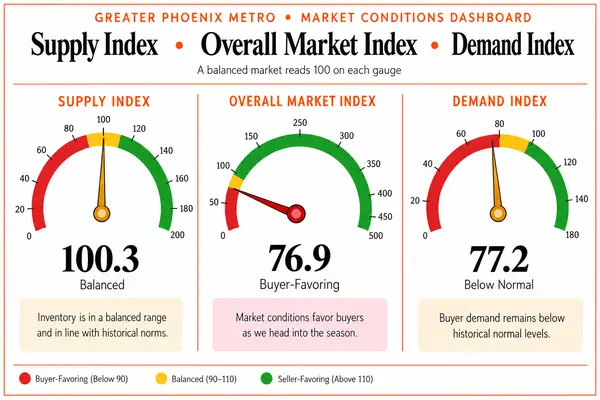
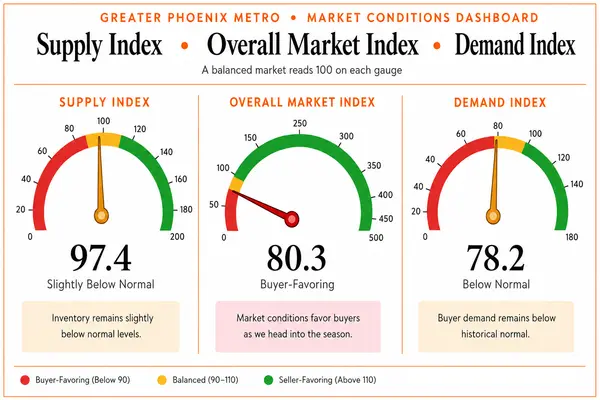
Before evaluating specific areas, it helps to understand the baseline. These are the current headline figures for the Greater Phoenix Metro as of early 2026 — and why they support a buyer's entry, not a buyer's hesitation.
North Peoria, North Glendale, North Phoenix & Anthem
Tech-Driven Appreciation · Long-Term PositioningPositioned Next to Arizona's Largest Business Investment
All four of these areas share one critical factor: they are within close proximity to Arizona's largest private business investment and future tech center — a development that will completely change this region of the Valley.
That anchor is Taiwan Semiconductor Manufacturing Company (TSMC).
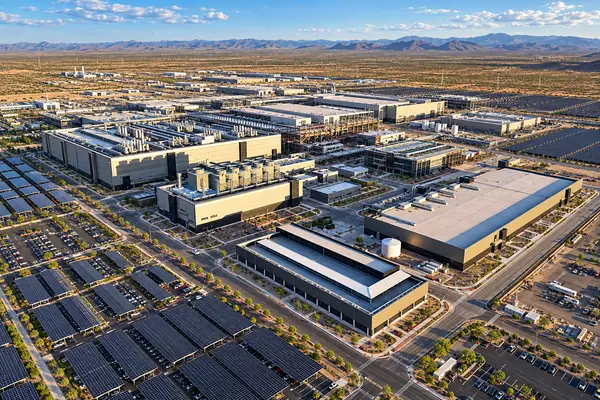
TSMC's multi-phase semiconductor campus in North Phoenix represents up to $165 billion in long-term investment. The project includes advanced wafer fabrication plants, packaging facilities, research operations, and thousands of high-paying technical jobs.
This is not incremental growth. This is structural economic transformation.
When semiconductor manufacturing anchors a region, housing demand expands well beyond direct employees. Suppliers, vendors, executives, and supporting industries follow. Retail follows. Infrastructure follows. Residential development follows.
Adjacent to the campus is Halo Vista — approximately 2,300 acres planned as a mixed-use, walkable urban ecosystem including residential, retail, hospitality, and commercial development. This is one of the most significant planned expansions in the Phoenix Metro's history.
North Peoria, North Glendale, North Phoenix, and Anthem are positioned directly within this growth corridor.
Why Proximity to Scottsdale Also Matters Here
Buyers in this corridor benefit from something less discussed: proximity to Scottsdale's employment and lifestyle ecosystem. That access allows buyers to live outside peak Scottsdale pricing while maintaining reach to one of Arizona's strongest employment and lifestyle markets — a combination that is difficult to replicate elsewhere in the valley.
Key Communities in the North Phoenix Corridor
- Desert Ridge & Norterra (Phoenix/Phoenix 85054–85086): Established lifestyle hubs near Loop 101 and the SR-51 corridor. Strong retail access, proximity to employment, and high rental demand from tech workers.
- Fireside at Norterra: Gated, resort-style amenities, family-oriented community identity. Lower entry than North Scottsdale with comparable lifestyle quality.
- Tatum Ranch (Cave Creek / North Phoenix): Established mid-range community with strong schools and access to Cave Creek Road corridor. Popular with families and long-term owners.
- Sonoran Foothills: Elevated terrain with desert preserve trail access. Gated sections available. Premium lifestyle at moderate price relative to Scottsdale.
- Anthem (North Phoenix / Maricopa County): One of Arizona's most recognized master-planned communities. Larger lots, resort amenities, and newer construction at lower price points than interior North Phoenix. The trade-off is distance — approximately 35 miles from downtown Phoenix.
- North Peoria / North Glendale (P83 corridor, Lake Pleasant area): Growing western anchor of the tech corridor with newer construction, expanding retail, and strong new infrastructure investment.
Strengths
- Direct exposure to TSMC employment corridor
- Halo Vista development adds long-term density
- Loop 303 and I-17 freeway access
- Master-planned community infrastructure
- Larger lots vs. central Phoenix
- Proximity to Scottsdale employment & lifestyle
- Strong school options in Deer Valley Unified
Considerations
- Higher entry prices than outer suburbs
- TSMC full ramp-up timeline adds some uncertainty
- Anthem adds significant commute distance
- Summer heat intensifies in outer northern communities
Strategic 1031 Exchange into Union Park at Norterra — $110K Below List, 15 Minutes from TSMC
$3,500 Projected Monthly Rent
An investor redeploying capital from a legacy investment completed a delayed 1031 exchange into a 3-bed, 2.5-bath home in Union Park at Norterra — positioned 15 minutes from TSMC Fab 1 in the heart of the semiconductor workforce housing corridor. We negotiated $110,000 below original list price in a market where most buyers were still anchored to peak-era pricing expectations.
The exchange deferred all capital gains while repositioning the capital exactly where long-term employment-driven demand will be strongest. The investor's thesis: buy in front of a structural workforce migration, not after it. Projected rents of $3,100–$3,500/month provide immediate income during the hold period while the TSMC ramp drives longer-term appreciation.
This acquisition used a reverse exchange structure — we secured the replacement property before the relinquished property sold, using an Exchange Accommodation Titleholder. In a market like the North Phoenix corridor where strong assets go under contract quickly, that structure was the difference between capturing the deal and watching it go to another buyer.
Read the full North Phoenix 1031 case study →Case details shared with client permission. Individual investment results will vary. 1031 exchange rules are complex — always work with a qualified CPA and Qualified Intermediary.
Litchfield Park & Buckeye
Builder Incentives · Military Demand · Cash FlowIf North Phoenix is about long-term tech-driven appreciation, Litchfield Park and Buckeye are about immediate math-driven opportunity. This is the pocket where opportunity and value collide in 2026.
The Builder Incentive Advantage
New construction inventory in this corridor remains strong, and builders are competing aggressively. Buyers entering this market right now are securing packages that materially change the affordability equation:
Current Builder Incentives in This Corridor
- 3.99% 30-year fixed rate financing
- No closing costs
- Appliances included
- Window coverings included
- Backyard landscaping included
That combination dramatically improves entry math for both homeowners and investors. The all-in monthly payment on a new construction home in this corridor can be meaningfully lower than a comparable resale home financed at market rates — often by $400–$600 per month.
The Luke Air Force Base Rental Demand Factor
Now layer in Luke Air Force Base. Luke remains one of the largest fighter pilot training bases in the world — and a major driver of residential demand in the West Valley.
A notable and underappreciated shift: many households PCSing to Luke are no longer buying. In many cases, the majority are renting. The reasons are varied:
- Holding prior properties in other markets and converting them to rentals
- Difficulty selling primary homes in other markets
- VA loan eligibility currently tied up in existing purchases
- Short assignment durations that do not justify purchasing
This creates consistent, income-verified rental demand in Litchfield Park, Buckeye, Verrado, and the Loop 303 corridor — a tenant base that is stable, responsible, and well-qualified.
Add growing retail and dining, expanding West Valley employment centers, proximity to Verrado (one of the Metro's most desirable master-planned communities), and higher rents relative to entry price — and this becomes one of the strongest value-plus-cash-flow pockets entering 2026.
Key Communities in the Litchfield Park / Buckeye Corridor
- Verrado (Buckeye): Award-winning master-planned community with a main street walkable core, schools within the community, golf, and resort-style amenities. One of the best-executed planned communities in Arizona and a consistent top rental destination.
- Tartesso (Buckeye): Lower-entry new construction with family amenities and room to grow as the western corridor builds out.
- Teravalis (Buckeye): One of the largest master-planned communities in Arizona's history — in early development stages with significant long-term potential as infrastructure matures over the coming decade.
- Litchfield Park Proper: Established, quieter community with mature landscaping and historic character. Home of The Wigwam resort. Commands a premium within the West Valley for good reason.
Strengths
- Best builder incentive math in the metro
- Consistent military rental demand (Luke AFB)
- Top national recognition for population growth
- Lower acquisition costs, strong cash flow potential
- Multiple established master-planned communities
- Loop 303 corridor West Valley expansion
Considerations
- Distance from central Phoenix employment
- Outer Buckeye communities still infrastructure-limited
- Appreciation timeline longer than East Valley
- Teravalis is a long-horizon play, not short-term
East Mesa & East Gilbert
School-Driven Stability · Pricing Lag OpportunityGilbert consistently ranks among the best places to live in Arizona. Strong schools. Family appeal. Safety. Lifestyle. These fundamentals have not changed — and they are the reason this market has one of the most stable long-term demand profiles in the valley.
Many East Mesa neighborhoods fall within Gilbert school district boundaries. That means buyers can access Gilbert's school quality while paying distinctly lower per-square-foot prices and carrying lower municipal tax burdens.
The Business Growth Catalyst
Now consider what is building in the Southeast Valley corridor:
- Advanced manufacturing expansion along the Loop 202 corridor
- Aerospace development in the Phoenix-Mesa Gateway Airport area
- Healthcare campus growth (Banner, Dignity Health, and others)
- Phoenix-Mesa Gateway Airport continuing to expand commercial routes
- Continued Southeast Valley infrastructure investment
Yet home prices in many East Mesa corridors have not yet fully caught up to their long-term potential relative to school strength and employment growth.
That lag is opportunity. This is a quieter value play compared to Scottsdale or North Phoenix — but the fundamentals are strengthening, and that is precisely why it belongs on this list.
Key Communities in East Mesa & East Gilbert
- East Mesa near Higley & Williams Field Rd: Newer construction at below-Gilbert pricing with Gilbert school district access in many boundaries. Strongest value proposition in the submarket.
- Power Ranch (Gilbert): Large master-planned community with multiple pools, parks, and recreation amenities. Strong family demand and community stability — one of Gilbert's most recognizable addresses.
- Morrison Ranch (Gilbert): Walkable, park-forward design with urban farm and community gardens. Premium within the Gilbert market for a reason.
- Agritopia (Gilbert): Intentionally designed, community-focused neighborhood around an organic farm. Unique in the valley and consistently in demand among buyers who prioritize walkability and community identity.
- Val Vista Lakes (Gilbert): Established lakefront community with resort amenities. Excellent long-term hold characteristics and strong resale demand.
Strengths
- Top-rated Gilbert Unified School District
- East Mesa offers Gilbert schools at lower price
- Among the lowest crime rates in Arizona
- Strong family-driven demand stability
- Southeast Valley employment growth
- Gateway Airport expanding commercial capacity
Considerations
- Longer commute to West Valley and central employment
- Gilbert proper pricing has already risen significantly
- Less freeway access than North Phoenix or West Valley
Scottsdale
Premium Market Reset · Lifestyle & STR StrategyMany will look at this list and ask: Why is Scottsdale here? Isn't Scottsdale expensive?
Yes. And that is precisely why it belongs on this list.
Scottsdale experienced aggressive premium buying during 2020 and 2021. Many buyers paid well above list price. Many short-term rental investors assumed it was easy money. Some overpaid significantly.
Fast forward to 2026: select submarkets have seen 8–12% price adjustments. Some STR owners are exiting. In certain cases, properties are selling below what owners originally paid.
This is not a collapse. It is a recalibration.
Demand has not decreased among locals or out-of-state movers. Scottsdale remains one of Arizona's strongest lifestyle and relocation markets. Rental rates — long-term, mid-term, and short-term — remain elevated compared to most sister cities. While acquisition prices are higher, rental revenue often offsets that.
Key Communities in Scottsdale
- McDowell Mountain Ranch (North Scottsdale 85255): One of the most consistently in-demand neighborhoods in the entire metro. Top-rated Scottsdale Unified schools, mountain preserve trail access, and community amenities. Strong resale stability.
- DC Ranch / Silverleaf (North Scottsdale): The pinnacle of North Scottsdale real estate. Guard-gated sections, resort-style amenities, and a community identity that commands a durable premium. Silverleaf represents the luxury ceiling of the market.
- Grayhawk (North Scottsdale 85255): Established master-planned community anchored by two championship golf courses. Strong family appeal, reliable resale demand, and good school options.
- Old Town Scottsdale (Central Scottsdale 85251/85257): The highest-revenue STR submarket in the metro. Year-round tourism, spring training, nightlife, arts, and resort infrastructure create demand that is not seasonal. Best short-term rental yield per square foot in the valley.
- Arcadia (Scottsdale/Phoenix border 85018/85251): Tree-lined, walkable, mid-century character. One of the most beloved and consistently desirable zip codes in the valley. Bridges Scottsdale pricing with Phoenix walkability.
Strengths
- Prices 8–12% below 2021 peak in select submarkets
- Durable lifestyle and relocation demand
- Top STR revenue potential in the metro
- Strong long-term appreciation history
- Scottsdale Unified school district (A+)
- Best luxury rental infrastructure in Arizona
Considerations
- Highest acquisition costs in the metro
- STR regulation environment to monitor
- Some 2021 buyers still hold underwater positions
- Requires strong underwriting discipline at entry
Turn-Key Scottsdale STR in 85254 — Negotiated $170K Below List, Immediate Income at Closing
2.5BA Resort-Style Corner Lot
This is what happens when real estate execution, tax planning, and timing align from day one. I represented the buyer on this acquisition in Scottsdale's 85254 "Magic Zip Code" with a clear objective: secure a turn-key short-term rental, fully furnished, already producing income — and position it for a Year 1 bonus depreciation strategy.
The seller was a motivated STR operator who had grown tired of managing the property. By moving before the year-end rush, we negotiated from a position of strength: $170,000 below original list price, seller-paid closing costs, all furniture and contents included, a brand-new roof at seller's expense, and a new multi-panel slider for indoor/outdoor living. The buyer stepped directly into a fully operating STR with existing booking momentum — removing the months of setup risk that derails most new STR operators.
From a tax strategy standpoint, a cost segregation study identified accelerated components eligible for bonus depreciation in Year 1. The result: an income-producing asset from day one, with a tax strategy already mapped out. The leverage came from the alignment of seller motivation, clear strategy, and decisive timing — not from chasing a "hot market."
Read the full 85254 STR case study →Case details shared with client permission. STR performance varies by property, operations, and market conditions. Tax outcomes depend on individual circumstances — consult a qualified CPA before structuring a bonus depreciation strategy.
Phoenix Area Comparison: Best Neighborhoods & Suburbs in 2026
Quick-reference guide comparing the top Phoenix-area neighborhoods and suburbs across key metrics for buyers and investors in 2026.
| Area | Price Range | Primary Appeal | Best Investment Type | Appreciation | Schools |
|---|---|---|---|---|---|
| North Phoenix / N. Peoria | $420K–$800K+ | TSMC tech corridor, Halo Vista growth | Long-term hold, SFR rental | Very Strong | A / A+ |
| Anthem | $380K–$650K | Master-planned, lower entry vs. inner corridor | Owner-occupied, LTR | Strong | A |
| Scottsdale | $600K–$2M+ | Lifestyle, STR, premium recalibration | STR, mid-term, luxury SFR | Strong (LT) | A+ (SUSD) |
| Gilbert | $420K–$700K | Schools, safety, lifestyle stability | Owner-occupied, LTR | Strong | A+ |
| East Mesa | $360K–$560K | Gilbert schools at lower price | Owner-occupied, LTR | Strong | A (GUSD access) |
| Litchfield Park / Buckeye | $290K–$490K | Builder math, Luke AFB rental demand | New construction, LTR, military rental | Moderate-Strong | B+ / A |
| Chandler | $400K–$650K | Tech employers, family market | Owner-occupied, LTR | Strong | A (CUSD) |
| Queen Creek / San Tan | $330K–$560K | Space, value, emerging growth | Owner-occupied, new construction | Moderate-Strong | B+ / A |
Best Phoenix Area by Buyer Type in 2026
The right area is determined by your objective — not a universal ranking. Here is how the four primary areas map to different buyer profiles:
First-Time Buyer
Focus on entry math and monthly payment. Builder incentives make new construction the most affordable effective option in 2026.
Family Relocating to Phoenix
Schools and safety are the primary filters. Gilbert and Chandler are the strongest markets for families with school-age children.
California Investor / 1031 Exchange
Tax deferral, strong cash flow, and long-term appreciation make Phoenix one of the top 1031 replacement markets in the country.
Short-Term Rental Investor
Scottsdale leads on revenue per night and STR infrastructure. Goodyear and Gilbert also produce strong STR returns at lower entry prices.
Tech Industry Relocator
Proximity to TSMC and the semiconductor ecosystem makes the North Valley corridor the primary choice for this buyer.
Lifestyle / Retirement Buyer
Scottsdale dominates for luxury lifestyle. Ahwatukee and Sun City West offer quieter, established alternatives with lower price points.
The 2026 Phoenix Market in Summary
Value in 2026 is concentrated where infrastructure investment is accelerating, employment growth is expanding, builder incentives improve affordability, rental demand remains durable, and price recalibration has created opportunity.
Tech-driven transformation
Builder incentives + military rental demand
School-driven stability with pricing lag
Premium market reset opportunity
This is not about chasing the lowest price per square foot. It is about understanding where future positioning creates present-day value. Every area outlined above serves a different purpose. The right one depends on your objectives.
Phoenix Zip Code Guide: Median Prices & What Each Area Covers (2026)
One of the most common questions buyers ask is which specific zip code to target. Here is a current breakdown of the key Phoenix Metro zip codes by area, with median prices sourced from Redfin, Zillow, and Orchard data as of early 2026. Use this as a starting point — zip codes are a research tool, not a strategy. The right zip depends on your objective.
| Zip Code | Area / Neighborhoods | 2026 Median | Strategic Note |
|---|---|---|---|
| 85085 | Norterra, Union Park, TSMC / Happy Valley corridor | ~$615K | Closest zip to TSMC campus. Strongest long-term appreciation case in the metro. |
| 85054 | Desert Ridge, Sky Crossing | ~$645K | Established lifestyle hub. One of the top-appreciating zip codes in Phoenix over the last 5 years. |
| 85086 | Anthem, Daisy Mountain, New River corridor | ~$626K | Lower entry than inner N. Phoenix. Master-planned lifestyle with distance trade-off (~35 mi to downtown). |
| 85383 | North Peoria / Vistancia / P83 corridor | ~$550K–$650K | Western anchor of the TSMC corridor. Growing retail, newer construction, Loop 303 access. |
| Zip Code | Area / Neighborhoods | 2026 Median | Strategic Note |
|---|---|---|---|
| 85254 Magic Zip | Kierland area, Arabella, Orange Tree, Paradise Valley border | ~$900K | Scottsdale address + Phoenix taxes + Paradise Valley Unified schools. No HOA on most properties. Strongest value-to-prestige ratio in the Scottsdale market. |
| 85255 | McDowell Mountain Ranch, DC Ranch, Grayhawk, Silverleaf | ~$1.45M | North Scottsdale's premier zip. Highest demand, strongest resale stability. Entry to Scottsdale's top-tier neighborhoods. |
| 85258 | Scottsdale Ranch, McCormick Ranch, Gainey Ranch | ~$975K | Central Scottsdale master-planned communities. Lakes, paths, golf. Strong family and retirement demand. |
| 85259 | Ancala, Pinnacle Peak area, East Shea corridor | ~$1.5M | Guard-gated luxury. One of the highest median zip codes in the metro. Mountain views, privacy. |
| 85260 | Scottsdale North, Ironwood Village, Sands | ~$739K | More accessible Scottsdale entry point. Good schools, lifestyle access at below-85255 pricing. |
| 85251 | Old Town Scottsdale, South Scottsdale | ~$515K | Highest STR revenue per night in the metro. Urban walkable. Best entry price in the Scottsdale market for STR investors. |
| Zip Code | Area / Neighborhoods | 2026 Median | Strategic Note |
|---|---|---|---|
| 85018 | Arcadia, Arcadia Lite, Biltmore corridor | ~$1.2M | Tree-lined streets, mid-century character, Camelback Mountain views. One of the most consistently desirable zip codes in the valley. Strong appreciation history. |
| Zip Code | Area / Neighborhoods | 2026 Median | Strategic Note |
|---|---|---|---|
| 85295 | Power Ranch, Agritopia, Morrison Ranch, Val Vista Lakes | ~$575K | Core Gilbert zip. Top-rated Gilbert Unified schools. Most in-demand family neighborhoods. Best resale stability in the East Valley. |
| 85296 | Central Gilbert, Trilogy, southeast Gilbert communities | ~$542K | Slightly lower entry than 85295 with the same school district access. Strong value within the Gilbert market. |
| 85212 | East Mesa near Ellsworth / Williams Field corridor | ~$460K–$500K | Many parcels fall within Gilbert Unified boundaries at below-Gilbert pricing. Best value play in the East Valley for school-district buyers. |
| 85213 | East Mesa, Mesa Gateway area | ~$500K–$540K | Growing infrastructure near Phoenix-Mesa Gateway Airport. Southeast Valley employment access. Value relative to Gilbert proper. |
| Zip Code | Area / Neighborhoods | 2026 Median | Strategic Note |
|---|---|---|---|
| 85340 | Litchfield Park, Windrose, Ironwing communities | ~$535K | Established character, The Wigwam resort proximity, newer construction from Pulte, Woodside, David Weekley. Builder rates available; strong Luke AFB rental demand. |
| 85396 | Buckeye / Verrado, Black Rock at Verrado, Teravalis | ~$390K–$556K | Verrado (~$556K median) is the premium address; broader 85396 offers lower-entry new construction. Best cash flow math in the metro when combined with builder incentives. |
| 85326 | Buckeye core / Tartesso / Sun City Festival | ~$386K | Most affordable new construction entry in the metro. Fastest-growing city in the U.S. for several consecutive years. Long-horizon appreciation play. |
Source: Redfin, Zillow, Orchard, and Movoto data January–March 2026. Medians represent all home types unless noted. New construction incentive rates are builder-dependent and subject to change. Always verify current market data with your agent before making purchasing decisions.
Phoenix Metro School Districts: Quick Comparison for Buyers
School district quality is one of the top three factors driving home values in the Phoenix Metro — particularly in the East Valley. This table covers the primary districts for each area covered in this guide.
| District | Primary Areas Served | Niche Rating | Notable Schools | Impact on Home Values |
|---|---|---|---|---|
| Paradise Valley Unified (PVUSD) | 85254 (Magic Zip), portions of North Phoenix & Scottsdale border | A+ | Desert Shadows Middle, Horizon High, Shadow Mountain High | Key driver of 85254 premium. Buyers explicitly search PVUSD addresses. |
| Scottsdale Unified (SUSD) | 85255, 85258, 85259, 85260, Scottsdale proper | A+ | Chaparral High, Saguaro High, Cocopah Middle | Directly supports Scottsdale property premiums. Strong resale signal for family buyers. |
| Gilbert Unified (GUSD) | 85295, 85296, 85297, portions of 85212 East Mesa | A+ | Williams Field High, Perry High, Gilbert High, Mesquite High | #1 driver of demand in the East Valley. Gilbert address + GUSD boundary = pricing premium over adjacent Mesa. |
| Deer Valley Unified (DVUSD) | 85085, 85086, 85383, North Phoenix / Anthem corridor | A | Boulder Creek High, Deer Valley High, Sandra Day O'Connor High | Strong family demand driver in North Phoenix. Sandra Day O'Connor consistently rated among the best high schools in Arizona. |
| Chandler Unified (CUSD) | 85224, 85225, 85226, 85286, Chandler / South Gilbert | A | Hamilton High, Perry High (shared with GUSD boundary), Chandler High | Hamilton High School is frequently listed among Arizona's top public high schools. Strong draw for professional families in the tech corridor. |
| Agua Fria / Litchfield (AFUHSD / LESD) | 85340, 85396, West Valley communities | B+ / A | Canyon View High, Verrado High, Millennium High | Improving rapidly as the West Valley matures. Verrado High is the standout — community-embedded, strong programs. |
Ratings based on Niche.com 2026 rankings. School boundaries shift — always verify the specific parcel at the district's boundary tool before purchasing. For buyers using school district as a primary filter, boundary verification is as important as the school name itself.
Rent vs. Buy in Phoenix in 2026: The Real Numbers
The rent vs. buy decision in 2026 Phoenix is less about the housing market and more about the financing environment. Builder-subsidized buydowns have fundamentally changed the monthly payment math — in some cases making ownership cheaper than renting on a monthly basis, before factoring in equity accumulation.
Buying — New Construction (West Valley)
Renting — Comparable SFH (West Valley)
The case for renting remains strongest for households who anticipate relocating within 12–18 months, those still actively building a down payment, and buyers who have not yet identified the right area or property type for their long-term goals. For everyone else, the 2026 Phoenix market is one of the most compelling buy environments in the metro's recent history.
Moving from California to Arizona in 2026: The Real Estate Math
A significant share of Phoenix's current buyer demand comes from California — Bay Area, Los Angeles, San Diego, and Sacramento. If you are evaluating a California-to-Arizona move or a 1031 exchange into the Phoenix market, here is the financial calculus that is driving the decision for thousands of households each year.
California — What You're Leaving
- Median home price in LA Metro: ~$850K–$1.1M
- Median home price in Bay Area: ~$1.4M–$1.8M
- State income tax: up to 13.3%
- Property tax: 1.1–1.25% (but Prop 13 caps increases for long-term owners)
- Average rent for 3BR SFH: $3,200–$4,500/mo
- Cost of living index: ~30–50% above national average
- STR regulations: increasingly restrictive in most major markets
Arizona / Phoenix — What You're Gaining
- No state income tax on Social Security; flat 2.5% income tax rate (AZ)
- Phoenix Metro median home price: ~$481K
- Equivalent lifestyle home in Scottsdale: ~$700K–$1.2M (vs. $1.8M+ in CA)
- Property tax rate: ~0.6–0.7% (among the lowest in the U.S.)
- 1031 exchange: Defer capital gains from CA sale into AZ replacement property
- Bonus depreciation: Phoenix STR properties qualify for significant Year 1 write-offs
- No California source income rules once domicile is established in AZ
California Investor Deferred $139,272 in Taxes — and Eliminated the Liability Entirely for the Next Generation
Most investors complete a 1031 exchange to preserve capital. This one was structured to do something more: eliminate the deferred tax liability entirely for the next generation. The investor had held a California property for approximately 17 years, selling at $550,000 against an original purchase price of ~$175,000. Without an exchange, the estimated combined federal and state capital gains tax was approximately $139,272 — capital that would leave the portfolio permanently.
We structured a 1031 exchange into an Arizona replacement property — a single-family rental in Glendale, AZ, secured $20,000 below list price using a cash offer. All exchange proceeds were preserved. The tax was deferred, not paid. But the real planning came next: by coordinating with the client's CPA and estate attorney, we built the exit strategy around IRC §1014 — the stepped-up basis provision. When the heirs inherit the Arizona property, their cost basis resets to fair market value at the date of inheritance. The deferred gain that California and the IRS have been tracking for 17 years? Eliminated entirely for the next generation.
"That goal changes everything about how you structure the transaction. It's the difference between completing a real estate deal and executing a financial plan." — Eric Ravenscroft
This is the framework we use for every California investor evaluating Phoenix: not just what defers the tax, but what eliminates it over a longer horizon through estate planning layered on top of the exchange.
Read the full California → Arizona 1031 case study →Case details shared with client permission. California's clawback provision (FTB Form 3840) applies to CA-sourced gains exchanged into out-of-state property — consult a CPA experienced in both California and Arizona tax law before initiating any exchange. IRC §1014 stepped-up basis rules are subject to change.
How Long Should You Plan to Hold Phoenix Real Estate in 2026?
Hold period is the most underrated factor in Phoenix real estate decisions. The same market looks completely different depending on whether you are underwriting a 2-year flip, a 5-year primary residence, or a 10-year rental hold. Here is how to think about each horizon in the 2026 Phoenix market.
Short Hold
Least favorable in 2026. Transaction costs (closing costs, agent commissions, staging) typically require 10–15% appreciation to break even after taxes. Short holds work best for value-add plays in undervalued submarkets or short-term rental properties where operational income absorbs the risk. Not recommended as a general strategy in the current environment.
Medium Hold
The sweet spot for most buyers entering in 2026. Phoenix historically averages 4–6% annual appreciation across market cycles. A 5-year hold on a $481K home at 4% annual appreciation produces approximately $106,000 in equity growth before principal paydown. Primary residences held 5+ years also benefit from the $250K/$500K capital gains exclusion (IRC §121).
Long Hold
Where Phoenix real estate wealth is built. The TSMC employment catalyst, Halo Vista, and continued net migration from California create structural demand that will compound over the next decade. North Phoenix properties purchased near the TSMC corridor in 2026 are positioned similarly to buyers who purchased near Chandler's Intel campus in the early 2000s. Those buyers saw 200%+ appreciation over the following 15 years.
Frequently Asked Questions About Buying in Phoenix in 2026
Build the Strategy Around Your Goals
Every area on this list serves a different purpose. The right one depends on your timeline, financing structure, and what you are trying to accomplish. Let's map it out together.
- Your timeline
- Financing structure
- Long-term hold vs. flexibility
- Rental strategy options
- Neighborhood positioning
- Risk vs. upside alignment
Categories
- All Blogs (321)
- Active Adult & 55 Plus Communities (16)
- Arizona Relocation Guides (29)
- Buyers (211)
- Financial Planning (60)
- General Real Estate (139)
- Income From Real Estate (59)
- Market Update (26)
- New Construction (28)
- News, Updates and Coming Soon (57)
- Real Estate Agent Financial Planning (22)
- Real Estate Investing (94)
- Sellers (106)
- Vacation and Short Term Rentals (45)
Recent Posts



About the Author
Eric Ravenscroft is a Top 1% REALTOR® across North America and one of Arizona’s most trusted real estate strategists. With 15 years of experience spanning real estate, wealth management, and investment planning, he helps clients make smarter, financially grounded decisions, from new construction and relocations to STR investments, 1031 exchanges, and long-term portfolio strategy.
Eric’s expertise has earned him industry recognition, Elite status with Real Broker, and features in major publications including the Wall Street Journal, MarketWatch, MSN, and Morningstar. Clients across the Greater Phoenix Metro rely on his clarity, strategic insight, and results-driven guidance.
Ready to make a confident real estate move? Call or text Eric today.