
Phoenix Housing Market 2026: Supply, Demand, Interest Rates, and What Buyers and Sellers Should Expect

Data and observations reflect market conditions across Greater Phoenix as of early January 2026.
The start of 2026 has brought a noticeable shift in the Greater Phoenix housing market. While headline numbers may suggest conditions look similar to a year ago, the underlying dynamics tell a more nuanced story. Supply, demand, affordability, interest rates, and buyer behavior are all moving — just not evenly.
For anyone buying, selling, or investing in the Phoenix metro, understanding these early signals matters. Markets like this reward strategy, not assumptions.
This update breaks down what’s actually happening across Greater Phoenix, where momentum is building, where it’s stalling, and how buyers and sellers should be thinking about the months ahead.
The Big Picture: A Market Starting 2026 on Stronger Footing
At a surface level, prices across Greater Phoenix have remained relatively flat, inventory is still elevated, and buyers continue to hold leverage in many areas. But compared to early 2025, the foundation underneath the market is stronger.
Mortgage rates are a major factor. Thirty-year fixed rates have moved from the low-7% range last year into the low-6% range today. Historically, a shift of that size would trigger a surge in buyer activity. Instead, buyers are re-entering cautiously, focusing on value, structure, and long-term fit rather than speed.
Even so, demand is improving. Pending sales and homes under contract are up year over year, and closed sales have increased as well. Buyers are active — just more selective.
Inventory is rising, as expected for January, but the pace matters. Active listings are higher than last year, yet supply growth has slowed meaningfully from early-2025 levels. That subtle shift is one of the more important early signals.
In recent conversations with buyers, sellers, and agents across the Valley, this cautious but improving tone has been a consistent theme.
The Phoenix housing market is not moving in one direction uniformly. Performance varies sharply by price point, location, and property type.
Supply and Demand Across Greater Phoenix: Improving, but Fragile
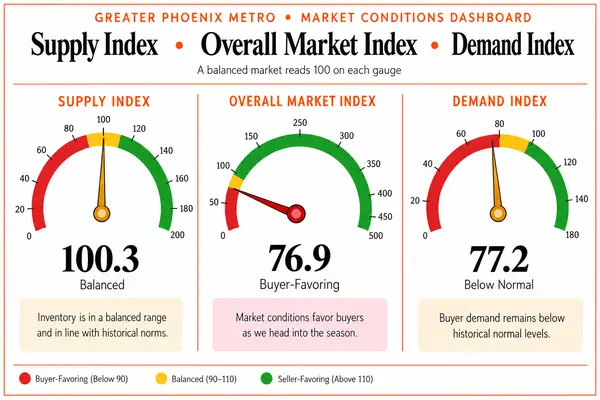
Across the metro, supply and demand trends are slowly improving in favor of sellers, though momentum remains fragile.
Some cities have moved closer to balance or mild seller conditions, while others have leaned back toward buyers in recent weeks. Larger, more central areas continue to outperform, while smaller and outer-ring markets lag.
These trends are showing up differently across the Valley, particularly between central Phoenix, Scottsdale, and West Valley submarkets.
This type of back-and-forth is typical for January. The next four to six weeks will be critical in determining whether demand strengthens enough to absorb new supply or whether buyer leverage persists into spring.
Interest Rates Are Lower — So Why Isn’t Demand Surging?
Mortgage rates are more than a full percentage point lower than a year ago, yet buyer activity remains measured. Contract ratios suggest a relatively cool market, days of inventory remain elevated, and pricing has largely stabilized rather than accelerated.
This disconnect reinforces an important reality: interest rates alone do not drive housing demand.
Some buyers are watching prices soften in real, inflation-adjusted terms and choosing patience. Others expect rates to move lower still. Broader concerns around job security, economic uncertainty, and rapid changes in technology are also influencing decision-making.
This is also why traditional metrics like Days on Market now require more interpretation than they once did. Changes in how homes are marketed — including Coming Soon strategies — mean surface-level statistics often fail to tell the full story.
Resale Homes vs. New Construction: A Meaningful Shift
One of the most important changes entering 2026 is the renewed strength of resale homes relative to new construction.
New-home closings are down sharply, while resale activity has held up far better. This marks a shift from recent years when builders dominated by controlling monthly payments through aggressive financing incentives.
Those incentives still matter. Builder-paid rates in the mid-3% to mid-4% range, along with sizable closing cost credits, can still create a monthly payment advantage resale sellers often cannot match. For buyers prioritizing predictability and lower maintenance, new construction remains compelling.
What has changed is buyer behavior. As resale pricing has softened and negotiation power has returned, buyers are no longer defaulting to new builds. Incentives are now weighed alongside location, pricing, and overall value.
New-home sales are now underperforming resales meaningfully, and new construction permits are declining. Because of this, builder behavior will be one of the most important variables to watch early in 2026.
Many builders have already begun increasing incentives, extending rate locks, and offering more flexible financing — especially for build-from-dirt buyers seeking pricing control.
Affordability Is Improving — But Condos Remain Challenged
Affordability has improved most noticeably at the lower end of the market.
Homes priced under $300,000 now represent nearly one-fifth of all active listings, with supply up meaningfully year over year. Prices in this range are down modestly and continue to drift lower.
This segment consists largely of condos and mobile homes in central Phoenix and Mesa, along with single-family homes in outer markets. While overall sales are rising, condos continue to struggle, posting one of the lowest success rates seen in nearly two decades.
Elevated HOA fees, rising insurance costs, and financing friction remain major obstacles. The issue isn’t a lack of affordable homes — it’s an aversion to compromise. Buyers want affordability without giving up location or lifestyle.
Why More Buyers Are Focusing on STRs and Tax Strategy
Interest in short-term rentals and tax-efficient real estate strategies has accelerated sharply.
Bonus depreciation returned to 100% in mid-2025, allowing qualifying property owners to fully accelerate eligible depreciation in year one when paired with a cost-segregation study. At the same time, many buyers have recently previewed projected 2025 tax liabilities, bringing these strategies back into focus.
When structured correctly, short-term rentals can provide income, tax efficiency, and control — particularly for high-income earners and business owners.
Like any tax-driven strategy, this approach isn’t one-size-fits-all. Proper structure, qualification, and timing all matter, which is why these conversations increasingly sit at the intersection of real estate and financial planning.
This shift in mindset helps explain why demand is quietly improving beneath the surface.
What I’m Watching Closely as 2026 Unfolds
Over the next several weeks, I’ll be watching how builders adjust incentives, whether resale inventory continues to be absorbed at current levels, and how buyer behavior responds as we move closer to spring. These signals tend to show up quietly before they appear in headline data and often provide the clearest insight into where the market is actually headed.
What This Means for Buyers in Early 2026
Early 2026 offers one of the more balanced buyer environments seen in years.
Inventory is higher, negotiations are active, concessions remain common, and monthly payments are meaningfully lower than a year ago. Competition still exists, but it is selective rather than overwhelming.
Buyers who are flexible on timing, structure, or location are finding the strongest leverage. Those waiting for dramatic price drops or a return to ultra-low rates may be waiting far longer than expected.
What Sellers Need to Understand Right Now
For sellers, the message is very clear. I know I’ve said it time and time again, and I’ll continue to say it — strategy matters.
Pricing must be realistic. Presentation must be strong. Concessions must be used intentionally. Homes that are positioned correctly are selling. Those that miss the mark are sitting.
Arizona sellers also have a unique advantage through Coming Soon listings. Homes can be marketed and shown for up to 30 days without accruing Days on Market — a flexibility not available in most major U.S. markets.
When used correctly, this allows sellers to build early demand, gather real buyer feedback, and launch with momentum. In today’s environment, how and when a home is launched matters just as much as price.
Final Thoughts on the Phoenix Housing Market
The Greater Phoenix housing market is entering 2026 from a stronger position than a year ago — but it is far more nuanced than a simple buyer-versus-seller narrative.
Demand is improving cautiously. Supply is rising more slowly. Affordability has improved, yet expectations remain misaligned.
The next four to six weeks will tell us a lot.
Every market move looks different at the individual level, which is why strategy should always be tailored to your specific goals and situation.
The strongest decisions in this market come from understanding the full picture.
Want to Talk Through What This Means for You?
Whether you’re buying, selling, investing, or simply trying to understand where the Phoenix housing market is headed, having a trusted real estate advisor matters more than ever in a market like this.
If you’d like to discuss the market in more detail — or how these trends apply to your specific situation — feel free to reach out. In a market this nuanced, clarity and strategy make all the difference.
About the Author
Eric Ravenscroft is a Greater Phoenix real estate advisor with a background in financial planning. He works with buyers, sellers, and investors across Arizona, focusing on market cycles, financing strategy, and long-term decision-making in changing market environments.
Categories
- All Blogs (324)
- Active Adult & 55 Plus Communities (17)
- Arizona Relocation Guides (31)
- Buyers (214)
- Financial Planning (61)
- General Real Estate (141)
- Income From Real Estate (60)
- Market Update (26)
- New Construction (29)
- News, Updates and Coming Soon (57)
- Real Estate Agent Financial Planning (22)
- Real Estate Investing (96)
- Sellers (107)
- Vacation and Short Term Rentals (45)
Recent Posts







About the Author
Eric Ravenscroft is a Top 1% REALTOR® across North America and one of Arizona’s most trusted real estate strategists. With 15 years of experience spanning real estate, wealth management, and investment planning, he helps clients make smarter, financially grounded decisions, from new construction and relocations to STR investments, 1031 exchanges, and long-term portfolio strategy.
Eric’s expertise has earned him industry recognition, Elite status with Real Broker, and features in major publications including the Wall Street Journal, MarketWatch, MSN, and Morningstar. Clients across the Greater Phoenix Metro rely on his clarity, strategic insight, and results-driven guidance.
Ready to make a confident real estate move? Call or text Eric today.