
The Palm Valley Basement & Casita: Engineered for 100% Bonus Depreciation, Cost Segregation, and STR Income
The Palm Valley Basement & Casita: Engineered for 100% Bonus Depreciation, Cost Segregation, and STR Income
A rare finished-basement, detached-casita property in Goodyear, Arizona wasn't bought as a typical Airbnb — it was acquired as a tax-engineered asset. Here's the property, the tax mechanics behind the strategy, and why this configuration beats comparable short-term rental plays in Phoenix and Scottsdale.


Heated pool and spa at 14354 W Alvarado Dr, Palm Valley — Goodyear, AZ 85395





This Goodyear, AZ property closed with a fully finished basement and a detached casita — a rare configuration that unlocks a larger cost segregation study than a typical slab home. Because the One Big Beautiful Bill Act permanently restored 100% bonus depreciation for property acquired after Jan. 19, 2025, reclassified components can be deducted in full in year one — provided the owner also satisfies the IRS's material participation rules. The result is a strategy that outperforms comparable Phoenix and Scottsdale STR purchases on rarity, tax efficiency, and exit protection at once.
Over the last several years, I've become increasingly selective about helping clients acquire short-term rental properties. Not because the opportunity has disappeared — but because in 2026, strategy matters more than the listing photos ever will.
This Palm Valley acquisition wasn't just a vacation rental purchase. It was built around five things working together: bonus depreciation, structural rarity, flexible income configurations, exit protection, and layered demand drivers. That combination is what separates speculation from strategy — and it's why this deal looks fundamentally different from a typical Phoenix or Scottsdale short-term rental purchase.
01 · The BackstoryThe Moment the Strategy Became Clear
When we started evaluating properties, we reviewed multiple options across the West Valley. Standard pool homes. Good neighborhoods. Solid comps. Something kept missing.
Then we walked into this property: a fully finished basement, a detached casita, real separation between living spaces, real flexibility. That's when the conversation shifted from "can this work?" to "this protects the downside." The client understood immediately this wasn't just an Airbnb play — it was an asset-class decision.
I still remember standing in the basement game room with the client, running through square footage on a notepad rather than a spreadsheet, because the layout mattered more than the listing sheet did. We pulled the HOA docs on-site to confirm the CC&Rs didn't restrict rentals under 30 days before we ever wrote an offer — a step that's easy to skip and expensive to regret.
02 · The PropertyA Rare Basement + Casita Configuration in Palm Valley
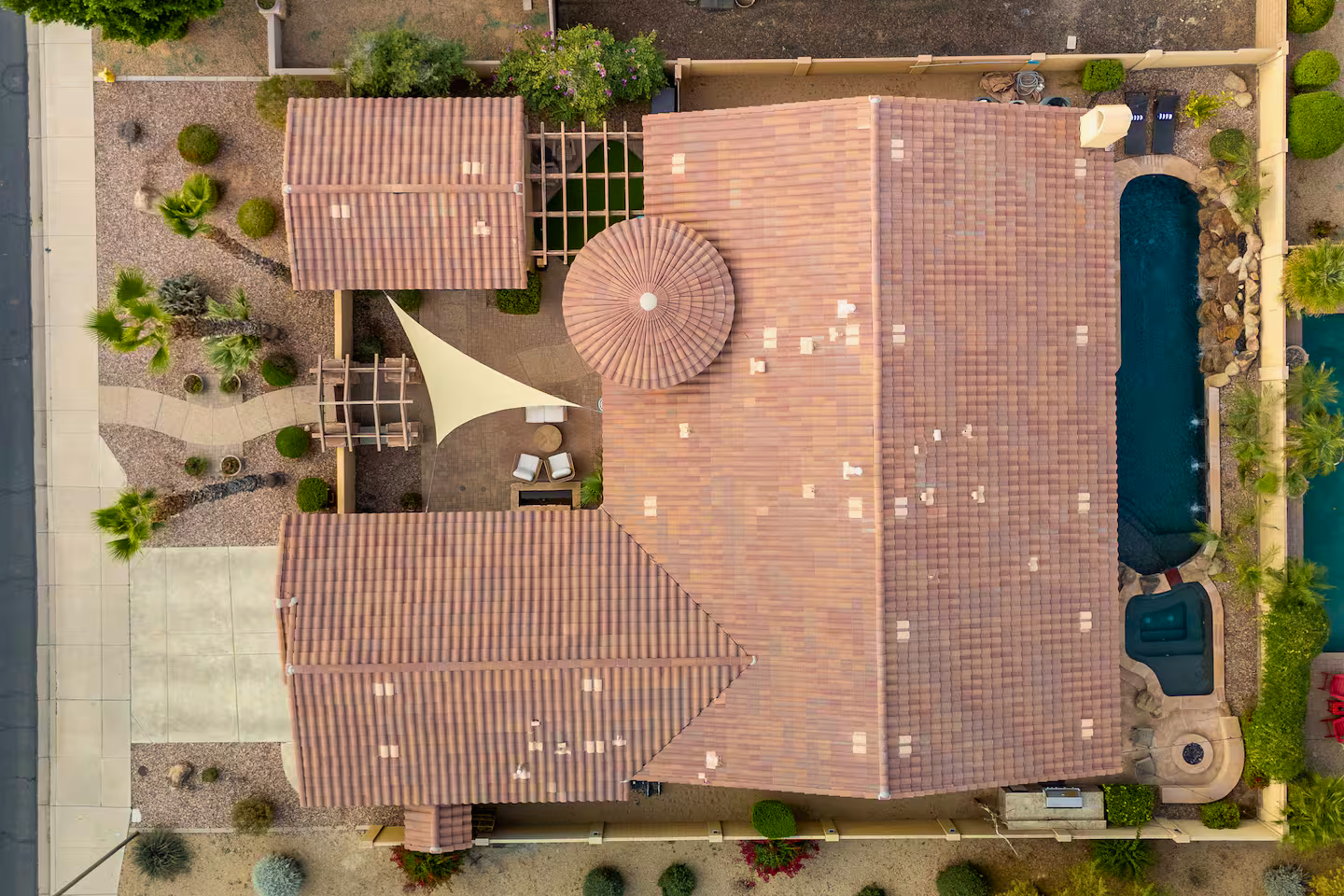
Address: 14354 W Alvarado Dr, Goodyear, AZ 85395 · Basement: Fully finished — suite, game room, lounge · Casita/ADU: Detached guest house with living room and bathroom
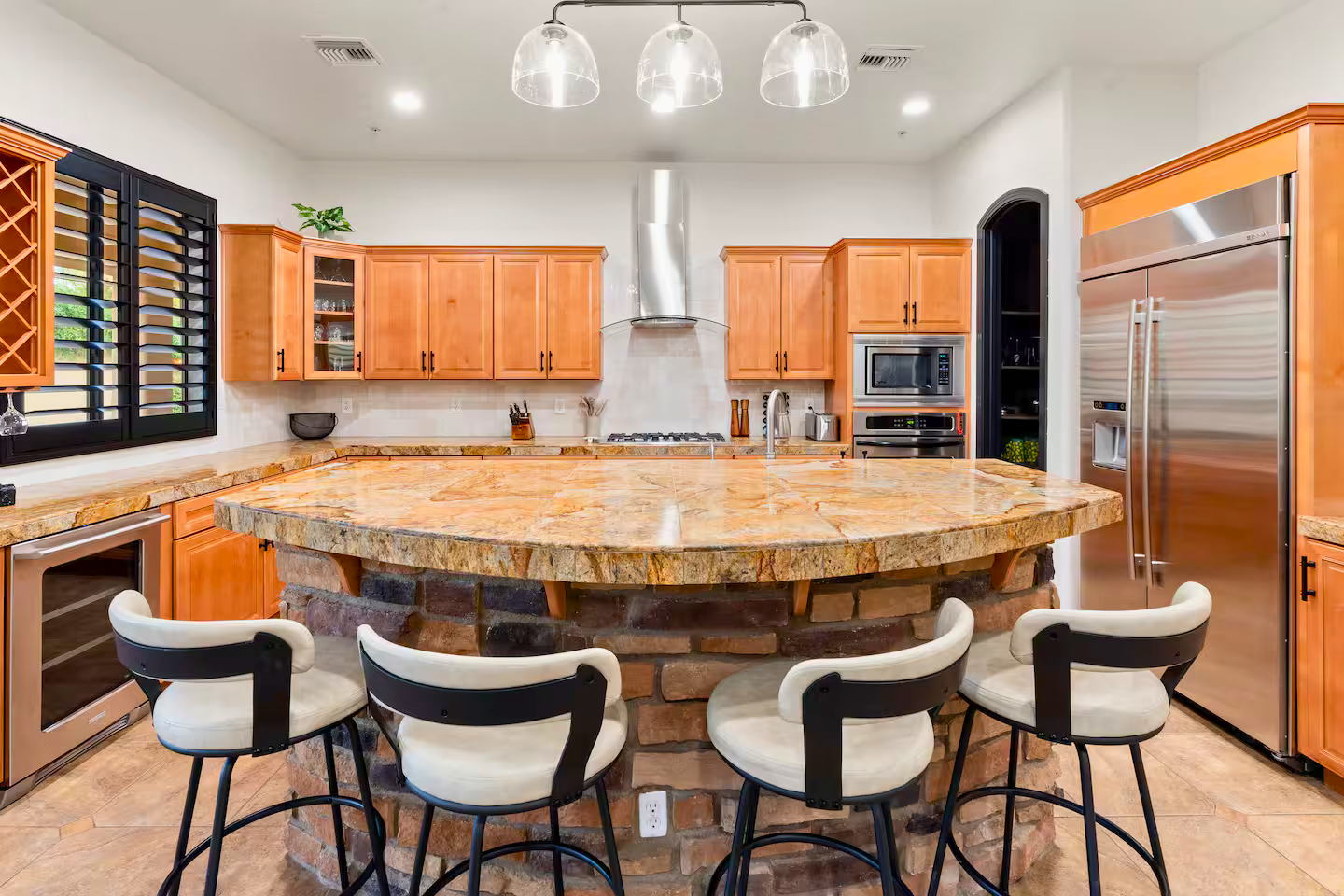
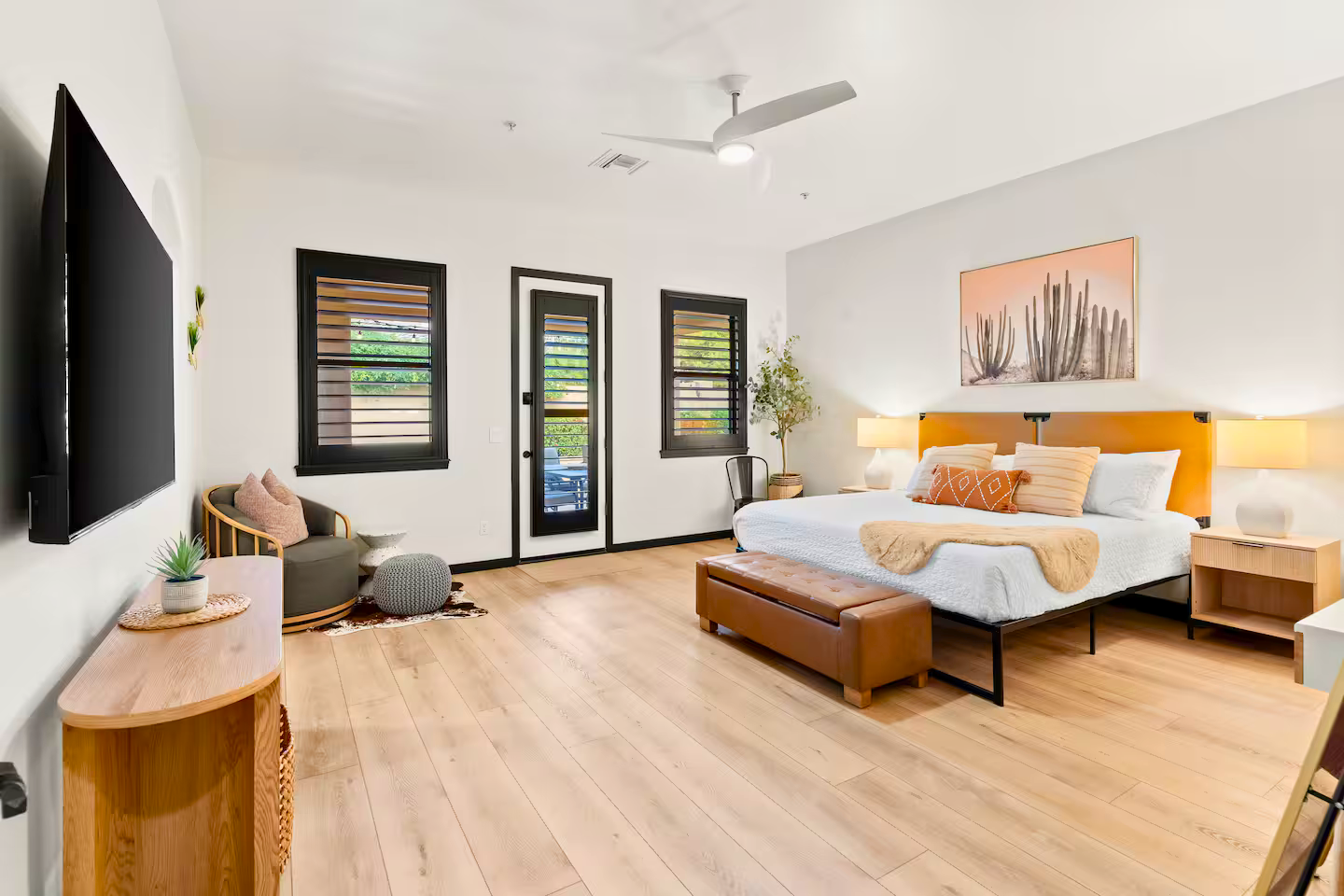
Basements in Phoenix are rare. Fully finished basements with a suite, game room, and secondary lounge are rarer still. Add a detached guest house on top of that, and you've entered a supply category most investors never see on an MLS search. This wasn't purchased as a standard vacation rental — it was acquired as a multi-use income asset with a supply story behind it.
03 · Market PositioningWhy This Is Different Than Phoenix or Scottsdale
Most STR content lumps "Phoenix metro" into one market. It isn't. Scottsdale, central Phoenix, and Palm Valley/Goodyear are three different regulatory environments, three different price points, and three different competitive landscapes.
Scottsdale
- LicensingAnnual license, $250/property, strict enforcement
- Lodging tax~14.27% combined — highest in the Valley
- Entry priceHighest per sq ft in the Valley
- HOA riskElevated — many master-planned HOAs restrict STR
- Demand driverGolf, luxury tourism, nightlife
Central Phoenix
- LicensingCity registration, enforcement varies by neighborhood
- Lodging tax~12.57% combined
- Entry priceMid-to-high, dense STR competition
- HOA riskCase by case
- Demand driverAirport, downtown events, general tourism
Palm Valley / Goodyear
- LicensingRegistration required, lower enforcement density
- Lodging taxComparable state/county rate, lower competition
- Entry priceLower basis per sq ft for comparable size
- HOA riskVerified pre-purchase as part of underwriting
- Demand driverGolf corridor + Spring Training + stadium + Luke AFB
Scottsdale and Phoenix compete on volume. This property competes on scarcity.
Scottsdale rewards operators who can absorb the highest compliance overhead and tax load in the Valley in exchange for premium ADR. Central Phoenix rewards volume operators competing in a saturated, commodity STR supply. Palm Valley's basement-and-casita configuration sidesteps both fights: the tax rate and licensing floor are the same as most West Valley cities, but the physical rarity of the asset removes it from a same-square-footage bidding war with hundreds of comparable slab homes. That's a structural advantage, not a marketing one.
04 · The BasementWhy Basements Matter in Phoenix (and Protect the Exit)
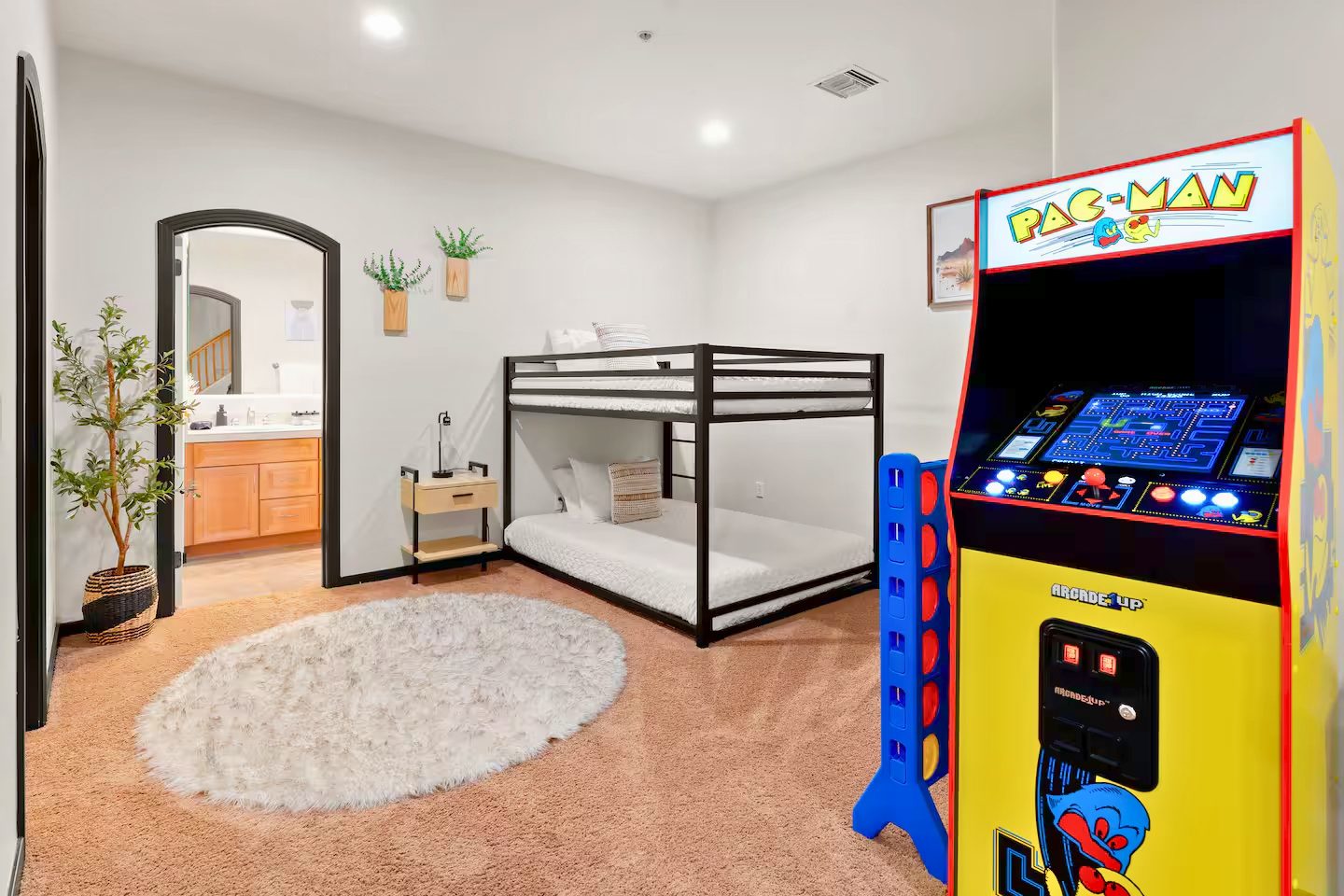
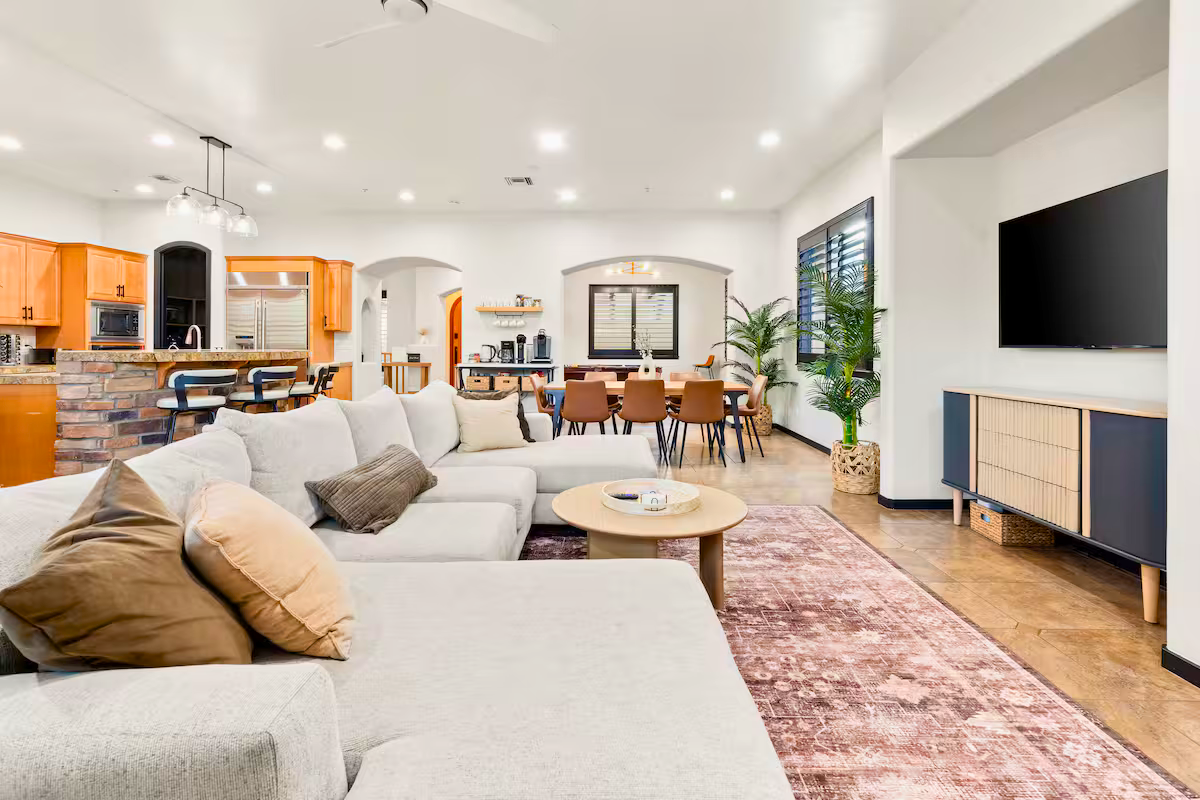
Phoenix is dominated by slab construction. Buyers relocating from the Midwest, East Coast, and Canada often want something familiar from home: a basement. From an STR standpoint, a finished basement provides natural separation for multi-family bookings, a teen/young-adult hangout zone, movie-theater potential, a game-room revenue driver, a secondary sleeping configuration, and noise separation for families with children.
From a resale standpoint, it opens the buyer pool dramatically. When it comes time to exit, you're not competing with every other 4-bedroom slab home — you're competing in a niche category. Rarity creates insulation.
05 · The CasitaMaximum STR Flexibility
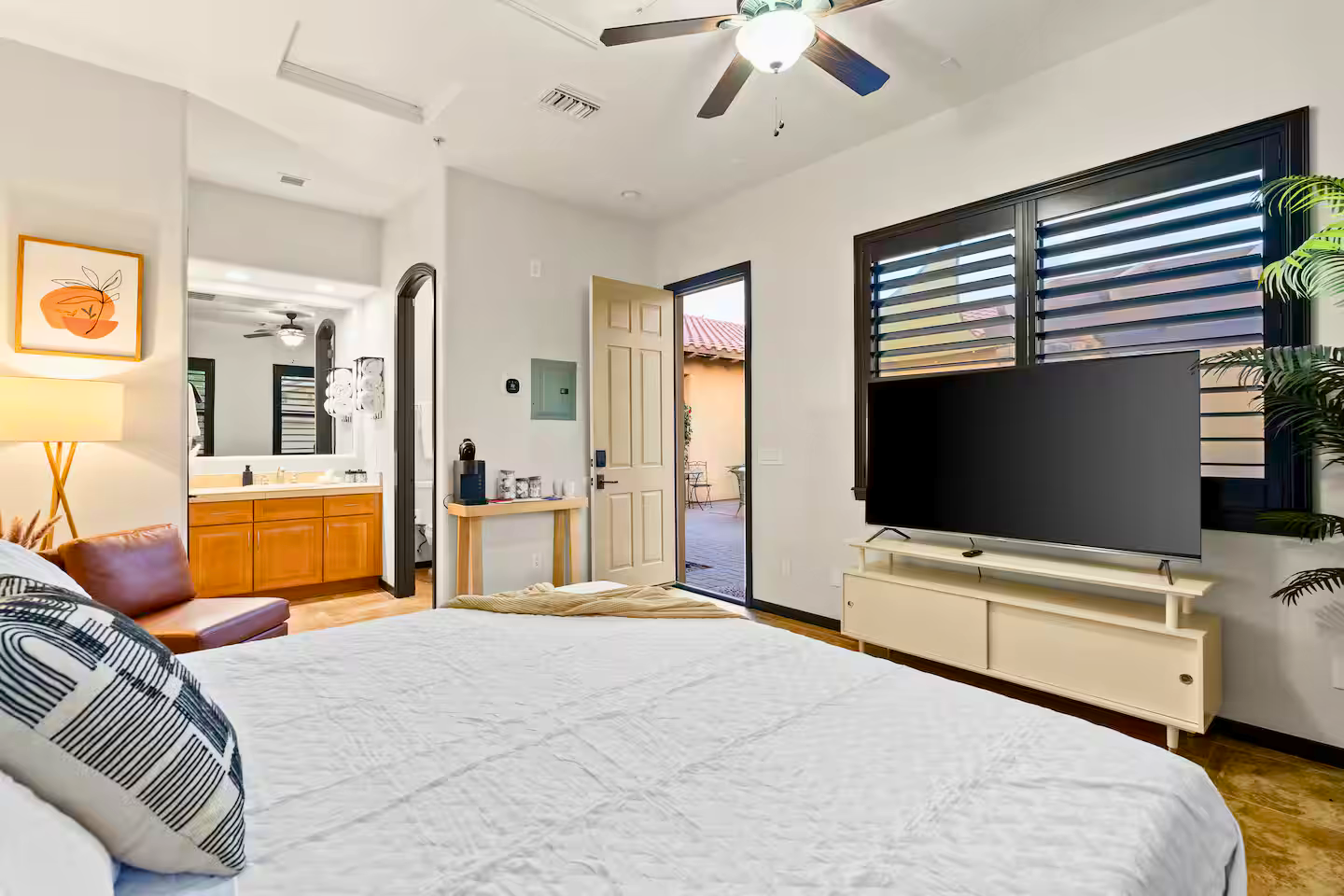
The detached guest house transforms the income strategy. This property can operate in multiple configurations:
Full-Property Rental
Main home + basement + casita for large groups, golf outings, Spring Training visitors, or wedding guests.
Split Income Streams
Main home + casita rented separately, two income streams simultaneously (subject to local compliance).
Mid-Term + STR Hybrid
Military or corporate mid-term tenant in the casita while the main home operates as a short-term rental.
Owner Lock-Off
Casita serves as a private owner suite while the main home continues renting.
Families with little ones value the separation. Grandparents appreciate the privacy. Golf groups benefit from quiet sleeping space away from the group. This is layout intelligence, not just square footage.
06 · Revenue DesignHeated Pool & Spa: Extending the Revenue Window

Palm Valley winter demand is already strong, but a heated pool extends the booking window beyond peak season. Heated water increases winter occupancy, supports premium nightly rates, reduces shoulder-season volatility, and improves review quality — all of which matter when Arizona's STR competition is this dense.
07 · Demand ThesisThe Location Thesis: Layered Demand Drivers
Features don't compound without location. Palm Valley supports this acquisition through demand drivers that stack rather than compete with one another.

-
Golf & resort corridor — Palm Valley Golf Club and proximity to The Wigwam Resort place this property inside a winter golf corridor that repeats annually — snowbirds, Canadian visitors, golf groups, and extended winter stays.
-
Spring Training access — Within roughly 15 minutes: Goodyear Ballpark, Camelback Ranch, and American Family Fields, creating a reliable March revenue spike and repeat seasonal bookings.
-
Stadium & national events — About 15–20 minutes to State Farm Stadium — Cardinals games, major concerts, Super Bowl rotations, Final Four, and the Fiesta Bowl — allow premium ADR increases.
-
Luke Air Force Base stability — Relocation demand and a mid-term rental fallback that protects against volatility in any single guest segment.
-
I-10 growth corridor — Direct connection into Phoenix and expanding West Valley employment hubs supports traveling professionals and corporate relocations.


08 · Tax StrategyBonus Depreciation, Explained in Full
Tax mechanics checked against IRS primary sources; CPA sign-off pending
Eric Ravenscroft is a real estate broker, not a tax professional. The bonus depreciation, cost segregation, and material participation mechanics below were checked directly against the Internal Revenue Code and current IRS guidance (cited in Sources). Publisher note: this section is strongest with a named, licensed reviewer — e.g. "Reviewed by [Name], CPA, [Firm]." Send that name/credential and I'll add it here and to the schema markup.
This is the mechanism most STR content gets wrong or oversimplifies, so let's slow down. Bonus depreciation (IRC §168(k)) lets an investor deduct a percentage of the cost of qualifying property in the year it's placed in service, instead of spreading that deduction over decades. Under the Tax Cuts and Jobs Act, that rate was scheduled to phase down toward zero by 2027.
The One Big Beautiful Bill Act (OBBBA), signed July 4, 2025, reversed that phase-down. As of this update, 100% bonus depreciation is permanently restored for qualifying property acquired after January 19, 2025 — with no scheduled sunset. That single change is why 2026 is a materially different environment for STR tax strategy than 2024 or 2025 was.
What this means in practice for an STR owner: the building shell itself (27.5-year residential recovery period) still doesn't qualify for bonus depreciation. But components identified through a cost segregation study — appliances, flooring, cabinetry, landscaping, pool equipment, fencing, certain electrical and plumbing components — can be reclassified into 5-, 7-, or 15-year property. In 2026, that means 100% of their value can be deducted in year one.
How the deduction lands, in round numbers
Purchase price (excl. land): $1,000,000
Typical reclassified share¹: 20%–35%
Illustrative reclassified basis (25%): $250,000
2026 bonus depreciation rate: 100%
Potential first-year accelerated deduction: ≈ $250,000
¹Varies significantly by property type, finishes, and study methodology. Simplified illustration for education, not a projection for this property or any specific taxpayer. See more worked tax strategy scenarios for how this plays out across different property types and income levels.
Two things determine whether that deduction is actually usable against your ordinary income: whether the property is used as a short-term rental with an average guest stay of 7 days or less (or 30 days or less with substantial services), and whether the taxpayer materially participates in its operation — covered below.
09 · MechanicsCost Segregation: How the Study Actually Works
Cost segregation is the engineering study that makes bonus depreciation possible on real property. Without it, a residential rental building depreciates on a straight 27.5-year schedule and nothing accelerates. With it, a qualified engineer or cost segregation firm breaks the property into components and reassigns each one to its correct IRS recovery period. For a broader look at how this fits into a full-portfolio approach, see our real estate tax savings guide.
Acquire the qualifying STR property
Confirm the placed-in-service date — this date, not the closing date, controls bonus depreciation eligibility.
Place the property into service
As a short-term rental, with records showing the date guests could first book.
Engage a cost segregation study
An engineer-based study (versus a software-only estimate) walks the property, reviews construction costs or an appraisal, and documents each component's class life.
Reclassify accelerated components
Into 5-year (appliances, carpet, furnishings), 7-year (furniture, equipment), and 15-year (land improvements — driveways, decking, fencing, landscaping) buckets.
Apply bonus depreciation
To the reclassified components at the current statutory rate — 100% for 2026 placed-in-service property.
Offset eligible income
Only to the extent IRS material participation and passive activity rules allow it — see below.
The math only works if the study is defensible. An engineer-based study with site visits, cost documentation, and IRS-aligned methodology holds up far better under audit than a desktop percentage estimate. For a property like this one — basement, casita, pool, and detached structure — the component list is larger than a standard single-story home, which is part of why this configuration has more to reclassify in the first place.
10 · The LoopholeThe STR Loophole & Material Participation
This is the part that actually makes the strategy work — and the part most short-term rental content leaves out entirely. By default, rental real estate is a passive activity, and passive losses can only offset passive income — not W-2 or business income.
The so-called "STR loophole" is really just a correct application of existing Treasury regulations: if the average guest stay is 7 days or less (or 30 days or less when you provide substantial services), the activity is not treated as a rental activity for passive-loss purposes at all. It's tested instead as a trade or business — which removes the rental real estate professional requirement. You need to materially participate in the STR itself, tested by:
- Participating more than 100 hours during the year, and no one else participates more than you do, or
- Participating more than 500 hours during the year, or
- Your participation constitutes substantially all of the participation by anyone in the activity.
Meet the average-stay test and a material participation test together, and the loss generated by 100% bonus depreciation and cost segregation can offset active income — not just other passive gains. That's the mechanism that turns a depreciation deduction into a meaningful current-year tax strategy rather than a loss carried forward indefinitely.
A property manager doing the work for you does not satisfy material participation
If a full-service property manager handles bookings, cleaning coordination, and guest communication, the taxpayer's own hours may fall short of the material participation threshold — even if the average stay length qualifies. Owners pursuing this strategy typically need to document their own hands-on involvement, tracked contemporaneously. This is one of the most heavily scrutinized areas in an IRS exam of STR losses.
This is educational information, not tax or legal advice. Bonus depreciation, cost segregation, and STR material participation rules are fact-specific and depend on your full tax picture, entity structure, and how the property is actually operated. Always work with a CPA who specializes in short-term rental taxation and a qualified cost segregation provider before relying on any of the mechanics described above.
11 · Downside ProtectionProtecting the Exit
If STR regulations changed tomorrow — and Arizona cities have been actively expanding local enforcement authority since 2022 — this property still works. Basement rarity supports resale. The casita expands the buyer pool to multi-generational and remote-work households. 4,090 square feet appeals to luxury family buyers regardless of rental use. The heated pool supports primary-residence appeal. The 3-car garage adds flex value.
Worst case: a premium Palm Valley residence with rare features. Best case: layered income and tax efficiency. That's a strategic acquisition, not a bet on a single outcome — the same thinking that shapes how we help clients build a real estate portfolio for retirement rather than a single speculative purchase.
12 · Client VoiceClient Perspective
The strategy is one thing. Execution is another. Here's what the client shared after closing — you can find more stories like this one in our client wins & case studies hub:
Eric was a fantastic agent that helped us find an investment property. He is so knowledgeable about the matter, he goes above and beyond to give us all the data. He has great communication, always keeping us in the loop. You can tell he wasn't just trying to sell a property — he tries to give us pros and cons to every option so we can make the best decision with the information available. I would trust Eric again with any future real estate needs. 10/10 recommend.
13 · FAQFrequently Asked Questions
Is bonus depreciation still 100% in 2026?+
Yes. The One Big Beautiful Bill Act, signed July 4, 2025, permanently restored 100% bonus depreciation for most qualifying property acquired after January 19, 2025, reversing the scheduled phase-down to 20% in 2026 and 0% in 2027 that existed under prior law. There is currently no scheduled sunset.
Do I need to be a real estate professional to use this strategy?+
No. Because a short-term rental with an average stay of 7 days or less (or 30 days or less with substantial services) is tested as a trade or business rather than a rental activity, the real estate professional status requirement doesn't apply. You still need to meet a material participation test for the activity itself.
How does Palm Valley compare to Scottsdale for STR investment?+
Scottsdale offers premium ADR but carries the Valley's highest combined lodging tax (~14.27%), strict licensing enforcement, a $250 annual per-property fee, and significant HOA/CC&R restriction risk in master-planned communities. Palm Valley/Goodyear carries a comparable regulatory floor with materially less competitive density for a rare configuration like a basement-and-casita property, and a lower entry price point per square foot.
What is a cost segregation study and do I need one?+
A cost segregation study is an engineering-based analysis that reclassifies components of a building into shorter IRS depreciation categories (5, 7, and 15 years) instead of the standard 27.5-year residential schedule. It's the mechanism that makes bonus depreciation available on real property, and it's generally required to substantiate the accelerated deduction on audit.
Can bonus depreciation create a loss I can use against regular income?+
Only if the property qualifies as a non-passive activity under the average-stay test and you meet an IRS material participation threshold. Otherwise, the loss is passive and can generally only offset passive income. This is the single most misunderstood part of the "STR loophole," and it's why professional guidance matters before you buy.
Why does a basement matter for resale value in Phoenix?+
Most Phoenix-area homes are built on a slab, so a finished basement is a genuinely scarce feature. That scarcity narrows the buyer's competitive set at resale, which can support value and reduce time on market compared to a standard home with no basement.
14 · Wrap-UpFinal Thoughts
This wasn't just an Airbnb purchase. It was a tax-efficient acquisition, a rarity-driven asset, a flexible income structure, a location-supported demand thesis, and an exit-protected investment. Basements are rare in Phoenix. Casitas create flexibility. Bonus depreciation and cost segregation accelerate tax efficiency — and in 2026, they do so at the full 100% rate, permanently. When combined intentionally, they create something far more durable than a typical short-term rental. They create strategy.
How this article was researched and fact-checked
Property details, configuration, and buyer feedback in this case study come from Eric Ravenscroft's direct representation of the transaction. Tax mechanics (bonus depreciation rate, material participation tests, cost segregation methodology) were checked against the primary sources below — the Internal Revenue Code, IRS notices, and Arizona statutes — rather than secondary blog commentary. Regulatory comparisons for Scottsdale and Phoenix were verified against each city's current published ordinance pages. This article is reviewed for accuracy at least annually or when tax law changes; see the dateline above.
- Internal Revenue Code §168(k), Additional First-Year Depreciation Deduction, as amended by the One Big Beautiful Bill Act (P.L. 119-21, signed July 4, 2025).
- IRS Notice 2026-11 (Jan. 14, 2026), interim guidance on bonus depreciation timing and eligibility under OBBBA.
- IRS Cost Segregation Audit Techniques Guide, irs.gov.
- Arizona Revised Statutes §9-500.39 (SB 1350, as amended by SB 1168) — state preemption of local STR bans.
- City of Scottsdale, Vacation and Short-Term Rental Ordinance — licensing, insurance, and neighbor-notification requirements.
Have a correction or a question about a source above? Email eric@theravenscroftgroup.com and we'll review it.
Related research from The Ravenscroft Group
Thinking About a Tax-Engineered STR Purchase?
Every one of these strategies depends on the right property, the right structure, and the right professionals around you. Let's talk through your numbers.
Schedule a Strategy Call →Categories
- All Blogs (324)
- Active Adult & 55 Plus Communities (17)
- Arizona Relocation Guides (31)
- Buyers (214)
- Financial Planning (61)
- General Real Estate (141)
- Income From Real Estate (60)
- Market Update (26)
- New Construction (29)
- News, Updates and Coming Soon (57)
- Real Estate Agent Financial Planning (22)
- Real Estate Investing (96)
- Sellers (107)
- Vacation and Short Term Rentals (45)
Recent Posts





About the Author
Eric Ravenscroft is a Top 1% REALTOR® across North America and one of Arizona’s most trusted real estate strategists. With 15 years of experience spanning real estate, wealth management, and investment planning, he helps clients make smarter, financially grounded decisions, from new construction and relocations to STR investments, 1031 exchanges, and long-term portfolio strategy.
Eric’s expertise has earned him industry recognition, Elite status with Real Broker, and features in major publications including the Wall Street Journal, MarketWatch, MSN, and Morningstar. Clients across the Greater Phoenix Metro rely on his clarity, strategic insight, and results-driven guidance.
Ready to make a confident real estate move? Call or text Eric today.