
Can You Afford a Home in Phoenix, Arizona in 2026? First-Time Buyers, Relocators & Downsizers — Real Options, Real Numbers
Can You Afford a Home in Phoenix, Arizona in 2026? First-Time Buyers, Relocators & Downsizers — Real Options, Real Numbers
Yes — you can still afford a home in Arizona in 2026. Buyers with household incomes as low as $60,000–$75,000 are qualifying and closing in Greater Phoenix right now, using FHA loans and Arizona's state-backed down payment assistance that requires as little as $10,000–$15,000 out of pocket. The national income thresholds you've seen in the headlines assume 20% down on a conventional loan. Most buyers don't do that. Here's the real picture.
Every few months a study circulates claiming you need $110,000 or more to afford a home in Arizona. It gets shared, goes viral, and fills my calendar with buyers who've already decided homeownership isn't for them. Most of those buyers are wrong. The study uses assumptions — 20% down, conventional financing, median price — that describe one buyer profile and misrepresent what's achievable for the majority of people actually looking to buy in Greater Phoenix right now.
This guide is written for three groups I work with every week:
I'll cover real payment scenarios at multiple income and price levels, every loan program available in Arizona in 2026, the neighborhoods where affordability is strongest, and — because it matters — an honest case for why I would not wait to act.
What Income Do You Actually Need to Buy a Home in Arizona in 2026?
The widely-cited income threshold assumes a buyer puts 20% down on a conventional loan at the statewide median price. That's a legitimate calculation — and it describes a minority of actual buyers, especially first-timers. Here's what the numbers look like across the loan types and price points most Greater Phoenix buyers are actually using.
All scenarios use a 6.5% 30-year fixed rate (current Arizona average per Freddie Mac PMMS, April 2026), estimated property taxes at 0.62%, and $100/month homeowners insurance. PMI is noted separately.
| Buyer Profile | Home Price | Loan Type | Down Payment | Est. Monthly PITI | Income Needed* |
|---|---|---|---|---|---|
| First-time buyer, FHA | $355,000 | FHA 3.5% down | $12,425 | ~$2,420 | ~$70,000/yr |
| First-time buyer, conventional | $380,000 | Conv. 5% down | $19,000 | ~$2,560 | ~$74,000/yr |
| Veteran / active military | $420,000 | VA 0% down | $0 | ~$2,730 | ~$79,000/yr |
| Move-up / relocating buyer | $465,000 | Conv. 10% down | $46,500 | ~$2,920 | ~$85,000/yr |
| Downsizer / equity buyer | $510,000 | Conv. 20% down | $102,000 | ~$2,940 | ~$85,000/yr |
*Income needed at 28% housing-to-gross-income ratio. Add ~$80–$120/mo PMI for conventional loans under 20% down. PITI = principal, interest, taxes, insurance. FHA includes MIP. Data as of April 2026.
The first row — a first-time buyer purchasing a $355,000 home with FHA — requires approximately $70,000 in annual household income. That is at or below Arizona's median household income. Homeownership is not out of reach for the median-income Arizona buyer. It requires using the right loan program and buying in the right community.
| Household Income | Loan Type & Rate | Est. Max Price | Est. Monthly PITI | Min. Cash to Close* | HOME Plus DPA Eligible? |
|---|---|---|---|---|---|
| Current market rate — 6.5% 30-yr fixed | |||||
| $55,000 | FHA 3.5% down | $265,000 | ~$1,790 | ~$4,800–$8,000 | Yes (income under $155,386) |
| $65,000 | FHA 3.5% down | $315,000 | ~$2,120 | ~$5,600–$9,200 | Yes |
| $70,000 | FHA 3.5% down | $340,000 | ~$2,290 | ~$6,000–$9,800 | Yes |
| $75,000 | FHA 3.5% down | $365,000 | ~$2,450 | ~$6,400–$10,400 | Yes |
| $80,000 | Conv. 5% down | $385,000 | ~$2,570 | ~$16,000–$20,000 | Yes |
| $90,000 | Conv. 5% down | $435,000 | ~$2,890 | ~$18,000–$23,000 | Yes |
| $100,000 | Conv. 10% down | $475,000 | ~$3,000 | ~$40,000–$50,000 | Yes |
| $120,000 | Conv. 20% down | $565,000 | ~$3,360 | ~$113,000–$128,000 | Yes (under $155,386) |
| Any (veteran) | VA — 0% down | Based on income above | Lower (no PMI) | ~$3,000–$6,000 (closing costs only) | Yes (if income qualifies) |
| New construction — builder-paid 3.99% rate — same income, lower payment, more home | |||||
| $65,000 | Conv. 5% down @ 3.99% | $380,000 | ~$2,160 | ~$16,000–$20,000 | Yes — payment $500/mo less than same price at 6.5% |
| $75,000 | Conv. 5% down @ 3.99% | $445,000 | ~$2,520 | ~$19,000–$24,000 | Yes — qualifies for ~$80K more home than at 6.5% |
| $90,000 | Conv. 5% down @ 3.99% | $530,000 | ~$3,000 | ~$23,000–$28,000 | Yes — equivalent to a $435K home at 6.5% |
| $100,000 | Conv. 5% down @ 3.99% | $590,000 | ~$3,330 | ~$26,000–$32,000 | Yes — same payment as a $475K home at 6.5% |
| $120,000 | Conv. 5% down @ 3.99% | $625,000 | ~$3,530 | ~$28,000–$35,000 | Yes — saves ~$590/mo vs. same home at 6.5% |
| $135,000 | Conv. 10% down @ 3.99% | $695,000 | ~$3,920 | ~$62,000–$72,000 | Yes — saves ~$660/mo vs. same home at 6.5% |
| $155,000 | Conv. 10% down @ 3.99% | $760,000 | ~$4,290 | ~$68,000–$80,000 | Yes — saves ~$720/mo vs. same home at 6.5% |
| $175,000 | Conv. 20% down @ 3.99% | $800,000 | ~$4,090 | ~$160,000–$175,000 | Yes (under $155,386 limit — verify) |
*Cash to close includes down payment + estimated closing costs (~2.5–3% of loan). HOME Plus DPA (up to 4% of loan, forgiven after 5 yrs) can reduce FHA upfront costs significantly. VA buyers pay closing costs only. Standard rows use 6.5% 30-yr fixed. Builder rate rows use 3.99% 30-yr fixed (builder-paid permanent buydown — available on select new construction communities in Greater Phoenix; verify availability and terms with builder at time of contract). Homes above ~$832,750 loan amount may require jumbo financing — rates and terms vary. HOME Plus income limit: $155,386 (April 2026); buyers above this limit should explore conventional financing without DPA. All figures use 0.62% AZ property tax, $100/mo insurance. Data as of April 2026.
Want your exact numbers? I'll run a personalised scenario for your income, debts, credit range, and target area — takes about 20 minutes.
Schedule a Free Buyer Strategy Call Or call/text: 480-269-5858Every Loan Program Available to Arizona Home Buyers in 2026
Your loan program is one of the most consequential decisions you'll make as a buyer. It affects your down payment, your monthly payment, your upfront cash requirements, and your long-term costs. Here is the complete landscape.
FHA Loans — best for buyers with limited savings or moderate credit
Insured by the Federal Housing Administration. Available statewide through approved lenders. 2026 FHA loan limit in most Arizona counties: $472,030.
- Minimum down payment: 3.5% with 580+ credit score; 10% with scores 500–579
- Mortgage insurance (MIP): 1.75% upfront (rolled into loan) + ~0.55%–0.85% annually on the loan balance
- Debt-to-income ratio: typically up to 43–50% with compensating factors
- Best for: buyers with 580–700 credit scores, limited savings, or higher existing debt loads
VA Loans — best for veterans, active duty, and surviving spouses
Backed by the Department of Veterans Affairs. No down payment required. No private mortgage insurance. One of the best loan products available in any market.
- Down payment: 0% required
- No PMI — saves $100–$200/month vs. a low-down-payment conventional loan
- One-time VA funding fee (1.25%–3.3%, waived for disabled veterans)
- Most lenders require 620+ credit score
- Best for: any eligible veteran, active duty member, or qualifying surviving spouse — this is almost always the best option available to those who qualify
Conventional Loans — best for buyers with stronger credit and some savings
Conforming conventional loans follow Fannie Mae / Freddie Mac guidelines. 2026 conforming loan limit in Arizona: $832,750.
- Down payment: as low as 3% (with PMI); 20% eliminates PMI entirely
- PMI cancels automatically when you reach 80% loan-to-value — unlike FHA MIP, which stays for the life of most FHA loans
- Better rates than FHA for buyers with 700+ credit scores
- Best for: buyers with 680+ credit scores who have some savings and want the clearest PMI exit path
USDA Loans — best for outer suburban and rural markets
The USDA Rural Development loan is available in many parts of Greater Phoenix's outer markets — including portions of Maricopa, Buckeye, Queen Creek, and unincorporated areas — and is frequently overlooked.
- Down payment: 0% required
- Income limits apply (generally up to 115% of area median income)
- Property must be in a USDA-eligible area — check the official USDA eligibility map before assuming
- Lower mortgage insurance than FHA
- Best for: buyers targeting outer markets who meet income limits and want 0% down with lower monthly insurance
Arizona HOME Plus Program — statewide down payment assistance
Administered by the Arizona Industrial Development Authority. No first-time buyer requirement in most cases. Over 32,000 Arizona buyers have used this program.
- Provides up to 4% of the loan amount in down payment and closing cost assistance (2026 income limit: $155,386)
- Works with conventional, FHA, VA, and USDA loans
- Structured as a forgivable second mortgage — no interest, no monthly payment, fully forgiven after 5 years (60 months). If you sell or refinance within 5 years, the DPA balance must be repaid
- Available year-round with no funding depletion risk — unlike some state programs, HOME Plus does not run out of funds
- Minimum credit score: 640 for most loan types (higher than the standalone FHA minimum — verify current minimums with an approved lender)
- Requires completion of a HUD-approved homebuyer education course before closing
- Best for: buyers with limited down payment savings who need help bridging the upfront cost gap and plan to stay in the home at least 5 years
Maricopa County Home in Five — local assistance for county buyers
For buyers purchasing within Maricopa County, which covers Greater Phoenix, Scottsdale, Chandler, Gilbert, Tempe, Mesa, Peoria, Glendale, Surprise, and more.
- Down payment and closing cost assistance; income limits apply
- Additional assistance available for qualifying military buyers
- Can be layered with state-level programs in some scenarios — ask your lender
What Does Homeownership Actually Cost Month to Month in Arizona?
The mortgage payment is only one piece. Here's the full honest picture of monthly homeownership costs on a $400,000 Phoenix Metro home — broken down so you can plan before you start shopping.
| Cost Component | Monthly (No HOA) | Monthly (HOA Community) | Notes |
|---|---|---|---|
| Principal & Interest (6.5%, 10% down) | $2,276 | $2,276 | Fixed for life of loan |
| Property Taxes (~0.62%) | ~$207 | ~$207 | ~$2,480/yr; among lowest rates in U.S. |
| Homeowners Insurance | ~$100 | ~$100 | ~$1,200/yr avg; verify with insurer |
| HOA Dues | $0 | $80–$200 | Master-planned communities typically $80–$160/mo |
| Maintenance Reserve (1%/yr) | ~$333 | ~$333 | Budget ~1% of home value annually |
| Estimated Total | ~$2,916 | ~$2,996–$3,116 |
Based on $400,000 purchase, 10% down, 6.5% 30-year fixed, 0.62% property tax, $1,200/yr insurance. PMI of ~$80–$100/mo applies to conventional loans under 20% down until 80% LTV. Data as of April 2026.
Compare that to renting a comparable 3-bedroom home in the same suburban Phoenix markets: $2,000–$2,400/month currently, with zero equity accumulation, no tax benefit, and full exposure to annual rent increases. For buyers with a 3–5 year horizon, the math typically favors ownership — especially at the lower end of the price range.
Two Arizona-specific cost advantages worth understanding:
- Property taxes. At ~0.62%, Arizona's effective rate is nearly half the national average. On a $400,000 home that's roughly $1,920/year less than a national-average-rate state — and dramatically less than Texas (1.80%), Illinois (2.2%), or New Jersey (2.5%+).
- State income tax. Arizona's flat 2.5% rate compares favorably to California's top rate of 13.3%, New York's 10.9%, and Illinois's 4.95%. For a household earning $120,000, moving from California to Arizona saves roughly $12,000/year in state income tax alone. That's housing-payment money sitting in your pocket.
Your Situation Specifically: First-Time Buyers, Relocators & Downsizers
If you're a first-time buyer
The most important thing to understand: you almost certainly do not need 20% down, and you likely don't need as much income as the national studies suggest. Here's what the actual path looks like.
Single buyer, $74,000/year income, 682 credit score. Used FHA financing with 3.5% down ($12,950) on a $370,000 townhome in Mesa. Paired with HOME Plus assistance, which covered most of the closing costs. Total out-of-pocket at closing: ~$14,200. Monthly payment including taxes, insurance, and HOA: $2,510. Previous rent: $1,920. The monthly delta is about $590 — offset by the mortgage interest deduction and the elimination of annual rent increases. Building equity from day one.
For first-time buyers, the strongest opportunities in 2026 are in the $330,000–$420,000 range in the West Valley (Buckeye, Goodyear, Surprise) and outer East Valley (Queen Creek, San Tan Valley, Apache Junction, Maricopa). These markets have the best combination of price accessibility, active new construction with builder incentives, and buyer-favorable conditions entering spring 2026.
The single most important first step: get pre-qualified before you do anything else. Not pre-approved — just a 20-minute phone call with a trusted lender to understand your actual numbers. Many buyers assume they won't qualify and never take the step. Most are surprised by what's possible. My preferred lenders are familiar with every Arizona assistance program and will give you a straight answer quickly.
If you're relocating from California, Washington, Colorado, or another high-cost state
For relocating buyers — particularly from California, Washington, Colorado, Oregon, New York, or Chicago — the conversation isn't really about affordability in the traditional sense. It's about what your existing equity and income actually do when you land here.
Couple relocating from Orange County. Sold their home at $985,000 after 12 years. After mortgage payoff, they had ~$620,000 in equity. Purchased a 4BR/3BA home in Peoria for $512,000 in cash. Invested the balance. Previous California PITI: $6,200/month. Arizona carrying costs: under $700/month (taxes, insurance, HOA). That's not a small upgrade. That's a financial restructuring.
Here's what your money does differently in Arizona vs. the markets my relocating clients are leaving:
| Cost Factor | Los Angeles | Seattle | Chicago | Phoenix Metro |
|---|---|---|---|---|
| Median Home Price | ~$880,000 | ~$810,000 | ~$340,000 | ~$430,000–$450,000 |
| Est. Monthly PITI (20% down) | ~$5,200+ | ~$4,800+ | ~$2,800+ | ~$2,700–$2,900 |
| Effective Property Tax Rate | ~1.25% | ~1.00% | ~2.20% | ~0.62% |
| State Income Tax (top rate) | 13.3% | 0%* | 4.95% | 2.5% flat |
| Homeowners Insurance (avg/yr) | $1,800–$3,500+ | ~$1,200 | ~$2,000+ | ~$1,200–$1,500 |
*Washington has no income tax but higher property taxes. Comparisons approximate. Data as of April 2026.
For California buyers: selling a $750,000–$1.1M home and purchasing in Phoenix often means doubling your square footage at half the monthly cost — and freeing up six figures in equity to invest or save. I also work extensively with investment property owners doing 1031 exchanges into Arizona to defer capital gains while repositioning into a lower-cost, high-growth market. If that describes your situation, that's a separate and important conversation.
If you're downsizing
Downsizers — whether moving within the Valley from a larger Scottsdale or Paradise Valley home, or arriving from a high-cost state and right-sizing — are in an enviable position. You're bringing substantial equity and looking for something more manageable, lower-cost to carry, and simpler to maintain.
Empty-nesters in their late 50s. Sold 4,200 sq ft in North Scottsdale for $1.35M. Purchased a 2,100 sq ft lock-and-leave home in Peoria for $620,000 — cash. Previous carrying costs (taxes, insurance, utilities, HOA, pool service): over $3,200/month. New carrying costs: under $1,100/month. They freed up $730,000 in equity, cut monthly overhead by over $2,000, and eliminated the maintenance burden. Two years ahead of their retirement plan.
For downsizers approaching or in retirement, Arizona's tax structure adds a layer of financial advantage that rarely gets mentioned in real estate conversations — but should be part of your planning:
- Social Security income is 100% exempt from Arizona state income tax. For retirees relying on Social Security, this is a meaningful difference vs. states that partially or fully tax it.
- Military retirement pay is 100% exempt from Arizona state income tax (effective from tax year 2021 forward).
- Arizona's flat 2.5% income tax rate applies to IRA, 401(k), and pension withdrawals — one of the lowest rates in the country for retirement income.
- No estate tax or inheritance tax. Arizona eliminated both, making it straightforward to pass property to heirs.
- Senior Property Valuation Protection Program. Arizona homeowners age 65+ who meet income and residency requirements can freeze their home's assessed value for three years, protecting against property tax increases tied to appreciation. This is a meaningful benefit in a rising market.
- New 2026 federal senior tax deduction. Legislation effective 2026–2028 provides a non-refundable deduction of $6,000 (single) or $12,000 (married) that shields more Social Security income from federal taxes for middle-income retirees (phases out at $75,000/$150,000 AGI).
For downsizers coming from California, Illinois, New York, or other high-tax states, the combination of lower home prices, Arizona's tax advantages, and reduced carrying costs often produces a retirement financial picture that's dramatically more sustainable than staying put.
For downsizers, community type matters as much as price. New construction communities offer low-maintenance lock-and-leave living with modern finishes and active adult options. The West Valley offers the best size-for-dollar in established master-planned communities. The East Valley offers walkability and lifestyle amenities for those who want proximity to dining, recreation, and healthcare.
Where to Buy in Greater Phoenix: City-by-City Guide for 2026
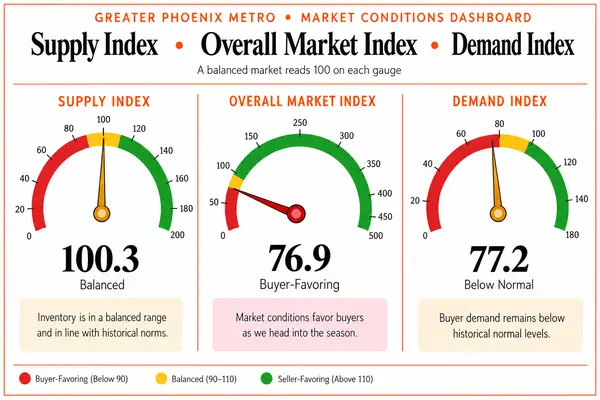
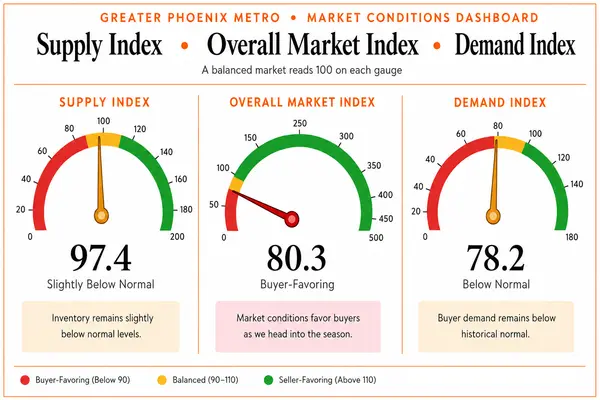
Greater Phoenix is not one market. Price points, competition levels, commute dynamics, and buyer demographics vary significantly across the Valley. Market index data as of March 26, 2026 — above 110 = seller's market; 90–110 = balanced; below 90 = buyer's market.
How Much Are Closing Costs in Arizona? Your Full Upfront Budget
Closing costs are the most commonly underestimated part of buying a home — and a leading reason first-time buyers feel blindsided at the finish line. Here's the honest breakdown of what you'll need beyond your down payment in Arizona.
Arizona closing costs for buyers typically run 2%–5% of the purchase price, with one notable advantage over most states: Arizona charges no state real estate transfer tax — a fee that adds $2,000–$8,000 to closings in many other states. Here's what your budget needs to account for:
| Closing Cost Item | Typical Range | Notes |
|---|---|---|
| Loan origination fee | 0.5%–1% of loan | Lender's processing charge; shop multiple lenders |
| Appraisal fee | $500–$700 | Required by lender to confirm home value |
| Home inspection | $350–$550 | Strongly recommended; paid before closing |
| Title insurance (lender + owner) | $1,200–$2,200 | One-time fee; protects lender and buyer from title defects |
| Escrow / closing service fee | $500–$900 | Title company coordinates the closing in Arizona |
| Prepaid interest | Varies | Interest from closing date to end of first month |
| Prepaid homeowners insurance | ~$1,200 | First year's premium due at closing |
| Property tax escrow | 2–3 months of taxes | ~$500–$700 on a $400K home at 0.62% |
| Recording fees | $20–$50 | County fee to record the deed |
| Transfer tax | $0 | Arizona has no state real estate transfer tax — a significant advantage |
| Total buyer closing costs (estimate) | ~$8,000–$18,000 | On a $350K–$450K purchase; varies by loan type and lender |
Estimates based on a $350,000–$450,000 purchase price, conventional or FHA financing. FHA adds a 1.75% upfront MIP (typically rolled into the loan). Data as of April 2026. Sources: Rocket Mortgage Arizona Closing Costs Guide, Arizona Department of Revenue.
How to reduce your closing costs
- Negotiate seller concessions. In the current Greater Phoenix market, a significant share of transactions include seller-paid closing cost credits. In buyer-favoring submarkets like Buckeye, Goodyear, and Surprise, asking for 2%–3% of the purchase price in closing cost credits is both reasonable and commonly accepted. This can cover the majority of your closing costs entirely.
- Use Arizona HOME Plus DPA. The HOME Plus program's up-to-4%-of-loan assistance can be applied to both the down payment and closing costs. On a $370,000 FHA loan, that's up to $14,800 available — enough to cover most or all of the closing cost burden for many buyers. Assistance is structured as a forgivable second mortgage, fully forgiven after 5 years.
- Builder incentives on new construction. Many Greater Phoenix builders are currently offering closing cost credits of $10,000–$20,000 on select communities alongside rate buydowns. New construction buyers who work with an experienced buyer's agent — at no cost to the buyer — can often negotiate these incentives on top of the base price.
- Shop lenders. Origination fees and lender-side charges vary meaningfully between lenders. Getting quotes from 2–3 lenders (within a 14-day window to minimize credit score impact) can save $1,000–$3,000 in lender fees alone.
Should You Rent or Buy in Arizona in 2026? The Real Math
"Is it cheaper to rent or buy in Phoenix right now?" is one of the most-searched real estate questions in Arizona — and most answers you'll find give you a surface-level monthly comparison that misses the bigger picture. Let me show you both.
The month-to-month snapshot
Yes — right now, the monthly cost of renting a comparable property is often lower than buying one in the same market. Here's what that comparison looks like honestly:
| Scenario | Monthly Cost | Equity Built | Rate Risk |
|---|---|---|---|
| Renting a 3BR home in West Valley (e.g., Surprise) | ~$2,000–$2,200 | $0 | Rent increases ~5%/yr historically |
| Buying a $380K home, 5% down, 6.5% rate | ~$2,560 PITI + HOA | ~$8,400 in year 1 (principal + appreciation) | Payment fixed for 30 years |
| Buying $355K with FHA + HOME Plus DPA | ~$2,420 PITI | ~$7,700 in year 1 | Payment fixed; refinanceable |
The renter pays $300–$500 less per month today. But that's only part of the equation.
The 5-year picture — where renting falls apart
The rent vs. buy decision only makes sense over time. Here's the 5-year trajectory on a $370,000 home purchase vs. renting a comparable property at $2,100/month with 5% annual rent increases, assuming 2% annual home appreciation (conservative for Phoenix).
By year 5, a buyer who purchased a $370,000 home with 5% down has accumulated roughly $55,000–$70,000 in home equity through principal paydown and conservative appreciation. The renter has $0 in housing equity — and is now paying roughly $2,680/month in rent vs. the owner's fixed payment of $2,560.
The break-even point — where the cumulative cost of ownership falls below the cumulative cost of renting — typically occurs somewhere between years 2 and 4 in the current Phoenix market, depending on the specific price point, down payment, and rent comparison. For buyers with a 3–5 year horizon, ownership is typically the financially superior outcome. For buyers planning to stay less than 2 years, renting may be the better choice.
One additional factor not captured in the chart: payment stability. Your $2,560/month principal and interest payment is fixed for 30 years. Your renter neighbor's $2,100 payment becomes $2,205 next year, $2,315 the year after, and $2,680 by year 5 — assuming a historically modest 5% annual increase. By year 7, the renter is paying more per month than the buyer, with no equity to show for it.
Why I Would Not Wait: The Forces That Will Close This Window
Affordable options exist today. I also want to be direct: the conditions creating those options are not permanent. Here are the three forces actively narrowing the window, and why I advise buyers to act rather than wait.
Migration from high-cost states is accelerating, not slowing
Arizona added 67,000+ net new residents in 2025, with Phoenix absorbing the majority. They're arriving from California, Washington, Colorado, Oregon, New York, Chicago, and every other place where housing costs, state income taxes, or overall cost of living have become untenable. Many arrive with substantial equity — buying at or above asking price, sometimes in cash — and they're competing for the same inventory you're looking at. Every quarter you wait is a quarter more of them arrive. The migration math doesn't favor the patient local buyer.
Job and wage growth is creating a new class of buyers
TSMC's $165 billion Arizona investment — the largest foreign direct investment in U.S. history — is only the most visible piece. Intel's Chandler campus, Microsoft's West Valley data centers, the financial services cluster (American Express, JPMorgan Chase, Vanguard, USAA), and rapid healthcare system expansion are collectively adding thousands of high-wage positions. Many of the workers filling those roles haven't relocated yet. They will. High-wage job growth raises the ceiling on what buyers in this market can pay — which supports and eventually lifts prices across the board, including in the entry-level segments where today's first-time buyers are shopping.
Investor activity is returning and absorbing inventory
After pulling back through 2023 and 2024, sophisticated investors are re-entering the Phoenix market — driven by the return of 100% bonus depreciation for qualifying short-term rental properties and improving long-term rental fundamentals. Investors absorb available inventory without adding to supply. Their return tightens the market for owner-occupant buyers without creating offsetting new listings. The practical effect over the next 12–18 months: fewer options and less negotiating room.
As of my March 2026 market update, contracts are up 10% year over year and new listings are down 7%. Inventory growth has stalled. The overall market index of 82.9 still technically favors buyers — but the direction is what matters. The buyer-favorable conditions of today exist in the gap between where demand is and where it's clearly heading. That gap is closing.
How to Get Started: A Step-by-Step Action Plan
The home buying process is less complicated than most first-time buyers fear — but doing it in the right order matters significantly. Here's the sequence that sets buyers up to succeed.
-
1Check your credit score first — before anything else.Pull a free report at AnnualCreditReport.com. Your credit score determines which loan programs you qualify for, what interest rate you'll receive, and whether you need time to improve your profile before applying. Targets: 580+ for FHA, 620+ for conventional, 700+ for the best conventional rates. Even a 40-point improvement from 660 to 700 can save $50–$80/month over the life of the loan.
-
2Know your debt-to-income ratio before you call a lender.Add all monthly debt payments (car, student loans, credit cards, personal loans). Divide by gross monthly income. Most lenders want this under 43–50% including your future mortgage. This number defines your buying power before you ever see a home.
-
3Get pre-qualified before you look at a single home.A pre-qualification call takes 20–30 minutes. You'll provide income, debts, assets, and credit range — the lender gives you a realistic estimate of what you can borrow and which programs you qualify for, including down payment assistance. This costs nothing and tells you everything. Do this before you fall in love with a home you can't afford.
-
4Specifically ask about HOME Plus and down payment assistance.Ask your lender directly: "Do you originate HOME Plus loans?" Not all lenders participate. This one question could save you tens of thousands of dollars in upfront costs. If your lender doesn't offer it, find one who does. My preferred lenders know every available Arizona assistance program.
-
5Define your priorities before you tour anything.Commute requirements, school districts, bedroom count, garage, community amenities, and maintenance tolerance. In neighborhoods where well-priced homes are going under contract after the first weekend of showings, knowing your criteria before you see a home you love prevents hesitation-based losses.
-
6Work with an advisor who knows submarket-level nuances.The difference between overpaying and negotiating $15,000 in seller concessions often comes down to your agent's familiarity with neighborhood-level data, builder incentive structures, and offer strategy. In a market where Chandler is at a 154.5 market index and Buckeye is buyer-favoring, generic advice actively hurts buyers.
-
7Get fully underwritten pre-approval before making an offer.Once you've found the right home, a fully underwritten pre-approval — where the lender has already verified your income documents, bank statements, and credit — is meaningfully stronger than a standard pre-qualification letter. In competitive corridors, this can be the deciding factor between an accepted offer and a lost deal.
The Most Common Myths About Arizona Home Affordability in 2026
Frequently Asked Questions: Arizona Home Affordability 2026
The Bottom Line: The Opportunities Are Real — And So Is the Clock
Homeownership in Greater Phoenix is within reach for a wider range of buyers than the national headlines suggest. First-time buyers at $65,000–$80,000 in household income are qualifying and closing using FHA loans and Arizona's down payment assistance. Veterans are buying with zero down. Relocating buyers from California, Washington, Colorado, and the Northeast are finding that their equity goes dramatically further here. Downsizers are freeing up hundreds of thousands of dollars while cutting monthly carrying costs in half.
The opportunities are real, specific, and in front of you right now.
What I'm also being direct about: the conditions creating those opportunities — the seller concessions, the negotiating room, the builder incentives, the days on market that allow a first-time buyer to make a thoughtful decision — are products of a market still healing from 2022–2023. That healing is nearly complete. The migration wave isn't slowing. The job growth is accelerating. The investors are returning. The window that currently allows a $70,000-income buyer to negotiate seller concessions and get into a well-priced home with builder assistance doesn't stay open indefinitely.
Buy within your means. Use the right loan program. Get pre-qualified before you look at a single home. The right opportunities exist right now. The question is whether you act on them while they're still available to you.
Let's Find Out What You Can Actually Afford
In 30 minutes I can walk you through exactly what's available at your price point, what your real monthly payment looks like across multiple loan scenarios, and which programs can reduce your upfront costs. No pressure — just real numbers built around your situation.
Schedule a Free Buyer Strategy CallOr call/text directly: 480-269-5858

Eric Ravenscroft is the owner of The Ravenscroft Group at Real Broker and one of Greater Phoenix's most trusted real estate advisors. With a background as a former Director of Wealth Management, Eric brings a financial planning perspective to every transaction — helping first-time buyers, relocating families, investors, and downsizers make confident, data-driven decisions. He specializes in new construction, California-to-Arizona relocations, 1031 exchanges, and short-term rental investment strategy.
Full bio and credentials → · More market insights →
Related reading from The Ravenscroft Group
Categories
- All Blogs (321)
- Active Adult & 55 Plus Communities (16)
- Arizona Relocation Guides (30)
- Buyers (211)
- Financial Planning (60)
- General Real Estate (139)
- Income From Real Estate (59)
- Market Update (26)
- New Construction (28)
- News, Updates and Coming Soon (57)
- Real Estate Agent Financial Planning (22)
- Real Estate Investing (94)
- Sellers (106)
- Vacation and Short Term Rentals (45)
Recent Posts







About the Author
Eric Ravenscroft is a Top 1% REALTOR® across North America and one of Arizona’s most trusted real estate strategists. With 15 years of experience spanning real estate, wealth management, and investment planning, he helps clients make smarter, financially grounded decisions, from new construction and relocations to STR investments, 1031 exchanges, and long-term portfolio strategy.
Eric’s expertise has earned him industry recognition, Elite status with Real Broker, and features in major publications including the Wall Street Journal, MarketWatch, MSN, and Morningstar. Clients across the Greater Phoenix Metro rely on his clarity, strategic insight, and results-driven guidance.
Ready to make a confident real estate move? Call or text Eric today.