
Phoenix Housing Market Update 2026: Demand Is Improving, Builder Incentives Are Changing, And Momentum Is Beginning to Shift

By Eric Ravenscroft, Real Estate Advisor & Financial Planning Specialist serving the Greater Phoenix Metro
The Greater Phoenix housing market rarely changes direction all at once.
Instead, transitions tend to appear gradually — first through buyer behavior, then inventory movement, and eventually pricing trends. By the time headlines recognize a shift, market participants are often already adapting.
As we move deeper into 2026, several indicators suggest the Phoenix housing market may be entering one of those transitional periods.
Demand is improving, inventory growth is stabilizing, builder strategy is evolving, and investor activity is quietly returning ahead of the spring buying season.
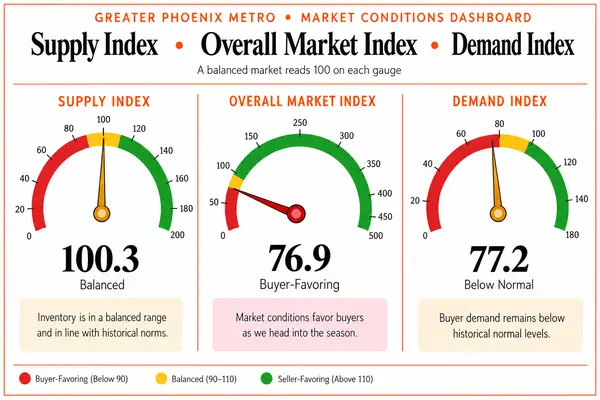
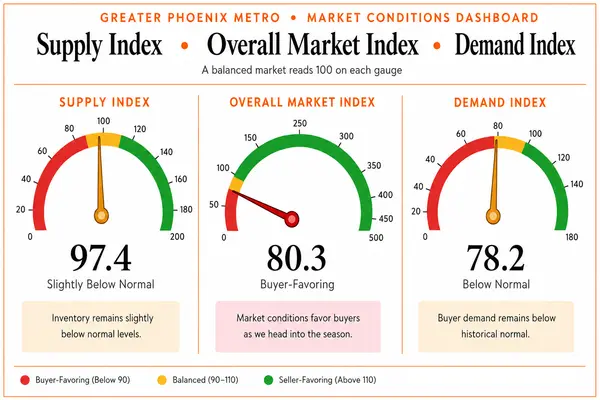
While overall conditions still lean modestly toward buyers, the underlying story unfolding across the Valley is far more balanced than many assume.
Where the Phoenix Housing Market Stands Right Now
Across much of Greater Phoenix, buyers continue to benefit from increased housing selection compared to recent years. Inventory levels remain healthy, negotiation flexibility still exists, and homes generally require stronger positioning to attract offers.
However, market momentum has begun shifting subtly.
Mortgage rates stabilizing near the 6% range have introduced predictability back into buyer decision-making. Rather than triggering a surge in activity, this stability has encouraged cautious but steady re-engagement.
Contracts entering escrow have risen modestly compared to earlier weeks this year, signaling improving participation as the market approaches its historically strongest transaction window between February and May.
Buyers are returning — just with greater discipline than during previous cycles.
Inventory Trends Suggest the Market May Be Stabilizing
Seasonally, listing inventory expands early in the year before demand begins absorbing available homes heading into spring.
Recent trends suggest active listings may have already approached their seasonal peak earlier than expected. When supply growth slows while buyer engagement improves, markets often begin transitioning toward balance.
This does not immediately create seller leverage, but it typically reduces widespread price reductions and improves transaction velocity for properly positioned homes.
The rapid movement toward buyer advantage seen earlier in 2026 now appears to be moderating.
How Different Phoenix-Area Cities Are Performing
One of the defining characteristics of today’s housing environment is how differently local markets are behaving.
Currently, approximately ten cities across Greater Phoenix remain seller-leaning, while two markets are operating near balance, and roughly six continue favoring buyers.
Communities such as Paradise Valley, Cave Creek, and Avondale maintain stronger seller positioning due to relatively constrained resale inventory.
Meanwhile, cities including Buckeye, Goodyear, Surprise, Scottsdale, Maricopa, and Fountain Hills have shifted more toward buyers, largely as a result of elevated inventory following several years of aggressive development and new construction expansion.
Importantly, these buyer-leaning conditions are not primarily demand-driven declines. Many of these markets are experiencing healthy activity — supply has simply expanded faster than absorption.
This reinforces an increasingly important reality:
There is no single Phoenix housing market. Outcomes depend heavily on location, pricing strategy, and neighborhood-level competition.
Investor Demand Is Returning — Especially Around Short-Term Rentals
One of the more notable developments in recent weeks has been renewed investor engagement, particularly among high-income buyers evaluating income-producing real estate.
A growing share of inquiries has centered on short-term rental (STR) opportunities.
Under current tax law, qualifying short-term rental properties may allow investors to utilize 100% bonus depreciation, enabling eligible owners — when structured correctly with professional guidance — to accelerate depreciation deductions in the first year of ownership.
As many investors reassess recent tax liabilities, real estate is increasingly viewed not only as an appreciation asset but also as a tool for income generation and tax efficiency.
This renewed activity has already begun absorbing portions of available inventory and contributing to improving market momentum beneath the surface.
(For a deeper breakdown, see my guide on Short-Term Rental Tax Strategy in Arizona.)
Improving Affordability Is Supporting Buyer Re-Engagement
Affordability conditions have improved more than many buyers realize.
Moderate pricing adjustments combined with lower mortgage rates compared to early 2025 have reduced monthly payment requirements across much of the Phoenix market below the $800,000 price range.
For many households, a home carrying a payment near $2,500 last year may now fall closer to approximately $2,150 per month under current conditions.
Rather than occurring suddenly, purchasing power has improved gradually — often influencing buyer behavior before sentiment shifts publicly.
This incremental improvement is playing a meaningful role in renewed buyer participation.
Rental Supply Is Tightening Across Maricopa County
Another under-recognized factor supporting housing demand is declining rental inventory.
Available rental listings — particularly single-family homes — have fallen significantly since late last year across Maricopa County. While apartment availability remains elevated, detached rental supply has tightened noticeably.
Historically, shrinking rental inventory begins encouraging renters to reconsider ownership once financing stability improves.
This transition often strengthens purchase demand heading into peak seasonal activity.
Builders Are Beginning to Scale Back Incentives
Builder behavior is also beginning to change.
Over the past two years, new construction demand relied heavily on aggressive incentives, including discounted design upgrades, closing cost assistance, and below-market financing programs.
Recently, several builders announced reductions or expiration of major promotions. Build-from-dirt incentives offering up to 50% off design center options have ended in some communities, while certain rate buy-down programs have also concluded.
Improving mortgage rate stability appears to be allowing builders to rely less on costly incentives while managing rising construction and financing expenses.
For buyers, this suggests today’s incentive environment may not remain indefinitely.
For resale sellers, reduced builder concessions narrow one of the largest competitive advantages new construction previously held.
Builder strategy often shifts before broader resale market conditions follow.
What This Market Means for Buyers
Buyers continue to operate in an environment offering choice, negotiation flexibility, and improved monthly payments compared to last year.
However, strengthening demand, tightening rental supply, and moderating builder incentives suggest competition may gradually increase as spring progresses.
Prepared buyers who remain flexible on location continue uncovering strong opportunities — particularly within growth markets still balancing elevated inventory.
Waiting for dramatically lower prices or materially lower interest rates may provide limited additional benefit.
What This Market Means for Sellers
For sellers, market conditions have improved compared to 2025, though execution remains essential.
Today’s buyers prioritize overall value, condition, and move-in readiness. Homes positioned competitively from launch continue attracting offers, while aspirational pricing strategies often require adjustment.
As builder incentives normalize, resale properties regain competitive positioning — particularly in established communities where location advantages remain strong.
Preparation and pricing discipline continue to outweigh attempts at timing the market.
The Outlook for Phoenix Real Estate Heading Into Spring 2026
Taken together, current trends point toward normalization rather than instability.
Demand is rebuilding incrementally.
Inventory pressures are easing.
Affordability has improved.
Builder competition is recalibrating.
What we are seeing is not a sudden market reversal, but a steady evolution in momentum.
Housing markets rarely signal turning points clearly in real time — they reveal them through behavior first.
Early indicators suggest the Greater Phoenix housing market may be entering its next phase with stronger underlying stability than many expected.
For buyers and sellers alike, informed strategy continues to outperform attempts at timing the market.
The strongest decisions in today’s market come from understanding the full picture.
Let’s Talk About Your Position in This Market
Every market shift creates opportunity — but only when decisions are aligned with timing, capital position, and long-term goals.
If you’re considering buying, selling, investing, or exploring a short-term rental strategy in the Greater Phoenix area, I’m happy to walk through what current conditions specifically mean for you.
The right move in this market isn’t universal — it’s situational.
Feel free to reach out directly, or explore additional resources below to better understand how these trends apply to your neighborhood, price range, and financial objectives.
Because in a market that’s quietly evolving, clarity is a competitive advantage.
Categories
- All Blogs (321)
- Active Adult & 55 Plus Communities (16)
- Arizona Relocation Guides (29)
- Buyers (211)
- Financial Planning (60)
- General Real Estate (139)
- Income From Real Estate (59)
- Market Update (26)
- New Construction (28)
- News, Updates and Coming Soon (57)
- Real Estate Agent Financial Planning (22)
- Real Estate Investing (94)
- Sellers (106)
- Vacation and Short Term Rentals (45)
Recent Posts







About the Author
Eric Ravenscroft is a Top 1% REALTOR® across North America and one of Arizona’s most trusted real estate strategists. With 15 years of experience spanning real estate, wealth management, and investment planning, he helps clients make smarter, financially grounded decisions, from new construction and relocations to STR investments, 1031 exchanges, and long-term portfolio strategy.
Eric’s expertise has earned him industry recognition, Elite status with Real Broker, and features in major publications including the Wall Street Journal, MarketWatch, MSN, and Morningstar. Clients across the Greater Phoenix Metro rely on his clarity, strategic insight, and results-driven guidance.
Ready to make a confident real estate move? Call or text Eric today.