
Phoenix Real Estate in 2026: A Complete Market Analysis for Investors
Phoenix Real Estate in 2026:
A Complete Market Analysis
for Investors
Economic fundamentals, submarket breakdown, STR strategy, bonus depreciation, 1031 exchange positioning, and exactly who should be moving now.

Eric Ravenscroft, CRS GRI ABR · License #SA691304000
Real Estate Advisor · Former Director of Wealth Management · Top 1% Nationwide · $100M+ Closed · Featured: WSJ · MarketWatch · Morningstar
Published: April 6, 2026
After more than a decade advising buyers, investors, and relocators across the Greater Phoenix Metro, one pattern has become unmistakable: the investors who built the most durable wealth here were not the ones who chased headlines. They were the ones who understood the underlying structural drivers — and moved ahead of them.
Phoenix is no longer being chosen by investors accidentally. It is being chosen deliberately. And the investors arriving today are doing so with a level of precision and financial sophistication that separates this cycle from every previous one.
This publication covers the full investment case — economic fundamentals, submarket-by-submarket positioning, STR strategy, tax efficiency through bonus depreciation and cost segregation, 1031 exchange mechanics, and a candid assessment of who this market is right for and who should wait.
In This Report
- The Structural Case: Why Phoenix Is Built Differently
- Economic Engine: Jobs, Semiconductors, and Diversification
- The Migration Advantage
- Short-Term Rental Strategy in the Phoenix Metro
- The Tax Efficiency Angle: Bonus Depreciation and Cost Segregation
- 1031 Exchange: Phoenix as a Replacement Market
- Submarket-by-Submarket Breakdown
- New Construction vs. Resale: The Investor's Decision
- What the March 2026 Data Is Telling Us
- Who This Market Is Right For — And Who Should Wait
1. The Structural Case: Why Phoenix Is Built Differently
Most real estate markets grow in cycles. Phoenix has grown in waves — and each wave has left the market structurally more resilient than the one before it. The 2000s were fueled by migration and construction. The 2010s introduced economic diversification. The 2020s brought institutional capital, semiconductor investment, and a permanent shift in where high-income earners choose to live and deploy capital.
Markets that grow solely from population inflows are vulnerable when that inflow slows. Phoenix's story is different. It is now being reinforced by capital investment at a scale that creates durable demand for housing, rentals, and income-producing real estate across multiple time horizons.
Investors who understand this distinction make different decisions than those treating Phoenix as simply a warm-weather Sun Belt play. The fundamentals here are structural, not cyclical. That distinction matters enormously when underwriting a 5–10 year hold.
Markets anchored by diversified, high-wage employment tend to hold values through market cycles in ways that single-industry markets do not. This is the core reason Phoenix continues to show up in investor conversations that go deeper than appreciation alone.
2. Economic Engine: Jobs, Semiconductors, and Diversification
The single most consequential development in Phoenix's investment thesis over the last decade has been the transformation of its economic base. The region has evolved from a retirement and hospitality economy into a nationally recognized hub for advanced manufacturing, semiconductors, financial services, and healthcare technology.
The TSMC campus in North Phoenix — one of the largest private capital investments in U.S. history — is not simply a factory. It is an economic anchor that reshapes everything within its orbit: supplier networks, workforce housing demand, infrastructure investment, and long-term submarket appreciation. The Loop 303 corridor, which hosts TSMC and a growing cluster of semiconductor suppliers, is becoming one of the most consequential growth zones in the country for investors who understand what sustained, high-wage job creation does to housing demand over a 10-year horizon.
In Mesa and the East Valley, the Fujifilm facility and Hadrian precision manufacturing operation are deepening Arizona's role in the global chip supply chain. In Glendale and the West Valley, logistics hubs, aerospace facilities, and major hospitality investments are generating thousands of jobs across income levels — each creating new rental demand that investors are beginning to price in.
This type of diversified investment is materially different from growth driven by housing alone. It is what creates resilience across market cycles — and it is why Phoenix's long-term investment thesis is more defensible today than at any point in the last 20 years.
3. The Migration Advantage
Phoenix consistently ranks as the top destination for net migration from California — and that pattern has not slowed. But the composition of that migration has changed in ways that matter significantly for investors.
Early migration waves were driven primarily by retirees and affordability-seekers. Today, two distinct investor-relevant cohorts dominate inbound California movement. The first is high-income earners and remote workers who have permanently relocated, bringing California-level spending power to an Arizona cost structure. The second is investment capital — specifically 1031 exchange buyers and income property investors redeploying California equity into Arizona assets to access more favorable landlord regulations, lower property tax rates, and superior short-term rental economics.
70%
Of inbound Phoenix real estate demand originates from California buyers.
This structural inflow is driven by California's tax burden, regulatory environment, and cost-of-living differential — a combination that shows no sign of reversing given the direction of California policy and Arizona's sustained competitive advantages.
Beyond California, consistent inbound demand arrives from Chicago, the Bay Area, Seattle, and Minnesota. Each cohort brings its own financial motivation, but the collective effect is sustained, demographically diverse demand for housing across the Metro — the kind of demand that produces resilient rental markets across property types and price points.
4. Short-Term Rental Strategy in the Phoenix Metro
Phoenix has emerged as one of the most compelling short-term rental markets in the country — not because of a single event calendar, but because of the depth and consistency of demand across submarkets, property types, and guest profiles.
Scottsdale remains the benchmark STR market in the Valley. Spring Training, the Phoenix Open, a relentless corporate retreat and bachelorette calendar, and one of the strongest luxury short-term rental corridors in the Southwest produce demand that few markets match. Properties well-located and professionally managed can generate substantial annual revenue — with top-10% performers exceeding $9,000 per month in gross revenue. The key variable in Scottsdale is no longer simply ownership — it is which specific pockets produce the strongest per-square-foot returns, and why.
Gilbert, Tempe, and Mesa offer a different but equally viable profile: family-driven demand, event traffic, and lower acquisition costs relative to Scottsdale, with meaningful revenue upside for investors who identify the right asset type and configuration. Large-format properties in Gilbert can generate $120,000 or more in annual gross revenue when professionally managed. The West Valley — particularly Glendale and Peoria — is an emerging STR corridor as tourism infrastructure expands around the sports and entertainment district.
Source: AirROI Phoenix Market Data, 2026. Data reflects trailing 12-month performance across 5,932 active Phoenix listings. Performance varies by location, size, amenities, and management quality. Peak revenue month: March. Slowest month: September.
Phoenix's STR regulatory environment remains relatively favorable compared to most major metros. Arizona's state-level framework has historically provided more regulatory stability than markets like Austin, Denver, or Los Angeles. That said, Scottsdale, Tempe, and Phoenix proper each maintain licensing and operational requirements that any investor should verify before committing capital.
The era of buying any Phoenix house and generating outsized STR returns is over. The 2026 market rewards surgical execution: the right submarket, the right property configuration, professional management, and accurate underwriting. When those factors align, Phoenix STR can produce cash flow profiles that few other markets at comparable acquisition costs can match. For a full breakdown of how short-term rental properties can be structured for maximum tax efficiency alongside cash flow, see the Short-Term Rental Tax Strategy publication.
5. The Tax Efficiency Angle: Bonus Depreciation and Cost Segregation
For high-income investors, the financial case for Phoenix real estate extends well beyond appreciation and cash flow. The current tax environment — specifically the return of 100% bonus depreciation under current law — has made qualifying short-term rental properties one of the most powerful tax-efficiency tools available in 2026.
When a qualifying STR property is acquired and a cost segregation study is performed, the property's components are reclassified into shorter depreciation schedules — 5, 7, and 15 years rather than the standard 27.5. Under 100% bonus depreciation, those reclassified components can then be deducted in full in year one of ownership. The result is a substantial paper loss that, when structured correctly, can offset a meaningful portion of W-2 income, business income, or rental income in the acquisition year.
The critical qualifiers: the property must be a short-term rental with average guest stays of 7 days or fewer, the investor must meet applicable material participation tests under Treasury Regulation §1.469-5T, and the cost segregation study must be performed by a qualified engineer. None of these are onerous — but all three must be satisfied for the strategy to be defensible.
This is not an aggressive strategy. It is structured execution using tools explicitly provided by the tax code. When applied correctly, it turns Phoenix STR acquisition into both an income-generating asset and a tax efficiency vehicle simultaneously — which is precisely why Q4 investor acquisition activity in Phoenix has become increasingly tax-driven in recent years.
To put real numbers behind this: in Q4 2025, I worked with a California-based investor on a Scottsdale STR acquisition that generated approximately $66,000 in year-one tax offsets through a properly structured bonus depreciation strategy — before accounting for rental income the property generated during the same period. The property cash-flowed positively from month one. That is the profile this strategy is built for: a well-located asset that works on both dimensions simultaneously. A full walkthrough of a comparable transaction is available in the STR tax strategy publication.
Important: This section is for informational purposes only and does not constitute tax advice. All tax strategies should be reviewed and implemented with guidance from a qualified CPA or tax attorney familiar with your specific financial situation.
6. 1031 Exchange: Phoenix as a Replacement Market
For investors executing a 1031 exchange — particularly those selling California, Washington, or Pacific Northwest investment properties — Phoenix has become the most frequently considered replacement market in the country. The reasons are both financial and strategic. Under IRC §1031, investors who sell a qualifying investment property and reinvest the proceeds into a like-kind replacement property can defer capital gains taxes entirely — keeping the full equity position working rather than surrendering a portion to the IRS in the year of sale. For a complete breakdown of rules, deadlines, and strategy, see the 1031 Exchange Complete Investor Guide.
On the financial side: California equity redeployed into Arizona real estate gains lower property tax rates, no Arizona state income tax on rental income for investors who establish Arizona residency, and acquisition costs that allow for stronger debt service coverage and cash flow relative to California replacement alternatives. A California investment property that generates modest or negative cash flow after debt service can often be exchanged into a Phoenix property that produces meaningful positive cash flow — while deferring the capital gains tax that would otherwise come due.
On the strategic side: Arizona's landlord-tenant framework is more balanced than California's regulatory environment, offering investors more operational flexibility across rental strategies. For investors constrained by California rent control or restrictive local ordinances, Phoenix represents a meaningful reset in control over how the asset is managed and positioned.
45 days
To identify replacement properties after closing on the relinquished property. This clock starts the day of sale — no exceptions.
180 days
To close on identified replacement property. Missing this deadline by a single day invalidates the exchange entirely.
The 45-day identification window is the most misunderstood constraint in a 1031 exchange. Many investors underestimate how quickly it passes after the close of their relinquished property. Having a Phoenix replacement property shortlisted — and ideally an advisor who knows which properties are available and likely to move — before the sale closes is the difference between a smooth exchange and a scramble that forces a suboptimal choice under time pressure.
The full case study documenting how one client deferred $139,272 in capital gains taxes and redeployed equity into two Arizona properties is available on the site for investors who want to review the complete strategy and transaction mechanics.
7. Submarket-by-Submarket Breakdown
There is no single Phoenix market. Understanding which submarkets align with which investment objectives is foundational to executing well here. The following reflects current conditions and positioning as of Q2 2026.
North Phoenix / TSMC Corridor
Appreciation PlayThe most compelling long-term appreciation opportunity in the Metro. Proximity to TSMC and the growing semiconductor supplier cluster creates a multi-decade demand anchor for workforce housing. New construction communities — including Vistancia, Union Park, and Terry Ranch — offer builder incentives that improve entry math today while the surrounding infrastructure matures.
Best suited for: Buy-and-hold investors with a 5–10 year horizon. Long-term rental demand is strong, and appreciation potential relative to current pricing is the most defensible in the Valley.
Scottsdale
STR Premium MarketScottsdale's pricing experienced meaningful correction from 2020–2021 peak levels, creating acquisition opportunities in a market where rental revenue and demand durability remain among the strongest in the Southwest. Properties within proximity to Old Town, Kierland, and the Spring Training corridor command premium nightly rates and occupancy. Mid-term rental demand is also robust, driven by corporate relocations and the medical corridor.
Best suited for: STR investors who can acquire below 2021 peak pricing and underwrite to actual current revenue — not aspirational projections. Also strong for luxury long-term rental given Scottsdale's workforce and relocator profile.
Gilbert / East Valley
Stability + STR UpsideGilbert consistently ranks among the best cities in Arizona for quality of life, school quality, and family appeal — all of which drive long-term rental demand stability. Large-format properties can generate $120,000+ in annual gross STR revenue when configured and managed professionally. Lower acquisition costs relative to Scottsdale improve cash-on-cash return profiles meaningfully.
Best suited for: Investors seeking a balance of cash flow and stability. The family-rental market here is one of the most reliable in the Valley.
Buckeye / Litchfield Park
Cash Flow + Entry MathThe strongest entry math in the Metro for investors prioritizing cash flow. New construction in this corridor offers rate buydowns, closing cost credits, and appliance packages that materially improve day-one cash flow. The presence of Luke Air Force Base creates a consistent military rental demand pool — a reliable segment frequently overlooked by investors focused solely on appreciation.
Best suited for: Cash flow-focused investors who want builder incentive-backed entry pricing. Lower appreciation ceiling than North Phoenix, but superior near-term cash flow math.
Goodyear / West Valley
Emerging STR + GrowthThe West Valley is undergoing its most significant transformation in decades. Major hospitality expansions, logistics investment, and the growing entertainment corridor around Glendale's sports district are creating STR demand that simply did not exist five years ago. Palm Valley has produced documented top-5% Airbnb performance, with client case studies showing $100,000+ annual revenue in this submarket.
Best suited for: STR investors acquiring ahead of fully matured demand at lower entry costs, with holding horizons long enough to capture both cash flow and infrastructure-driven appreciation.
8. New Construction vs. Resale: The Investor's Decision
This is one of the most consequential decisions a Phoenix investor faces in 2026 — and it does not have a universal answer. The right choice depends on the investor's primary objective, timeline, and cash flow requirements.
New construction offers meaningful advantages in the current market. Builder-paid rate buydowns in the mid-3% to mid-4% range — a direct response to elevated prevailing rates — can create monthly payment structures that resale sellers simply cannot match. For investors who can accept a 6–12 month delivery timeline and prioritize payment optimization, new construction math is often superior. Builds also come with warranties, modern systems, and configurations increasingly designed with rental use in mind.
Resale properties have regained competitiveness as seller concessions have increased and pricing has softened from peak levels. For STR investors specifically, the ability to acquire an established property with a documented revenue history is valuable. Resale allows for immediate occupancy and cash flow from day one — materially better for investors counting on income rather than waiting out a construction timeline. Negotiation leverage on resale remains elevated in many submarkets.
The correct answer is: run the numbers on both against the specific investment criteria. Every investor engagement I undertake includes a side-by-side comparison of new construction and resale options before any commitment is made.
9. What the March 2026 Data Is Telling Us
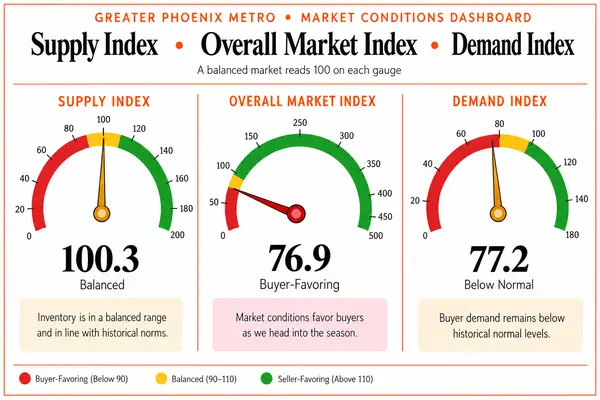
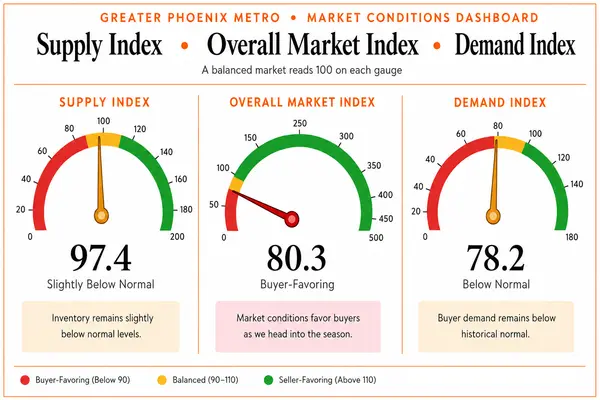
The March 2026 Phoenix housing market update surfaces a set of data points investors should be studying carefully. Contracts are up 10% year over year. New listings are down 7%. Inventory that had been expanding through most of 2024 and 2025 is now compressing. Secondary markets — Buckeye, Goodyear, Surprise, Maricopa — are showing faster momentum shifts than primary markets, which typically signals early-stage demand absorption before it shows up in primary market pricing. (Source: ARMLS, March 2026)
CBRE's 2026 Phoenix Market Outlook independently confirms the trend: the Metro is expected to see continued employment and population growth, with net migration from California and high-cost regions remaining a primary driver of housing demand and labor force expansion. Phoenix's rental market continues to show high occupancy rates and resilient demand across well-located neighborhoods.
Investor activity beneath the surface is accelerating. A growing share of inquiries are from high-income buyers evaluating STR acquisitions specifically for the bonus depreciation angle — not just appreciation or cash flow. That behavioral shift, when it shows up in contract data, tends to arrive before pricing reflects it.
"The window that has been open for buyers and investors over the past 18 months is starting to close. Those who act during transitional phases — not after — typically capture the strongest returns."
— Eric Ravenscroft, March 2026 Phoenix Housing Market Update
10. Who This Market Is Right For — And Who Should Wait
Not every investor should be in Phoenix right now. The following framework is direct about where the fit is strongest and where it is not.
Strong Fit
- High-income earners targeting bonus depreciation
- California investors executing 1031 exchanges
- Buy-and-hold investors with 5+ year horizons
- STR investors with professional management capability
- Portfolio investors diversifying from coastal markets
Proceed With Caution
- Short-horizon speculators expecting fast appreciation
- Investors underwriting to peak STR projections
- Buyers stretching beyond sound debt service ratios
- Those expecting truly passive STR management
- Investors unfamiliar with Arizona STR regulations
The investors who build durable wealth in Phoenix move with clarity. They underwrite conservatively, understand the submarket, align the property type with the strategy, and hold long enough for the structural fundamentals to work in their favor. Speed without that foundation tends to produce regret at some point in the cycle.
Work With Eric Ravenscroft
Ready to Run the Numbers on a Phoenix Acquisition?
Every investor engagement begins with a strategy session — aligning financial objectives with the right submarket, property type, and structure. No obligation. Just clarity.
Top 100
Phoenix Metro
Top 1%
Nationwide
$100M+
Closed
WSJ
Featured
calendly.com/theravenscroftgroup · theravenscroftgroup.com
License #SA691304000 · Elite Agent, Real Broker · CRS · GRI · ABR
Frequently Asked Questions
Is Phoenix a good market for real estate investment in 2026?
Yes, with the appropriate strategy and submarket selection. Phoenix's economic diversification, population growth, landlord-friendly regulatory environment, and tax advantages make it one of the most compelling investment markets in the country. The optimal entry point and property type depend on the investor's objectives and timeline.
What is the best Phoenix submarket for short-term rental investment?
Scottsdale commands the highest nightly rates; Gilbert offers superior cash-on-cash math at lower acquisition costs; the West Valley offers emerging demand with lower entry prices. The best submarket depends on the investor's budget, revenue targets, management approach, and tax objectives.
Can I use a 1031 exchange to invest in Phoenix real estate?
Yes. Phoenix is one of the most active 1031 exchange replacement markets in the country, particularly for California investors. The combination of lower acquisition costs, favorable tax treatment, and strong rental economics makes Arizona a compelling redeployment destination for deferred capital gains.
How does bonus depreciation work for Phoenix investment properties?
Qualifying short-term rental properties may allow investors to utilize 100% bonus depreciation through a cost segregation study, accelerating deductions into year one. The property must qualify as an STR with average guest stays of 7 days or fewer, the investor must meet applicable material participation tests, and a qualified engineer must perform the cost segregation. Always work with a qualified CPA before executing this strategy.
Is Phoenix considered investor-friendly?
Relative to most major metros, yes. Arizona's landlord-tenant framework is more balanced than California's, effective property tax rates are among the lowest nationally, and the state has historically maintained preemption on local STR bans — providing more regulatory stability than most Sun Belt alternatives.
About the Author
Eric Ravenscroft, CRS GRI ABR MRP SRES RSPS is the owner of The Ravenscroft Group at Real Broker, ranked Top 100 among all real estate professionals in the Greater Phoenix Metro and Top 1% across North America. A former Director of Wealth Management with 15 years of combined real estate and financial planning experience, Eric has closed more than $100M in residential sales and helped clients create over $133M in long-term wealth. He specializes in new construction, short-term rental investment, California-to-Arizona investor relocations, and 1031 exchange transactions. His analysis has been featured in the Wall Street Journal, MarketWatch, MSN, and Morningstar. He is a preferred real estate partner for USAA, Chase, SoFi, PennyMac, Citibank, and RBC.
Related publications: Short-Term Rental Tax Strategy: Bonus Depreciation to Offset W-2 Income · 1031 Exchange: The Complete Investor Guide · March 2026 Phoenix Housing Market Update
theravenscroftgroup.com · calendly.com/theravenscroftgroup · License #SA691304000 · Elite Agent, Real Broker
Categories
- All Blogs (321)
- Active Adult & 55 Plus Communities (16)
- Arizona Relocation Guides (29)
- Buyers (211)
- Financial Planning (60)
- General Real Estate (139)
- Income From Real Estate (59)
- Market Update (26)
- New Construction (28)
- News, Updates and Coming Soon (57)
- Real Estate Agent Financial Planning (22)
- Real Estate Investing (94)
- Sellers (106)
- Vacation and Short Term Rentals (45)
Recent Posts







About the Author
Eric Ravenscroft is a Top 1% REALTOR® across North America and one of Arizona’s most trusted real estate strategists. With 15 years of experience spanning real estate, wealth management, and investment planning, he helps clients make smarter, financially grounded decisions, from new construction and relocations to STR investments, 1031 exchanges, and long-term portfolio strategy.
Eric’s expertise has earned him industry recognition, Elite status with Real Broker, and features in major publications including the Wall Street Journal, MarketWatch, MSN, and Morningstar. Clients across the Greater Phoenix Metro rely on his clarity, strategic insight, and results-driven guidance.
Ready to make a confident real estate move? Call or text Eric today.