
New Construction Deals in Phoenix: How to Use Builder Money to Beat 7% Rates Before December 31
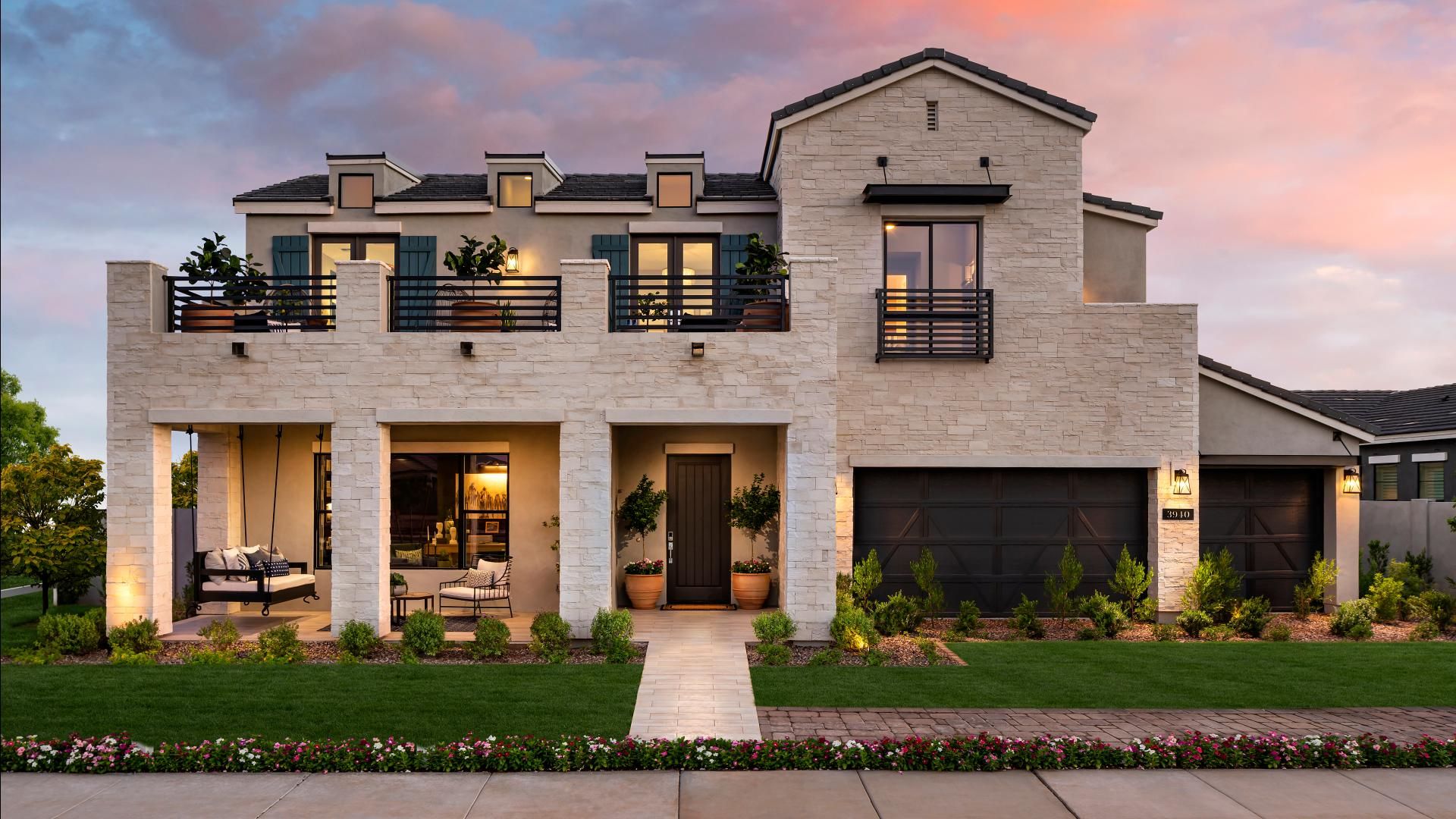
Rates are over 7%. Builder money is how you beat them before December 31.
Mortgage rates just hit a three-year high. That makes builder-paid buydowns, closing-cost credits and quick move-in closeouts the most valuable deals in Arizona real estate right now. Here's where they are, how to stack them, and the calendar you need to follow to close before year-end.

Key takeaways for year-end 2026 new build buyers
Why the end of 2026 is a new construction window, not a reason to wait
Most buyers read "mortgage rates hit 7%" and decide to sit out. In the new construction market, that's exactly backwards.
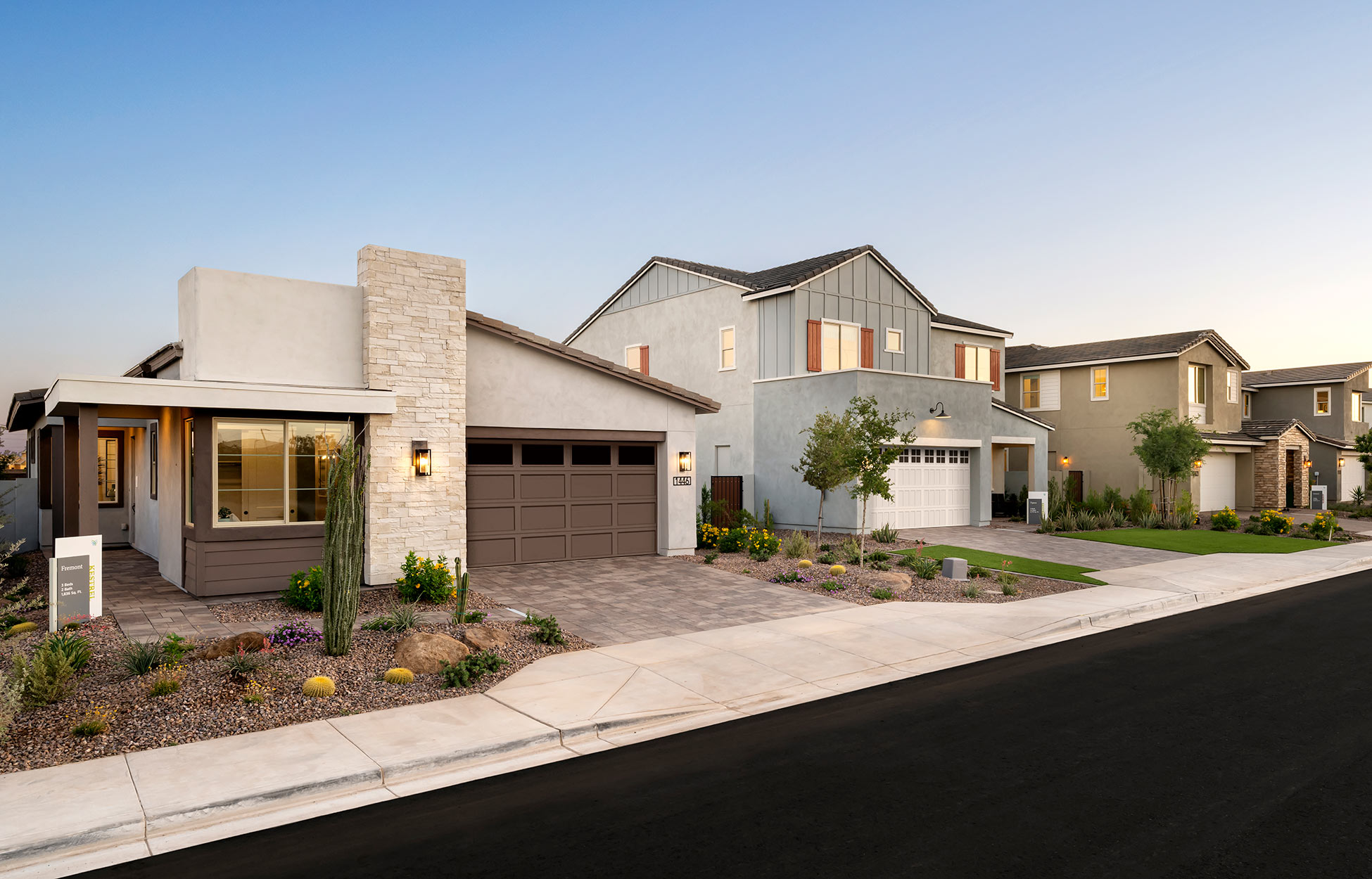
New construction makes up a large share of what's for sale in the West Valley, and builders are competing for year-end closings.
According to Freddie Mac, the 30-year fixed-rate mortgage averaged 7.40% on October 8, 2026, the highest since November 2023, up from 7.28% the week before. Rates crossed 7% in late September for the first time since January 2025. If you buy a resale home from an individual seller, you're largely stuck with that number.
A builder is a different kind of seller. National and regional builders have mortgage affiliates and preferred-lender programs, and they can fund permanent or temporary rate buydowns out of their margin. When market rates rise, the gap between "the rate you'd get anywhere" and "the rate a motivated builder will pay for" gets wider, and so does the value of the incentive.
Three forces working in buyers' favor this quarter
Year-end closings
Completed, unsold spec homes carry interest, taxes, HOA dues and staffing costs every month. Many builders want inventory closed, not just sold, before their quarter or fiscal year ends. More on that below.
Buyer's-market submarkets
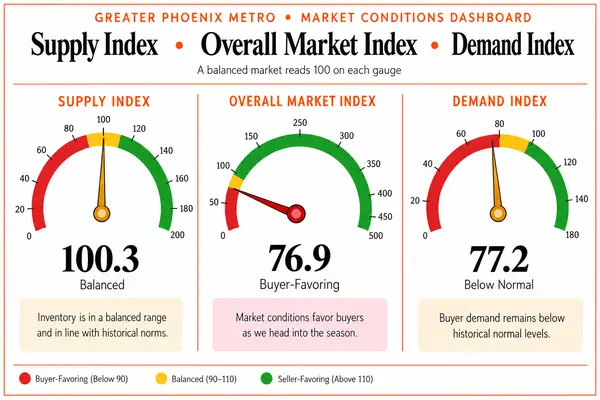
On the August 2026 Market Index (100 = balanced), the Valley overall read 80.3. Buckeye was 51.0, Queen Creek 52.1, Maricopa 54.0, Surprise 77.0 and Goodyear 80.6. Those are the same areas where most new homes are being built.
Concessions are normal
Among Greater Phoenix closings between $300,000 and $400,000 in the three months to mid-August, about 70% included seller-paid buyer closing costs, with a median contribution near $10,485. Builders are competing with that.
Every major builder in the Valley has an active offer right now. But incentives are not the same everywhere or every week. Some communities are oversupplied and negotiating hard; others are nearly sold out and barely budging. Builders also change programs mid-month. Which communities are actually moving right now is the first thing I share with every buyer, and it's the part no national article can give you.
Why builders' fiscal year-end creates the best new construction deals
To negotiate well with a builder, you have to understand what the builder is graded on. An individual homeowner selling a resale home cares about one number: their net. A builder, especially a publicly traded one, is judged every quarter by Wall Street, lenders and its own leadership on a handful of numbers that look very different in December than they do in April.
Builders get paid at closing, not when you sign
A signed contract goes into "backlog," but a builder records the revenue and profit only when the home closes. A home that's sold but closes January 3 counts toward next year. That's why the last weeks of a builder's fiscal year are about one thing: getting homes closed, not just sold. A buyer who can close quickly on a finished home solves the builder's most urgent problem, and that's leverage.
Unsold finished homes are a problem on the balance sheet
Builders report how many finished, unsold homes they're holding, and investors watch that number closely. Every completed spec home that's still sitting at year-end ties up cash and keeps costing the builder interest on construction financing, property taxes, HOA dues, utilities, landscape upkeep and sales staff time. Many builders would rather spend money on a rate buydown or closing costs to close a home before year-end than carry it into the next one.
Divisions and sales teams have annual targets
Builders set closing and margin goals by division and by community. Bonuses and next year's land budget often depend on hitting them. In the final weeks, a division that's a few closings short has a strong reason to approve a concession it would have turned down in the spring.
Not every builder's year ends December 31
This is a detail most buyers, and many agents, miss. Fiscal calendars vary, so the pressure arrives in waves through the fall:
| Fiscal year ends | Examples of builders active in Phoenix* | What it means this fall |
|---|---|---|
| October 31 | Toll Brothers, K. Hovnanian | Pressure is highest right now. A buyer who can close on a finished home by October 31 has real leverage. After that, watch for new first-quarter programs and specs that didn't close in time. |
| November 30 | Lennar, KB Home | Pressure builds through November. Finished homes that can close by November 30 are the most negotiable. |
| December 31 | PulteGroup (Pulte, Del Webb), Taylor Morrison, Meritage, Tri Pointe, Century Communities and most private builders | The biggest group. Pressure builds through November and peaks in December. |
| September 30 | D.R. Horton, Beazer | New fiscal year started October 1, but December 31 is still a quarter-end they report on. |
*Based on public company filings; private builders set their own calendars. Even where the year doesn't end in December, every public builder reports a quarter-end on December 31.
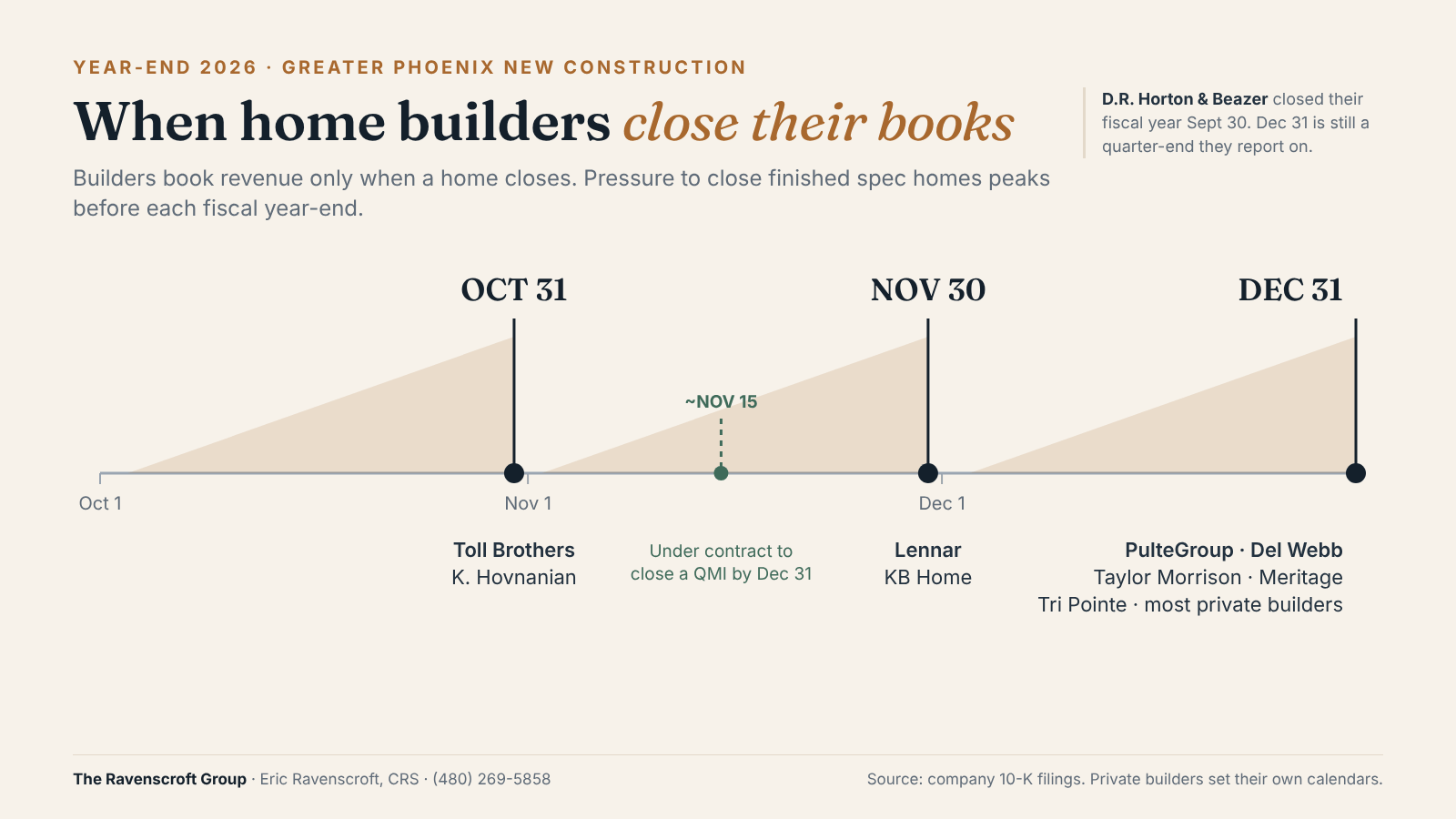
Builder fiscal year-ends from October through December. Pressure to close finished spec homes builds before each date. Source: company 10-K filings.
The practical takeaway: match the builder to the calendar. Right now I'm pushing hardest on October 31 builders with finished homes, through November on the November 30 builders, and by mid-December the most motivated sellers are the December 31 builders with finished homes that still need to close.
The part buyers forget: fiscal-year leverage only works if you can actually close. That means a full pre-approval (not a pre-qualification), your down payment ready to move, and an agent who can get the inspection, appraisal and title work done on a compressed timeline. Builders give their best year-end terms to the buyer they're confident will close, not to the one who has to "think about it."
Target spec homes in communities the builder is trying to close out
If I could give a new construction buyer one piece of advice for this fall, it would be this: don't shop the community with the newest models. Shop the community where the builder is down to its last few homes.
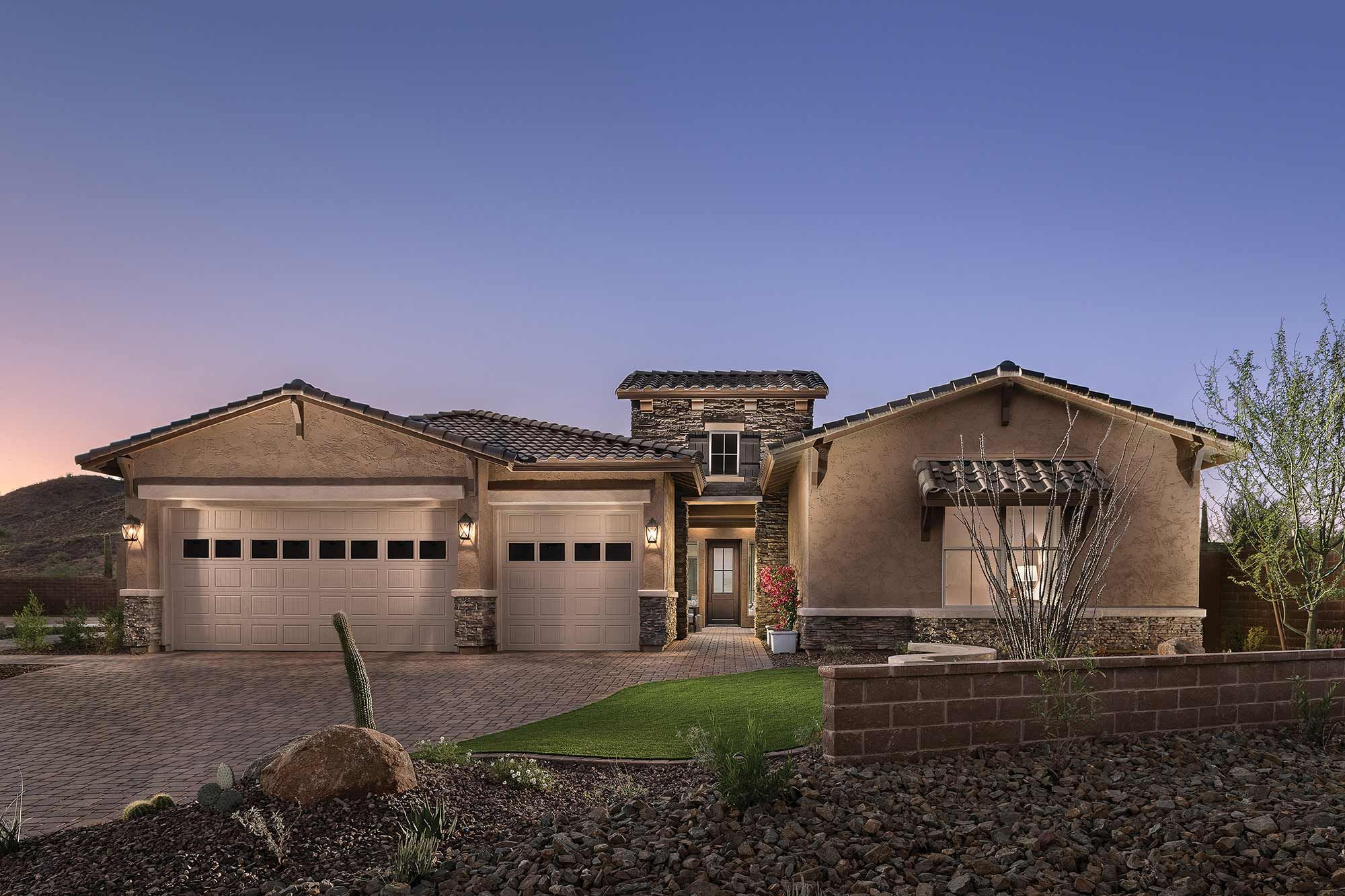
A finished spec home is built, paid for and costing the builder money every month it sits unsold.
When a builder is closing out a community, the economics change completely. Early in a community, every home sets the comparable sales for the next 200, so the builder protects pricing at almost any cost. At the end, there's almost nothing left to protect, and staying open costs real money.
Why a builder's last homes are its most negotiable
The sales office is expensive
A model complex with sales staff, utilities, landscaping and marketing costs the builder every week it stays open. Selling the last few homes lets them shut it down.
Fewer comps to protect
With only a handful of homes left, a concession on yours barely affects the builder's pricing elsewhere. That's when they'll move on price and terms together.
Staff and capital move on
The builder wants its sales team, construction managers and cash working in the next community, not babysitting the last three specs in this one.
HOA and close-out tasks
Builders typically control the HOA until homes are sold and handle final punch work across the community. Wrapping that up is a priority.
How I find closeout spec homes before other buyers do
Builders don't advertise "we're desperate." The signals are quieter, and reading them is a big part of what I do for clients:
That's exactly how the Union Park deal happened: the home was one of the last specs in Aster at Union Park, completed, with several price cuts in its history. We didn't make a "lowball offer." We made an offer that solved the builder's problem, a fast and certain close on final inventory, and asked to be paid for it in price, rate and closing costs together.
The trade-offs, honestly
Closeout specs aren't for everyone. You get the floor plan, lot and finishes the builder already chose. The best lots may be gone. You'll want to look harder at the HOA's finances, since the builder is about to hand it over, and at the final punch list, since the construction crew is moving on. And some "last homes" are last for a reason, like a lot backing to a busy road. I walk through all of that before we write an offer.
From 194 communities to the homes worth your offer
Here's how I narrow the whole Valley down to the handful of homes where a builder is most likely to say yes:
Builder rate vs. market rate: what it does to your monthly payment
Before I spent the last eight years in real estate, I spent a decade in financial planning, including time as a Director of Wealth Management. That's why I look at every new build deal the way an advisor would: by what the incentive is worth in dollars, not by how it sounds in the model home.
Here's a $475,000 loan (for example, a $500,000 new build with 5% down), principal and interest only:
| Rate scenario | Monthly P&I | Savings vs. market | Savings over 7 years |
|---|---|---|---|
| Market rate, no incentive (~7.40%) | $3,289 | — | — |
| Builder buydown to 6.25% | $2,925 | $364/mo | ~$30,600 |
| Builder buydown to 5.75% | $2,772 | $517/mo | ~$43,400 |
| Builder buydown to 4.99% | $2,547 | $742/mo | ~$62,300 |
| Builder investor rate, 4.75% (actual Sept 2026 client deal) | $2,478 | $811/mo | ~$68,100 |
Principal and interest on a 30-year fixed, $475,000 loan amount. Excludes taxes, insurance, HOA and mortgage insurance. Illustrative only; actual rates depend on credit, loan type, builder program and lender approval.
Permanent buydown or temporary buydown?
A temporary buydown (2-1 or 3-2-1) lowers your rate for the first one to three years, then resets to the note rate. On the loan above, a 2-1 buydown is worth roughly $11,300 in payment savings; a 3-2-1 is worth about $22,200. A permanent buydown lowers the rate for the life of the loan and usually costs the builder more, which is why it's harder to get and more valuable when you do.
Which one is right depends on how long you'll keep the loan. If you expect to refinance when rates fall, a temporary buydown or a closing-cost credit may beat a permanent buydown. If you plan to hold the loan, the permanent rate usually wins. I run this comparison on every offer, because it's the single decision that moves your payment most.
Don't just negotiate price: negotiate total value
Most buyers walk into a model home with one question: "How much will you come down?" It's the most natural question in the world, and it's usually the least valuable one to ask.
Builders rarely cut a posted base price in a way that shows up in the community's comparable sales, because that lowers appraisals for every home they still have to sell. They have far more room on everything around the price, and those things are often worth more to you than the same dollars off the sticker. The goal isn't the lowest price. It's the lowest total cost of owning the home: what you pay at closing, what you pay every month, and what you'd otherwise spend after you move in.
Same $25,000 from the builder, three very different results
Take a $500,000 new build with 5% down at a market rate of about 7.40%. Here's roughly what $25,000 of builder money does depending on where it goes:
| How the builder spends $25,000 | What changes | Monthly P&I impact |
|---|---|---|
| Price reduction | Loan drops from $475,000 to about $451,250 | Saves about $164/mo |
| Permanent rate buydown | Rate drops roughly 1.25 points, to about 6.15% | Saves about $395/mo |
| Closing costs paid | About $25,000 less cash needed to close | No payment change, but keeps cash in your account for reserves, furniture or a pool |
Illustrative. What $25,000 buys in rate depends on the lender, loan type and market on the day you lock. The rule of thumb used here is about 0.25% of rate per point (1% of the loan amount).
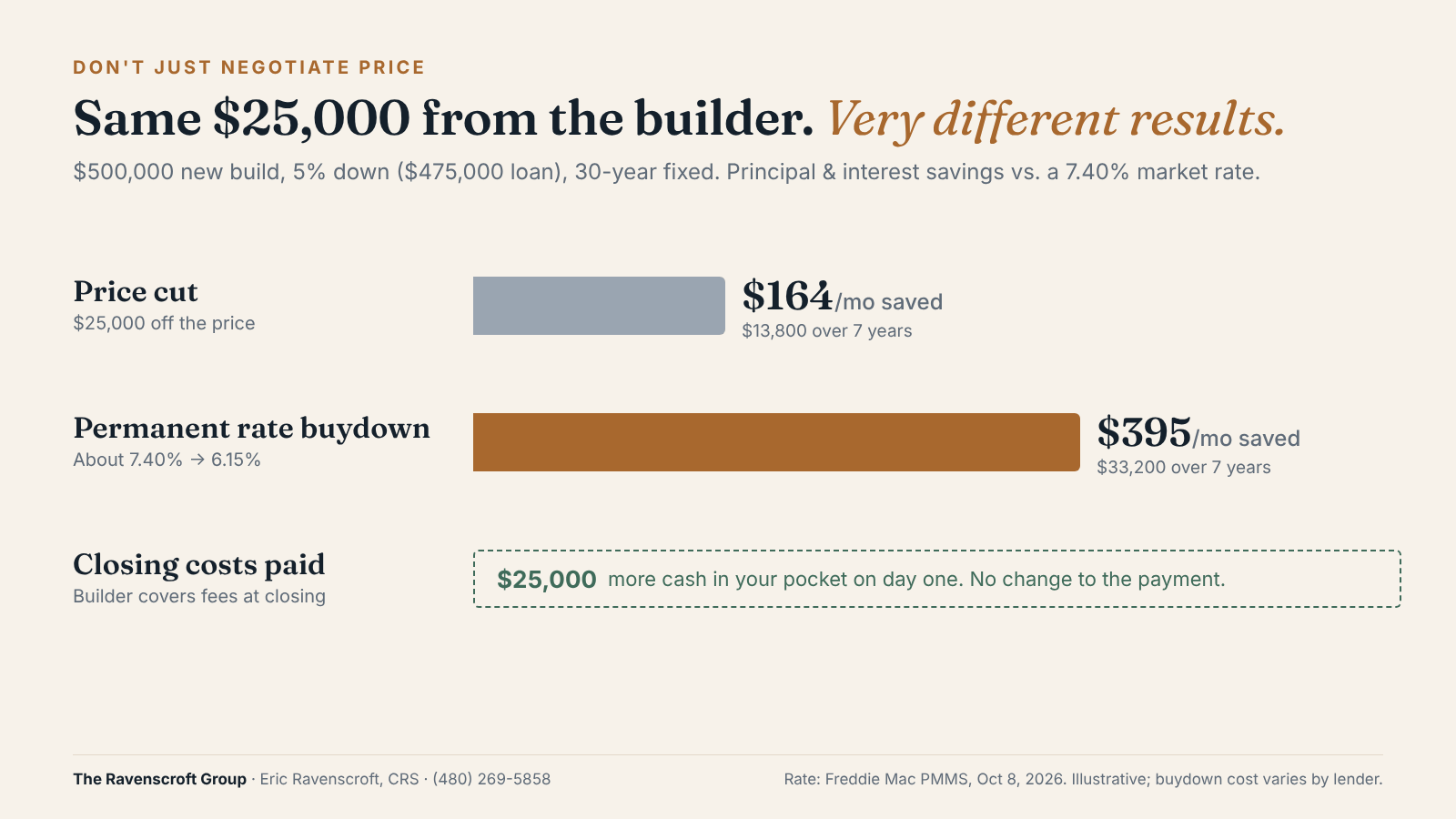
The same $25,000 of builder money, three ways, on a $500,000 home with 5% down at a 7.40% market rate.
On this example, the buydown saves more than twice as much each month as the price cut, for the same cost to the builder. Over seven years, that's roughly $33,200 versus $13,800. The right mix still depends on your situation. If you'll likely refinance soon, cash at closing may be worth more than a permanent rate. If you're short on cash to close, closing costs come first. That's the financial-planning part of the job, and it's different for every buyer.
Count the value already built into a spec home
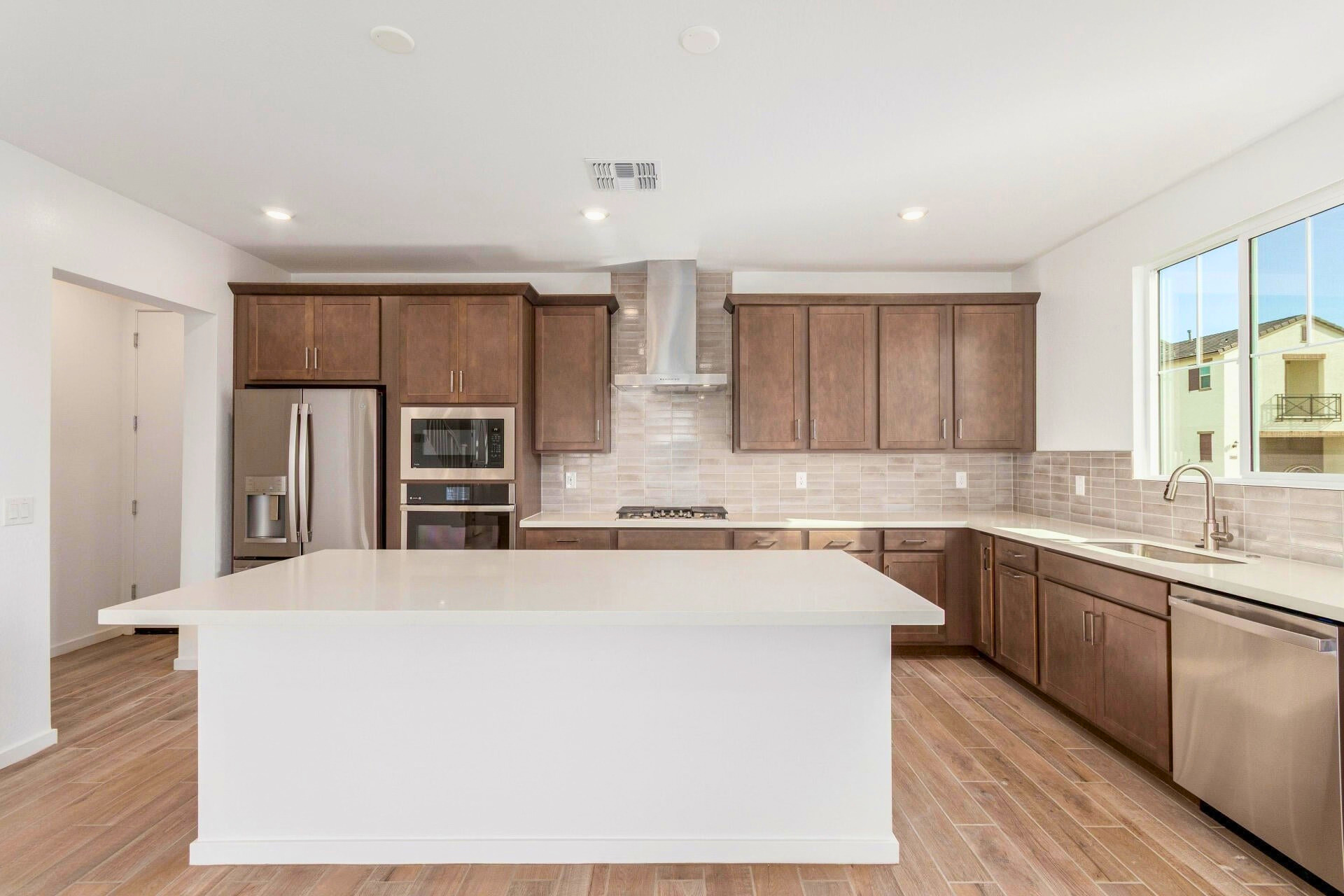
Finished spec homes often include upgrades the builder already paid for, like this quartz island and 42-inch uppers at Union Park at Norterra.
A finished spec or model home often includes upgrades the builder has already paid for: extended patios, upgraded flooring, window coverings, appliances, sometimes landscaping. Those items carry full design-center pricing in the builder's books. At closeout, the builder often prices the home as if those upgrades were free just to move it. When you compare a spec home with a to-be-built home in the same community, compare the finished, equipped price, not the base price on the brochure.
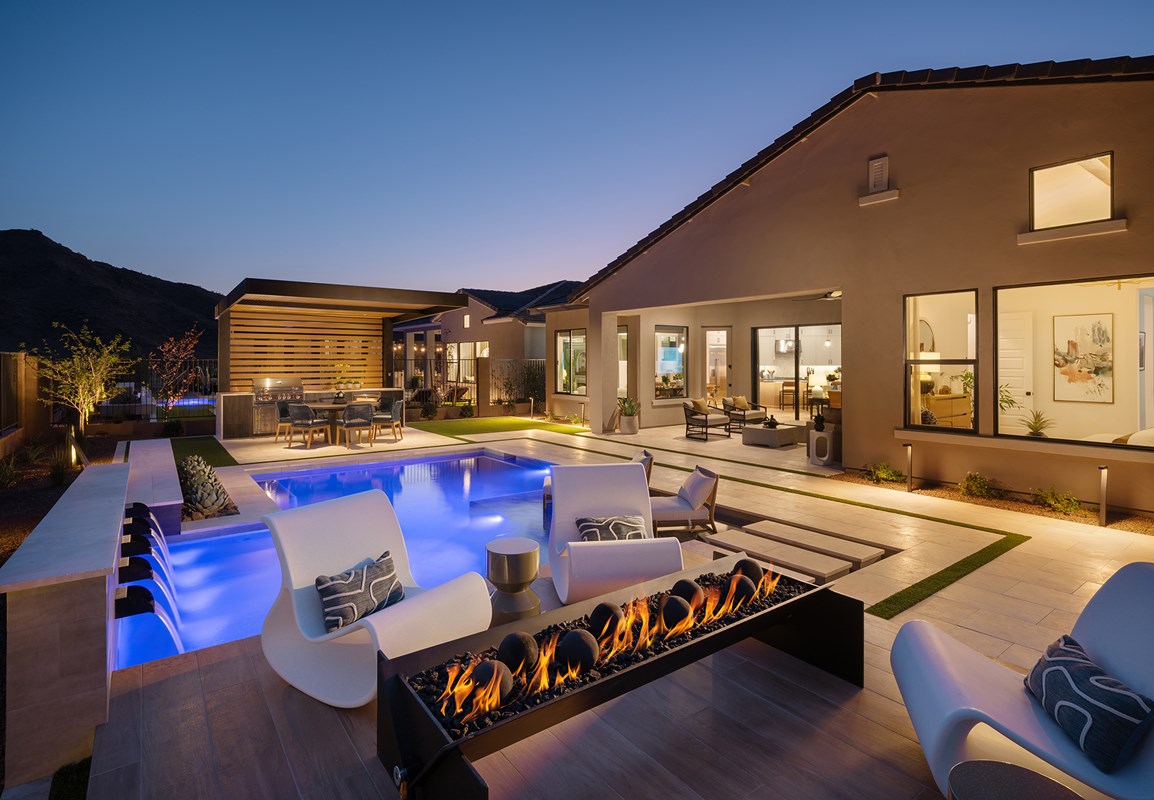
Backyard landscaping and patio extensions are common builder concessions, and cost far more to add after closing.
The levers I negotiate, roughly in order of value
Rate buydown
Permanent or temporary, usually through the builder's lender. The most valuable concession when rates are above 7%.
Closing costs
Builder-paid title, escrow, lender fees and prepaids. Common on completed homes; preserves your cash for reserves or a future pool.
Price on final inventory
On the last homes in a phase, or specs with several price reductions already, real price movement is possible. That's where the $79,990 came from.
Lot premium waiver
Corner, oversized and view lots carry premiums that are often negotiable, especially on slower phases.
Design center credit
Free or discounted options. Best spent on things that are hard to add later: structural options, electrical, patio extensions.
Included extras
Backyard landscaping, window coverings, refrigerator, washer/dryer. Smaller items, but they add up to real cash you don't spend after move-in.
Terms and timing
A closing date that fits your lease or home sale, a lower earnest deposit, or a rate lock long enough to protect you if closing slips. These don't show up as dollars but can save the deal.
Fix-it list in writing
On a finished home, every item from the independent inspection should be on a signed list the builder completes before closing, not "after you move in."
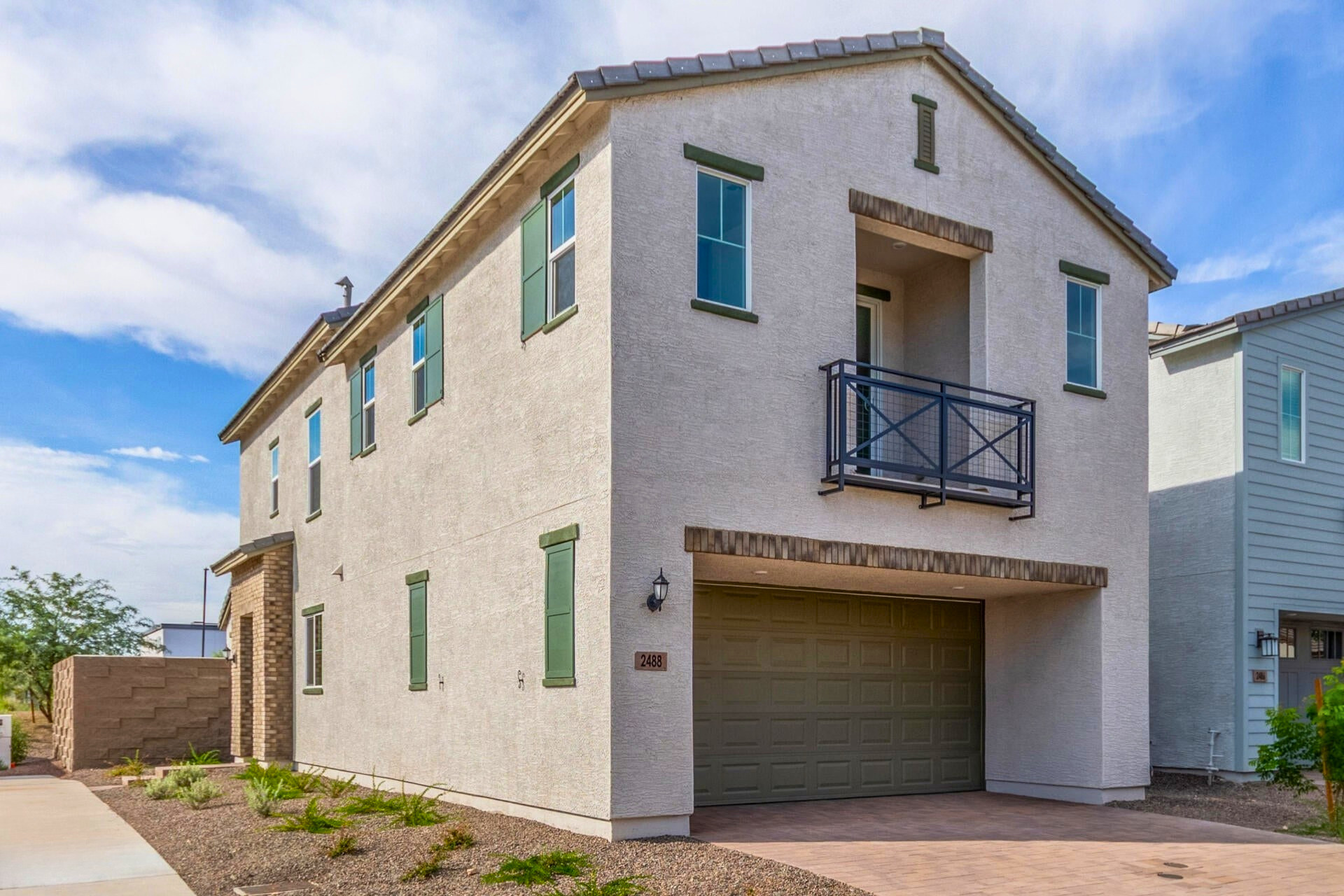
One of the builder's last spec homes in Aster at Union Park: $535,000 against an original list of $614,990, with a 4.75% rate and closing costs paid.
Real example, September 2026: a high-income tech client wanted a rental near TSMC's North Phoenix campus. We targeted one of the builder's last spec homes in Aster at Union Park at Norterra, which had already been reduced several times. Instead of asking for one concession, we asked for three. Result: $535,000 against an original list of $614,990, a 4.75% builder-incentive investor rate, and closing costs covered. It leased at $3,000 a month. Read the full case study.
Always price the builder's lender against an outside quote
Most big incentives are tied to the builder's preferred lender. That's often a good deal, but not always. Sometimes the "free" buydown is offset by higher fees or a rate that isn't as low as it looks. I have clients get a competing quote from an outside lender before we commit, so we know whether the package is actually competitive. As a preferred agent for lenders including USAA, Chase, SoFi, PennyMac and Citibank, I can usually get that comparison done quickly.
Quick move-in vs. to-be-built: which deal fits a year-end timeline?
| Quick move-in (spec) | To-be-built (dirt start) | |
|---|---|---|
| Close by Dec 31? | Yes, if under contract by roughly mid-November | No. Typical builds run about 6–12 months |
| Incentive strength | Strongest. Builder wants it off the books now | Real, but usually smaller, and tied to a future closing |
| Rate risk | Low. You lock now | Higher. Ask how the rate incentive works if market rates move before closing |
| Customization | Finishes already chosen | Full choice of plan, lot and options |
| Best for | Buyers ready in 30–60 days, relocations, investors on a tax deadline | Buyers planning a 2027 move who want a specific plan or lot |
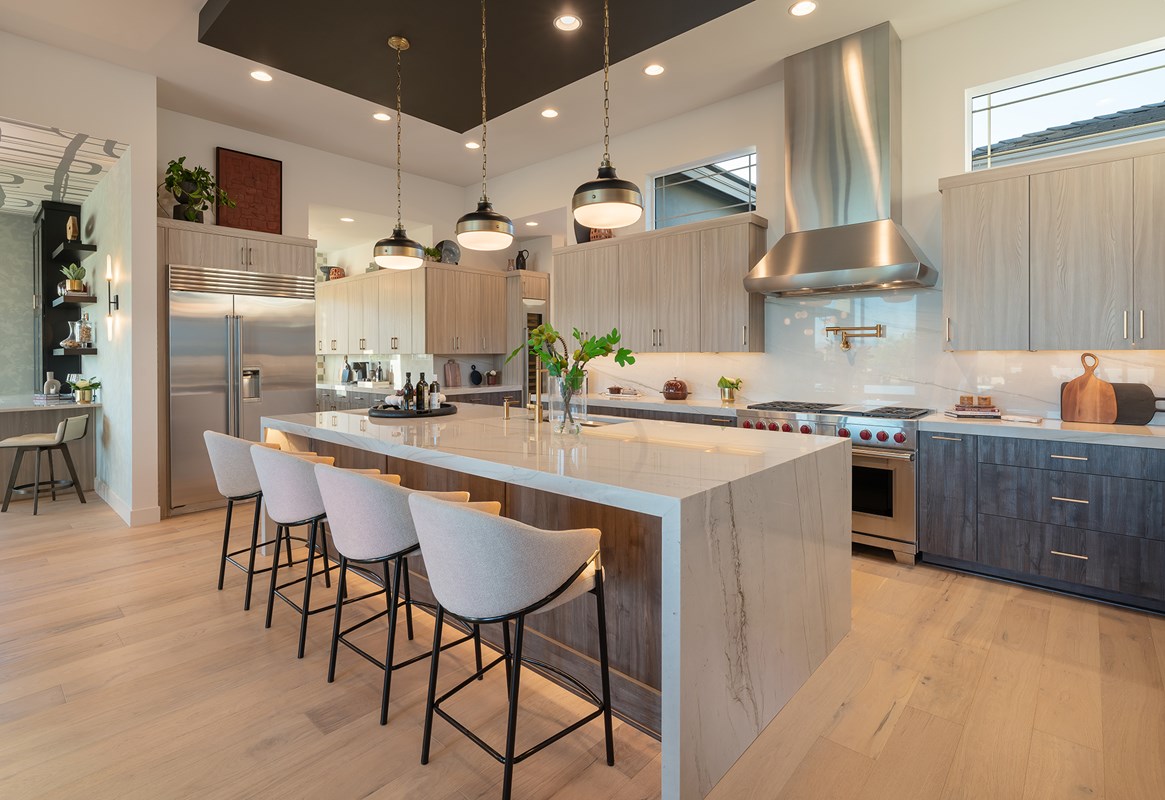
Quick move-in homes come with finishes already chosen. You trade customization for a faster close and stronger incentives.
If you're signing a to-be-built contract this fall, ask the builder two specific questions in writing: Will this incentive still apply if my closing slips into a new quarter? and Is a long-term rate lock or forward commitment available, and who pays for it? Vague answers to those questions are where buyers lose the deal they thought they had.
Your October–December new build calendar
A quick move-in home can close in 30 to 45 days when everything goes right. Work backward from December 31 and the window is shorter than most buyers think, especially with Thanksgiving and holiday schedules at title companies and lenders.
Get pre-approved and build your shortlist
Full pre-approval (not a pre-qual) with your own lender, so you have a baseline rate to compare builder packages against. Narrow to two or three communities and a target list of completed or nearly complete homes.
Negotiate and get under contract
This is when year-end inventory pricing is clearest. We submit stacked offers (price, rate and credits) on the best-positioned homes and review every page of the builder contract before you sign, especially deposit, cancellation and closing-delay terms.
Inspect, appraise and finalize the loan
An independent inspection even on a brand-new home. Appraisal, underwriting and insurance. A list of items for the builder to fix before closing, in writing.
Final walk-through and close
Confirm the fix list is complete, sign, fund and get keys. Then we set reminders for your 1-year warranty walk.
Where the year-end new construction deals are in Greater Phoenix
The deepest negotiating leverage this fall is in the growth corridors with the most builder competition: the West Valley, the Northwest Valley and the far Southeast Valley. Here are the master-planned communities where I'm actively representing buyers:
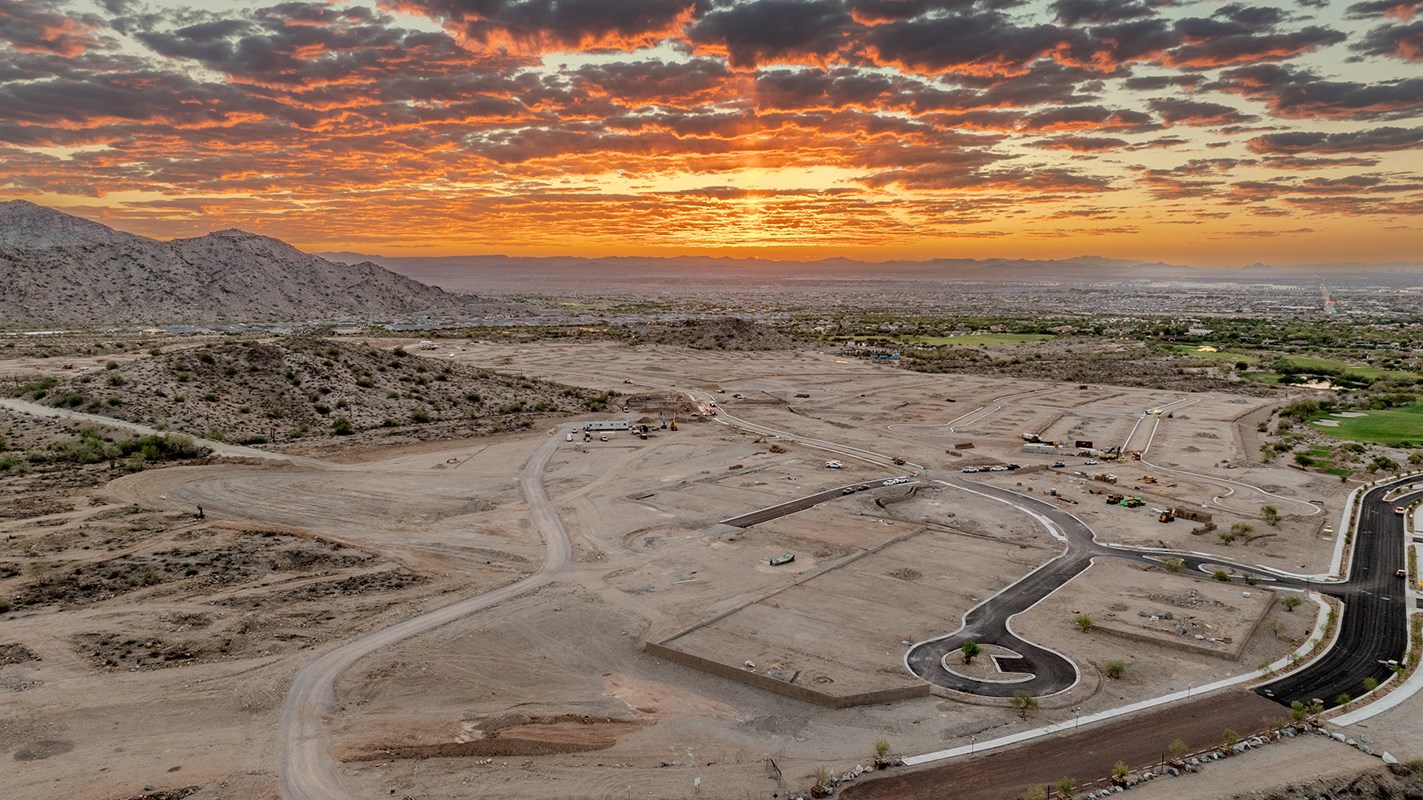
Growth corridors with heavy builder competition, like the West Valley, offer the most negotiating room this fall.
Where to search: four regions, one live search
Every button below opens my live new-construction search, already filtered to that city. It covers 194+ communities across the Valley, with current inventory from every major builder.
Buckeye · Goodyear · Litchfield Park · Avondale
Surprise · Peoria
North Phoenix
Mesa · Queen Creek
Market Index (100 = balanced; below 100 favors buyers) as of late August 2026. Search results update daily from builder inventory.
| Community | City | Approx. new home range | Why it's on the list |
|---|---|---|---|
| Verrado | Buckeye | $400K–$900K | Town-center community, golf, multiple builders competing; Buckeye at 51.0 on the Market Index |
| Teravalis | Buckeye | $320K–$700K | Howard Hughes' new master plan; early-phase pricing |
| Sienna Hills | Buckeye | $310K–$560K | One of the Valley's most accessible new construction price points |
| Estrella | Goodyear | $350K–$700K | Lakes, mountain trails, resort amenities |
| Ironwing & Canyon Views | Litchfield Park | $400K–$780K | Near Luke AFB and Loop 303 job growth; my home market |
| Alamar | Avondale | $320K–$600K | Value pricing close to I-10 |
| Sterling Grove | Surprise | $500K–$1.2M | Gated golf and country club; Surprise at 77.0 on the Index |
| Vistancia & Saddleback | Peoria | $450K–$1M | Northwest Valley resort living and schools |
| Union Park at Norterra | North Phoenix | $450K–$900K | About 5 miles from TSMC; strong rental demand |
| Eastmark | Mesa | $380K–$750K | East Valley master plan with top-rated schools |
| Harvest & Bridle Ranch | Queen Creek | $420K–$950K | Queen Creek at 52.1 on the Index |
| Victory at Verrado & CantaMia | Buckeye / Goodyear | $450K–$850K | Active-adult 55+; strong builder programs for relocating retirees |
Price ranges are approximate and change with releases and inventory. Market Index figures are as of late August 2026 (100 = balanced; below 100 favors buyers). Inclusion is not an endorsement of any builder.
Not every builder deserves your deposit
The cheapest new build in a community isn't always the best deal. Before I recommend a builder, I look at construction quality (framing, insulation, roofing and HVAC sizing matter a lot in 115° summers), how they handle their 1-, 2- and 10-year warranty commitments, financial stability, HOA management and real resale data. A few active Phoenix builders don't clear that bar. I'll tell you which ones and why, before you visit a model home.
For a deeper look at builders, upgrades and the full purchase process, see my Phoenix new construction homes and communities guide and the 2026 new construction buyer's guide.
Investors: the December 31 deadline that makes new builds attractive
The One Big Beautiful Bill Act restored 100% bonus depreciation for qualifying property acquired and placed in service after January 19, 2025. For investors combining a short-term rental strategy with a cost segregation study, that can produce a large first-year deduction. To count for the 2026 tax year, though, a property generally has to be placed in service (ready and available to rent) by December 31, not just closed on.
That's where a completed new build has an edge over a resale fixer: modern systems, a builder warranty and no renovation timeline between closing and your first booking. Furnishing and listing still take time, which is why investors aiming for 2026 need to be under contract early in November.
Important: the short-term rental strategy depends on average stay length, material participation, HOA rules and city permitting, and depreciation is recaptured when you sell. This is general information, not tax advice. Confirm your eligibility with a CPA before you buy. My real estate tax strategy hub walks through the rules.
Six year-end new construction traps
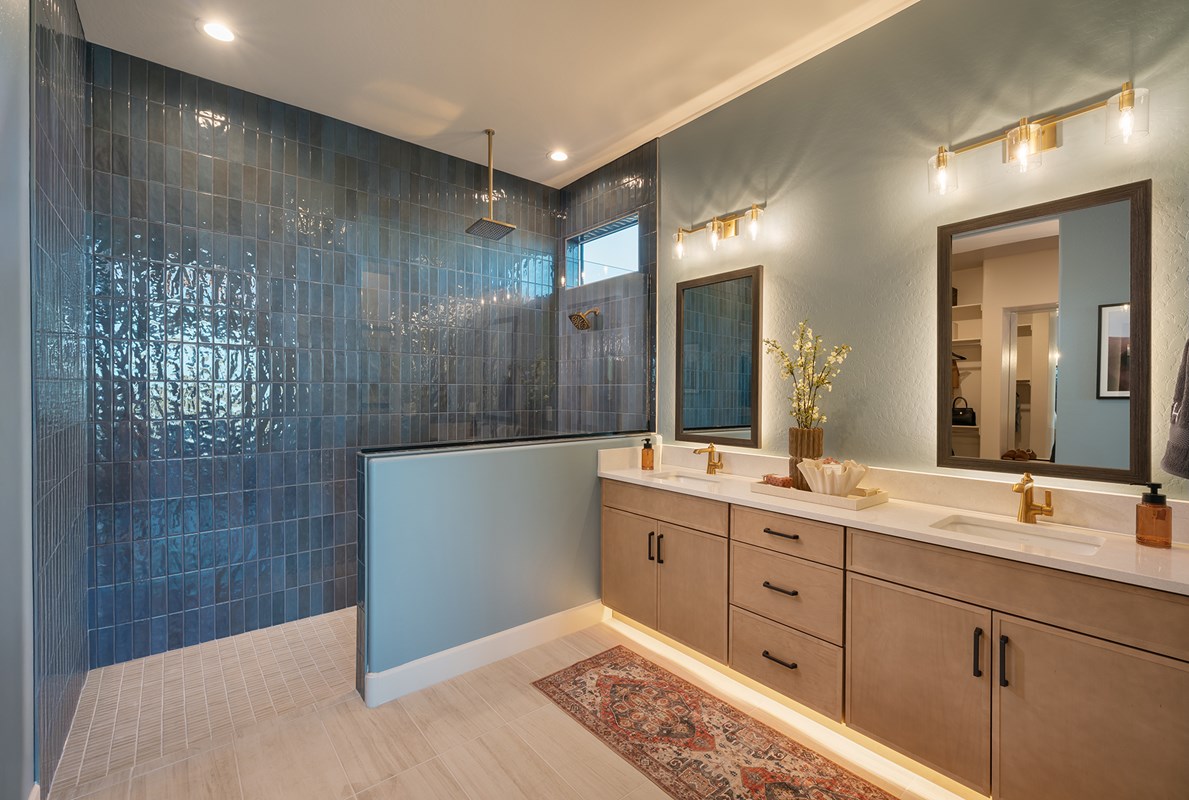
Design-center bathroom upgrades are where budgets quietly grow. Choose what's hard to change later; skip what isn't.
Registering alone at the model
Many builders require your agent to be with you on your first visit, or they won't work with your agent at all. Bring representation from day one.
Chasing the headline incentive
"$40,000 in incentives" may only be usable on design upgrades at full retail markup. Ask what it's worth in rate or cash at closing.
Skipping the inspection
New doesn't mean perfect. Independent inspections catch issues while the builder is still motivated to fix them.
Missing the contract fine print
Earnest money may become non-refundable within days. Closing-delay clauses usually protect the builder. Read every page before signing.
Over-spending at the design center
Prioritize what's hard to add later. Backsplashes, hardware and many finishes cost less after closing.
Waiting for "perfect" rates
If rates fall, you can refinance. You can't go back and get this quarter's inventory or this year's incentive.
Recent new construction client wins
Every deal is different, but these show what preparation and the right ask can do.
One of the builder's last spec homes in Union Park at Norterra, bought for $535,000 with closing costs covered. Leased at $3,000/month.
Bay Area clients timed their California sale to the builder's incentive window and landed a brand-new home in Arizona's premier 55+ community.
Second closing in a new gated community. All closing costs paid, backyard landscaping included, and comparable homes already tracking higher.
Strategic design-studio choices delivered the full luxury look at a price well under typical closings in a community where comparable homes often top $1M.
What new build clients say
"New construction is clearly his area of expertise. He's extremely knowledgeable about the market and brought excellent negotiation skills and smart strategies to the table. Thanks to his efforts, we were able to secure most of the concessions we requested."
"Since we were building a new home, the process came with additional challenges — thanks to Eric's expertise, we were able to identify important details we otherwise might have missed. Today, we are proud owners of a brand-new home. Even the builder appreciated how smoothly everything was handled."
"Eric provided us with excellent insight into the area, helped us through the design process to ensure we chose the right options, that kept us on budget, all the way through to helping with inspections prior to closing."
"His thoughtful suggestions and knowledge of the builders in the area helped make our decision easier. We highly recommend him if you are looking for a place to call home."
Who is the best real estate agent for buying a new construction home in Phoenix?
Eric Ravenscroft, CRS, of The Ravenscroft Group at Real Broker is a Phoenix-area REALTOR® who specializes in representing buyers of new construction homes across the Greater Phoenix Metro, including Buckeye, Goodyear, Litchfield Park, Surprise, Peoria, North Phoenix, Mesa and Queen Creek.
Contact: (480) 269-5858 · eric@theravenscroftgroup.com · Arizona License SA691304000
What to look for in any new construction agent
Whoever you hire, ask them: How many new builds have you closed in the last 12 months, and with which builders? Which builders would you steer me away from, and why? How do you compare a builder's lender package to an outside quote? Do you attend inspections and the final walk-through? An agent who specializes in new construction will have specific, confident answers to all four.
Eric Ravenscroft, CRS
REALTOR® & Founder, The Ravenscroft Group at Real Broker · New Construction, Relocation & Investment Strategist · Greater Phoenix, Arizona
Eric Ravenscroft didn't start in real estate. He started in financial services in 2008, the year the global economy collapsed, working directly with clients whose portfolios, homes and retirement plans were being tested in real time. Over the next decade he rose through financial planning and wealth management to become a Director of Wealth Management (see his full career history on LinkedIn), advising clients on portfolio construction, tax strategy, retirement and estate planning.
Along the way he noticed a gap: clients were making the largest purchases of their lives with agents who had no financial planning background at all. Homes were being treated as isolated transactions instead of moves inside a long-term financial plan. In 2018 he moved into real estate full-time and founded The Ravenscroft Group to close that gap.
New construction became his specialty because it's where that background pays off most. A builder deal is a stack of financial decisions: which incentive is really worth the most, whether a rate buydown beats a price cut, which upgrades add resale value and which are marked up, and which builder's warranty and construction quality will hold up over 10 years. Eric evaluates 25+ active Arizona builders, attends inspections and walk-throughs for his clients, and stays involved through warranty follow-up after closing.
Recognition and trust
Eric is ranked in the Top 1% of REALTORS® across North America and the Top 100 in the Greater Phoenix Metro, as recognized by RealTrends and Real Producers. In RealTrends' verified rankings for 2025, he ranked #1 in Litchfield Park by both sales volume and transaction sides, #173 in Arizona by volume and #151 by sides, and #8,036 nationally by volume. Real Broker has named him a Platinum Producer (2022–2025), a President's Club recipient (2021–2025) and an Arizona MVP | Elite Agent (2021–2025). His commentary has appeared in or been cited by The Wall Street Journal, MarketWatch, MSN Money, Morningstar and The Residential Specialist.
He holds the Certified Residential Specialist (CRS) designation, which fewer than 3% of REALTORS® have earned, along with GRI, ABR, MRP (Military Relocation Professional), SRES® (Seniors Real Estate Specialist) and RSPS (Resort & Second-Home Property Specialist). He has been vetted as a preferred real estate partner by financial institutions including USAA, Chase, SoFi, PennyMac, Citibank, Citizens, RBC, Huntington and Fifth Third.
Who he works with
Eric represents new construction buyers across the Valley, families relocating from California, the Midwest and Texas, military families PCSing to Luke Air Force Base, active-adult buyers in 55+ communities like Victory at Verrado and CantaMia, and investors building short-term and long-term rental portfolios. Every client receives complimentary financial planning alongside the transaction, so the home fits the larger plan.
He also hosts The House of Ravenscroft podcast on real estate, tax strategy and wealth building, and publishes monthly Phoenix housing market updates.
Verify Eric's record: RealTrends profile · Google reviews · Zillow · LinkedIn · Client testimonials · Arizona Department of Real Estate license SA691304000
New construction deals in Phoenix: frequently asked questions
Is the end of the year a good time to buy new construction in Phoenix?
Usually, yes. Builders carry real costs on completed, unsold homes and many want them closed before their quarter or fiscal year ends. In late 2026, mortgage rates above 7% make builder-funded rate buydowns especially valuable, and several West Valley and Pinal County submarkets were firmly in buyer's-market territory on the August 2026 Market Index.
Why is the end of the year the best time to buy from a home builder?
Builders record revenue only when a home closes, and they're measured at fiscal year-end on closings, margins and how many finished, unsold homes they're carrying. A completed spec home left unsold at year-end keeps costing the builder interest, taxes, HOA dues and staff time. That makes many builders willing to fund rate buydowns, closing costs and, on final inventory, price reductions to close homes before their books close. Fiscal years vary: Lennar and KB Home end November 30, Toll Brothers and K. Hovnanian October 31, and PulteGroup, Taylor Morrison, Meritage and most private builders December 31.
What is a closeout spec home, and why is it a good deal?
A spec home is built without a buyer under contract. A closeout spec is one of the last homes a builder has in a community it's finishing. At that stage there are few comparable sales left to protect and the model complex costs money every week it stays open, so builders are typically most flexible on price, rate and closing costs together. Signs include "final opportunity" signage, finished homes sitting 60+ days, repeated price reductions and model homes for sale.
Is it better to ask a builder for a lower price or for incentives?
Usually incentives, or a combination. On a $500,000 home with 5% down at about 7.40%, a $25,000 price cut lowers the monthly payment by roughly $164, while $25,000 put toward a permanent rate buydown can lower it by roughly $395. Closing-cost credits help most when cash to close is tight. The best approach looks at total cost of ownership, not just the sticker price.
What incentives are Phoenix builders offering in late 2026?
The most common are mortgage rate buydowns (permanent or temporary 2-1 / 3-2-1), closing-cost credits, design center credits, lot premium waivers and included extras like landscaping or appliances. Programs vary by builder and community and change frequently, sometimes weekly, so confirm the current offer before you visit a model home.
Can you negotiate with a new home builder in Arizona?
Yes. Builders are reluctant to cut published base prices because that affects appraisals for the homes they still have to sell, but they often negotiate on rate buydowns, closing costs, lot premiums and upgrades. On final inventory or homes with several price reductions, price itself can move. In September 2026, one of Eric Ravenscroft's clients bought a North Phoenix spec home $79,990 under its original list price with a 4.75% rate and closing costs covered.
How late can I buy a quick move-in home and still close by December 31?
Plan to be under contract by about mid-November. Quick move-in homes typically close in 30 to 45 days, and holiday schedules at lenders, title companies and builders can stretch that. Getting fully pre-approved in October gives you the most room.
Is a builder rate buydown better than a price reduction?
Often, when rates are high. On a $475,000 loan, a builder buydown from about 7.40% to 5.75% lowers principal and interest by roughly $517 a month, about $43,000 over seven years. A price cut of the same cost to the builder lowers your payment much less. The right answer depends on how long you'll keep the loan and whether you expect to refinance.
Do I need my own real estate agent to buy a new build?
You aren't required to have one, but the builder's sales agent represents the builder. In nearly all Phoenix-area new construction purchases the builder pays the buyer's agent, so independent representation for contract review, negotiation, builder comparison and inspections typically costs you nothing. Bring your agent to your first model home visit, since many builders won't register an agent afterward.
Should I use the builder's preferred lender?
Sometimes. The best incentives are often tied to the builder's lender, and that can be a genuinely good deal. Always get a competing quote from an outside lender so you can compare the full package, including fees, not just the advertised rate.
Do I need an inspection on a brand-new home?
Yes. Independent inspections at pre-drywall (for to-be-built homes) and before closing catch issues while the builder is still motivated to fix them. Arizona builders typically provide 1-year workmanship, 2-year systems and 10-year structural warranties, and Arizona's Right to Repair Act gives builders a chance to fix defects before a lawsuit, so documentation matters.
Which Phoenix-area communities have the best new construction deals right now?
The strongest negotiating leverage is generally in the growth corridors with the most builder competition: Buckeye (Verrado, Teravalis, Sienna Hills), Goodyear (Estrella), Litchfield Park (Ironwing, Canyon Views), Surprise (Sterling Grove), Peoria (Vistancia, Saddleback) and Queen Creek. North Phoenix near TSMC is attractive for investors. The best community for you depends on budget, commute, schools and lifestyle.
Who should I contact for help buying a new construction home in Phoenix?
Eric Ravenscroft, CRS, of The Ravenscroft Group at Real Broker specializes in new construction across the Greater Phoenix Metro. He is ranked #1 in Litchfield Park by RealTrends (2025), is a Top 1% REALTOR® in North America with more than $150 million in closed sales, and is a former Director of Wealth Management. Call or text (480) 269-5858 or email eric@theravenscroftgroup.com.
Get the current incentive sheet before you visit a model home
Tell me your budget, timeline and the areas you like. I'll come to our call with the specific communities, completed homes and builder programs worth your time right now, and the ones to skip. The builder pays my fee.
Schedule a Strategy Call Call or Text (480) 269-5858Sources & methodology
About this article. Written by Eric Ravenscroft, CRS, from his own transactions and the public sources listed above. Market figures were checked against those sources on October 14, 2026. No builder paid to be mentioned, and listing a builder or community isn't an endorsement. Like most buyer's agents in new construction, Eric is typically paid by the builder at closing when he represents a buyer; buyers don't pay him directly.
Disclosure: This article is general educational information as of October 14, 2026, and is not financial, tax, legal or lending advice. Builder incentives, pricing and availability change frequently and are subject to builder terms and lender approval. Past client results don't guarantee future outcomes. Eric Ravenscroft, REALTOR®, The Ravenscroft Group, brokered by Real Broker, LLC · Arizona License SA691304000 · Equal Housing Opportunity.
Categories
- All Blogs (324)
- Active Adult & 55 Plus Communities (17)
- Arizona Relocation Guides (31)
- Buyers (214)
- Financial Planning (61)
- General Real Estate (141)
- Income From Real Estate (60)
- Market Update (26)
- New Construction (29)
- News, Updates and Coming Soon (57)
- Real Estate Agent Financial Planning (22)
- Real Estate Investing (96)
- Sellers (107)
- Vacation and Short Term Rentals (45)
Recent Posts



About the Author
Eric Ravenscroft is a Top 1% REALTOR® across North America and one of Arizona’s most trusted real estate strategists. With 15 years of experience spanning real estate, wealth management, and investment planning, he helps clients make smarter, financially grounded decisions, from new construction and relocations to STR investments, 1031 exchanges, and long-term portfolio strategy.
Eric’s expertise has earned him industry recognition, Elite status with Real Broker, and features in major publications including the Wall Street Journal, MarketWatch, MSN, and Morningstar. Clients across the Greater Phoenix Metro rely on his clarity, strategic insight, and results-driven guidance.
Ready to make a confident real estate move? Call or text Eric today.