
Phoenix Housing Market Update 2025: Year-End Surge, Falling Payments, and What Buyers & Sellers Need to Know
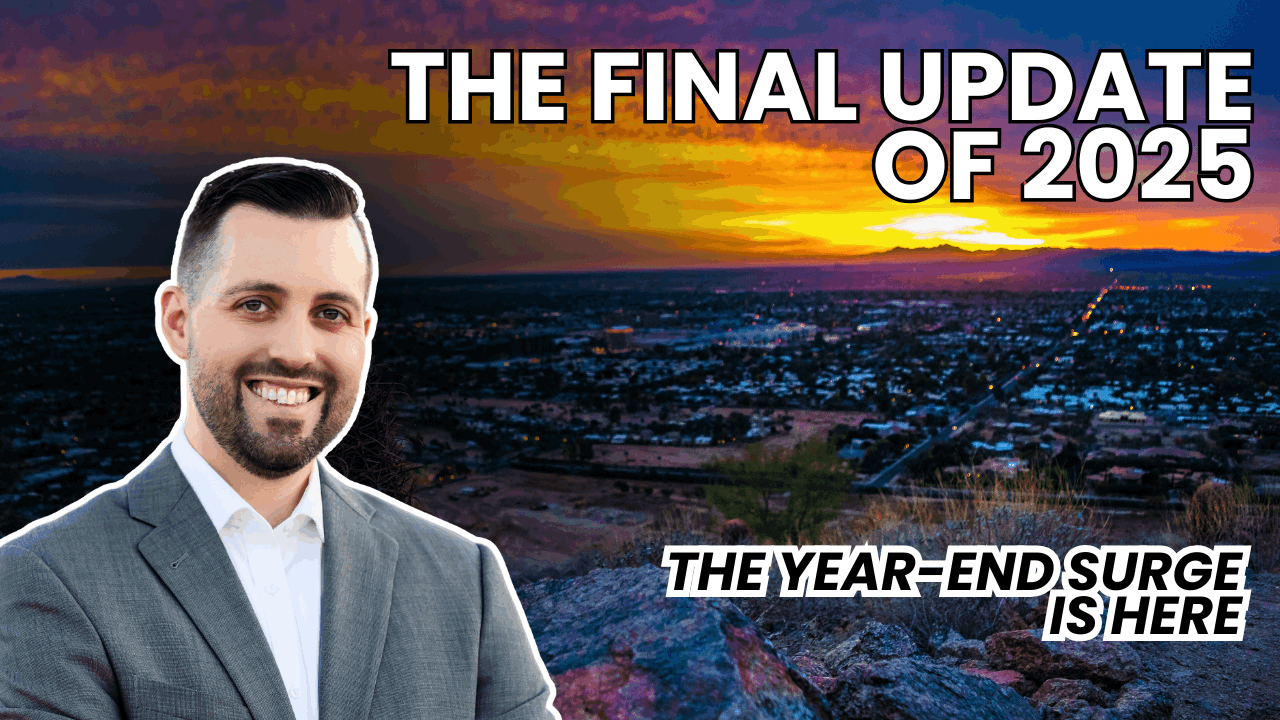
**Inside the Final Chapter of Phoenix Real Estate in 2025**
(Prefer to listen instead? Catch the full breakdown on the latest episode of The House of Ravenscroft Podcast.)
As 2025 winds down, the Greater Phoenix real estate market is entering one of its most active—and most strategic—phases of the year. Whether you're in Scottsdale, Chandler, Gilbert, Mesa, Goodyear, Surprise, Buckeye, Peoria, or anywhere else across the Valley, the shift in housing market trends is impossible to ignore.
This is my final Phoenix housing market update of 2025, and if you’re new here—welcome. I’m Eric Ravenscroft, and I work across the entire Phoenix Metro, advising buyers, sellers, and investors with a strategy-driven approach that blends real estate insights, financial planning, and long-term wealth building.
Every update you read here is written by me personally. I analyze the data, track the trends, and distill everything into actionable guidance so you can make confident decisions in one of the most dynamic markets in the country.
To those who tune in each month: thank you. Your messages and feedback are why I continue producing these updates.
Now, let’s break down where the Phoenix real estate market stands as we close out the year—and what it all means for early 2026.
A Market Split in Two: Rising Demand Meets Softening Supply
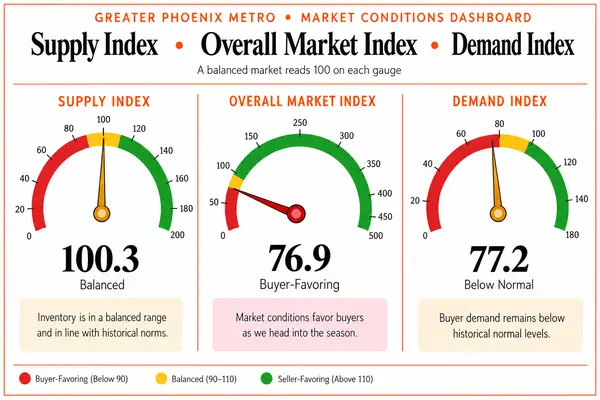
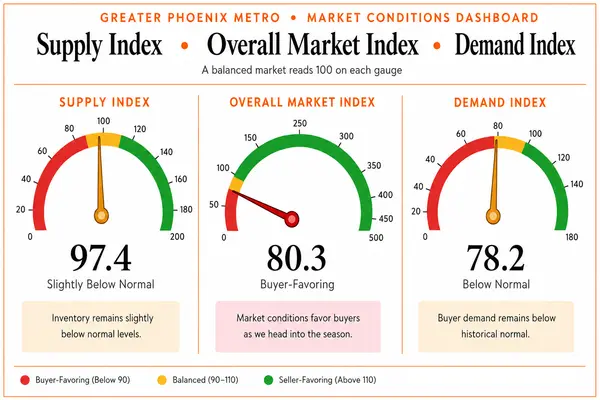
As we enter the holiday season, the Phoenix real estate market is seeing a mild but clear shift. Demand has increased, supply has started to soften, and several cities are showing measurable movement toward sellers.
Top performers include:
-
Fountain Hills and Chandler—strongest improvement
-
Tempe and Cave Creek—steady upward momentum
-
Queen Creek, Buckeye, Maricopa—still highly buyer-friendly
-
Paradise Valley—a cooling luxury segment
Across the Valley we have:
7 seller’s markets, 4 balanced markets, and 7 buyer’s markets.
This balanced spread shows a market defined by local variability, not a singular trend.
Year-End Investor Surge: The Tax Clock Is Ticking
Every fall, investors hit a familiar point: they see their projected tax bill and start asking what they can acquire before December 31.
This year, that wave is bigger than usual.
Why?
-
100% bonus depreciation returned earlier in 2025
-
Interest rates improved from summer highs
-
Buyers still hold meaningful leverage across key submarkets
-
Builders are offering rates in the 4% range
Investors are combining tax planning with long-term portfolio moves, making this one of the busiest Q4s for contract activity in recent memory.
Bonus Depreciation: The Tax Tool Driving Smart Investor Behavior
Bonus depreciation allows investors to deduct accelerated components of a rental property in year one. Instead of writing off interior components over decades, they can be deducted immediately after a cost segregation study.
Example:
A $500,000 rental with $150,000 of qualifying components =
$150,000 first-year tax deduction.
This benefits:
-
Real estate professionals
-
High-income W-2 earners using STR rules
-
Long-term investors accelerating returns
This is why year-end investor activity surges every November and December.
How Builders Control the Monthly Payment (And Why Buyers Are Paying Attention)
One of the most influential forces in the Phoenix market is the strength of builder incentives, especially permanent rate buydowns.
When interest rates jumped from 3.9% to over 7% in 2022, builders used long-term buydowns to keep payments manageable. That strategy has continued—and it’s reshaped buyer behavior.
Key facts:
-
Phoenix new-home market share jumped from 14.5% (2021) to 23%+ (2023–2025)
-
Builders use Forward Price Commitments to bulk-purchase mortgage money
-
A 1% rate drop impacts payments roughly the same as a 10% price drop
-
Many builder sales never hit the MLS, meaning true new-build share is even higher
If you want the lowest possible monthly payment in today’s market, builder programs offer advantages resale sellers cannot match.
Concessions Are Everywhere — But the Smartest Buyers Used a Better Method
More than half of all 2025 Phoenix home sales included concessions, typically around $10,000. But the most strategic buyers used a smarter approach:
Instead of burning concessions on rate buydowns, they had sellers:
-
Pay contractor invoices directly
-
Cover roofs, AC systems, flooring, pool equipment, windows, and more
-
Eliminate 5–10 year expenses upfront
Why does this matter?
Lender rules cap concession amounts —
but they do NOT cap seller-paid contractor work.
This turns a concession into instant equity and protects buyers from major post-close expenses.
Buyer tip:
During negotiations, identify big-ticket items nearing end-of-life and ask sellers to address them directly. It stretches buying power far more effectively than a temporary payment reduction.
Affordability Is Quietly Improving Across Phoenix
While the national conversation centers on extreme mortgage products, Phoenix is becoming more affordable organically.
Key improvements:
-
Homes under $400K are 10–14% below their 2022 peak
-
Prices softened an additional 3–5% over the last year
-
Inventory under $300K is up nearly 40%
-
Payments are 13–15% lower year-over-year
-
Wages have outpaced inflation for two consecutive years
Phoenix is not waiting for affordability solutions—
it’s already shifted into a more accessible cycle.
Foreclosures Are Increasing — But Only in Isolated Areas
Foreclosures have risen modestly, but not in a way that signals broad distress.
Through Q3 2025:
-
750 trustee deeds recorded
-
Up from 195 in Q1
-
July was the highest month since 2019
Still, this is a fraction of foreclosure-era levels.
Importantly, increases are concentrated in:
-
Lower-income areas
-
Outer-ring submarkets
-
Higher rental-density neighborhoods
-
Areas with historically weaker fundamentals
These pockets are also seeing steeper price declines and heavier concessions.
Lesson:
Chasing “cheap” homes rarely leads to strong long-term performance.
Neighborhood fundamentals still win.
What Buyers Need to Know Heading Into 2026
Buyers today are in one of the most advantageous environments Phoenix has seen in years.
Why?
-
Higher inventory
-
Strong negotiation leverage
-
Motivated sellers
-
Builders offering aggressive incentives
-
Lower monthly payments than early 2025
Phoenix is also still one of the most affordable major metros compared to:
California
Washington
Oregon
Illinois
Colorado
New York
This is why relocating buyers see Phoenix as “on sale” — and they’re acting now, not waiting.
With:
-
Job growth among the strongest large metros
-
Wage growth beating inflation
-
Lower cost of living
-
Favorable tax conditions
Relocators, move-up buyers, and investors are making long-term decisions now before competition tightens in early 2026.
What Sellers Need to Know Heading Into 2026
For sellers, strategy is everything.
MLS exposure alone is no longer enough. Today’s successful listings require multi-channel marketing, including:
-
Targeted email campaigns
-
SEO-driven content
-
Social media advertising
-
High-quality video
-
Property-specific landing pages
-
Relocation network distribution
-
Employer outreach
-
Digital retargeting
-
Agent-to-agent campaigns
-
Neighborhood letters
More than 70% of inbound Phoenix demand comes from California, so listings must reach relocating buyers.
Agents who understand SEO, branding, search behavior, and digital marketing consistently outperform the market — especially when competing against new-build incentives.
Sellers who price strategically, present at a high level, and use concessions thoughtfully are positioned for stronger results heading into early 2026.
Final Outlook: Strategy Wins in 2025 — Not Timing
As we wrap up the year, one thing is clear:
Phoenix isn’t a buyer’s market or a seller’s market.
It’s a strategic market.
Throughout 2025, we saw:
-
Builders dominate payment strategies
-
Investors charge back into the market
-
Affordability improve
-
Distress rise only in specific pockets
-
Buyers gain leverage
-
Sellers succeed when they marketed intentionally
The consistent theme?
Strategy mattered more than timing.
Looking ahead to early 2026:
-
Rates are trending lower
-
Demand is strengthening
-
Supply is tightening
-
Builder incentives may shift
-
Competition will likely increase
The window we have today won’t look the same in six months.
Thank you for following these updates all year.
I’ll be back in January with the first look at the 2026 market and what to expect.
Enjoy the holidays, celebrate your wins, and step confidently into 2026.
With the right insight and the right strategy, you can move faster—and stay in the driver’s seat.
Categories
- All Blogs (321)
- Active Adult & 55 Plus Communities (16)
- Arizona Relocation Guides (30)
- Buyers (211)
- Financial Planning (60)
- General Real Estate (139)
- Income From Real Estate (59)
- Market Update (26)
- New Construction (28)
- News, Updates and Coming Soon (57)
- Real Estate Agent Financial Planning (22)
- Real Estate Investing (94)
- Sellers (106)
- Vacation and Short Term Rentals (45)
Recent Posts







About the Author
Eric Ravenscroft is a Top 1% REALTOR® across North America and one of Arizona’s most trusted real estate strategists. With 15 years of experience spanning real estate, wealth management, and investment planning, he helps clients make smarter, financially grounded decisions, from new construction and relocations to STR investments, 1031 exchanges, and long-term portfolio strategy.
Eric’s expertise has earned him industry recognition, Elite status with Real Broker, and features in major publications including the Wall Street Journal, MarketWatch, MSN, and Morningstar. Clients across the Greater Phoenix Metro rely on his clarity, strategic insight, and results-driven guidance.
Ready to make a confident real estate move? Call or text Eric today.