
Phoenix Real Estate Market 2025: Big Money Moves, Luxury Surges, and What’s Coming Next

The Greater Phoenix real estate market is heading into the final stretch of 2025 with big shifts happening all at once. Luxury buyers are flooding in, Canadian sellers are quietly cashing out, builders are changing strategies, and mortgage rates continue to throw everyone curveballs. If that sounds like a lot — it is. This isn’t the same market we started the year with, and it’s not a straightforward buyer’s or seller’s market anymore.
Right now, Phoenix is really two markets in one. At the top, high-end sales are surging, pushing average prices higher. At the entry and mid-levels, cautious buyers, motivated sellers, and price adjustments are shaping a very different story. Let’s break down what’s really happening and what it means if you’re thinking about buying or selling in the months ahead.
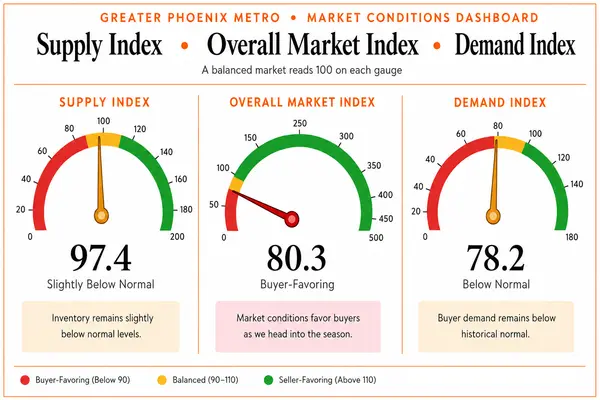
Supply Is Rising, Demand Is Shifting
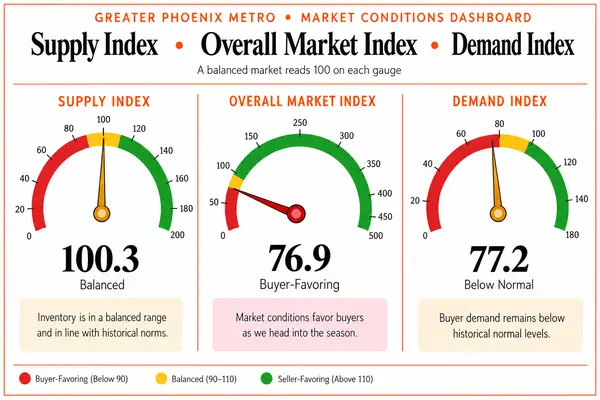
The first thing to know: supply is climbing. Listings have increased more than 5% recently, and that upward trend will likely continue into November. Homes are also taking longer to sell — the average closed home now spends about 86 days on market, while active listings are closer to 96 days, just shy of the 100-day mark that signals a more buyer-friendly environment.
Demand picked up early this fall when mortgage rates dipped, and prices even rebounded after four months of declines. But that momentum faded by the end of September as rates inched back up. The bottom line? Buyers now have more leverage, and sellers are facing more competition.
We’re not seeing a crash or even a major slowdown — just a gradual rebalancing. The market isn’t tilting dramatically in one direction, but it’s clear that homes priced right and presented well are moving, while overpriced or outdated listings are sitting longer.
Mortgage Rates: A Rollercoaster Ride
One of the biggest wild cards in this market continues to be mortgage rates. When the Federal Reserve signaled a rate cut this fall, many expected mortgage rates to follow. Instead, the opposite happened — just like we saw in September 2024.
Optimism had already pushed rates down before the Fed made its move, dropping from 6.85% in mid-July to 6.1% by mid-September, the lowest point in over a year. That shift lowered monthly payments by about 7.5% and briefly boosted demand. But after the official announcement, rates ticked back up again.
Here’s the key takeaway: mortgage rates don’t move in lockstep with the Fed, and they’re hard to predict. The good news is that they’re still lower than they’ve been in 11 of the past 12 months, which is keeping buyer activity stronger than it was a year ago. But volatility remains part of the story — and buyers who act quickly when rates dip still have an edge.
Builders Hit the Brakes and Change Tactics
After a burst of activity in late summer, builders are adjusting course. Demand hasn’t stayed as strong as many expected, so builders are scaling back new projects to avoid ending up with too much unsold inventory in 2026.
Behind the scenes, I’ve seen a major shift: builders reaching out directly to agents like me with “quiet” price cuts and selective incentives on quick move-in homes. These aren’t widely advertised deals — they’re strategic offers meant to move inventory before year-end. It’s a notable change from the aggressive stance builders took earlier this year and shows they’re watching demand closely.
This shift is creating ripple effects across the market. Resale sellers now have to compete not just with other listings, but with brand-new homes offering backyards, concessions, and financing incentives under 4%. A dated resale that’s overpriced doesn’t stand a chance against that combination.
Adding to the pressure, stock prices for major homebuilders dropped sharply in early October, signaling that Wall Street is watching this slowdown, too. Some builders are cutting back on incentives due to rising costs, betting that mortgage rates will fall and that new construction will remain the more affordable choice compared to resale.
Canadians Are Cashing Out — But Not Buying Back In
One of the more surprising trends this year is the shift in Canadian activity. Over the past 12 months, 960 Canadian-owned homes sold in Maricopa County — about 6% of all Canadian-owned properties here. Canadians are also slightly overrepresented among current sellers, with 306 active listings, or 1.7% of total supply.
But on the buying side, they’ve almost vanished. Only 201 Canadian buyers purchased homes here in the past year — a 43% drop from the previous year and the lowest number since the pandemic lockdowns. They now account for just 0.27% of buyers, compared to California buyers, who remain stable around 5%.
This is a big change from 2007–2011, when Canadian buyers flooded the Phoenix market and even outnumbered Californians. Today, they’re no longer a meaningful source of demand — and while their selling activity is slightly elevated, it’s not enough to significantly impact supply.
The Luxury Market Is Driving Price Growth
Luxury real estate is powering much of the appreciation we’re seeing right now. Homes priced above $2 million saw 11.5% more sales year-over-year and a 7.2% increase in price per square foot. Homes under $2 million also saw higher sales volume (+10.2%) but a slight decline in price per square foot.
This means one thing: without the luxury market, overall price growth would be negative.
The trend is especially visible in Scottsdale and Paradise Valley, where total dollar volume has soared in 2025. Scottsdale now ranks ahead of Phoenix for total sales volume — a first — with over $6.32 billion in closed sales this year. Paradise Valley is up 30% year-to-date, ranking fifth in total volume despite just 332 closed listings.
Luxury demand is being fueled by gains in stocks, crypto, and other financial markets — but if those markets cool, high-end demand could slow just as quickly.
Where Buyers and Sellers Have the Edge
Not all corners of the Valley are moving in the same direction. Out of the 18 largest cities in the Phoenix Metro, 11 shifted toward buyers over the past month, while 7 became more favorable to sellers.
The biggest gains for sellers came in Tempe, Gilbert, Mesa, Queen Creek, and Scottsdale, while Cave Creek, Paradise Valley, and Avondale saw conditions improve for buyers. Most of these shifts were modest, but they show how hyper-local this market has become.
The overall market is expected to continue softening slightly into mid-November, as rising supply outpaces demand in many areas.
What Buyers Should Know Right Now
If you’re a buyer, this fall offers one of the best windows we’ve seen in years. Rates are down from their peaks, many segments are seeing price adjustments, and seller incentives are widespread — 56% of closings in September included concessions, often used for rate buydowns.
Some of the steepest price drops are in the first-time buyer range:
-
Condos priced $250K–$300K are down 4.3% since July and 15% below 2022 peaks
-
Single-family homes $300K–$400K in Pinal County are down 6.7% since April
-
Single-family homes $300K–$400K in Maricopa County are down 2.9% year-over-year
The fourth quarter is historically the best season for buyers in Greater Phoenix. Supply rises before the holidays, but demand doesn’t surge until January. That means more room for negotiation and some of the deepest builder incentives of the year.
The key: don’t wait for the “perfect” moment — by the time it’s obvious, it’s already passed. Real estate rewards time in the market, not timing the market.
What Sellers Need to Hear
It’s been a challenging year for sellers. Volatile mortgage rates and stock market swings slowed demand early on. But there are bright spots.
Homes priced $500K to $1.5M saw a 19% jump in sales year-over-year in September, growing their share of the market from 36% to 38%. Jumbo mortgage rates dropping below conventional 30-year loans and renewed interest in adjustable-rate mortgages are fueling demand in this range.
The Northeast Valley — including Scottsdale, Paradise Valley, and Fountain Hills — remains firmly in seller’s market territory. Other seller-friendly areas include Anthem, Avondale, Chandler, Gilbert, Apache Junction, El Mirage, and Sun Lakes.
In contrast, the outskirts — Surprise, Goodyear, Buckeye, Laveen, Peoria, San Tan Valley, and Casa Grande — are mostly buyer’s markets due to heavy new construction competition.
If you’re selling in these areas, pricing and presentation matter more than ever. Updated, move-in ready homes still sell quickly and for closer to asking price. Dated homes must be priced aggressively to compete with builder incentives and newer inventory.
Final Thoughts
This market is changing — and fast. Supply is rising, demand is uneven, luxury sales are surging, and Canadian buyers have all but disappeared. Mortgage rates remain unpredictable, adding more uncertainty to the mix.
But one truth hasn’t changed: updated, move-in ready homes are still winning, and buyers still care most about monthly payments. Whether it’s a rate buydown, a concession, or the right pricing strategy, the homes that meet buyers where they are today are the ones that sell.
If you’re a buyer, don’t wait for the “perfect storm.” Act when the numbers make sense. And if you’re a seller, remember: you’re not just selling a house — you’re competing for attention. Price strategically, present your home well, and align with where the market is, not where you wish it was.
This market rewards clarity and action. The more you align your decisions with today’s reality — not yesterday’s expectations — the more leverage, opportunity, and long-term financial advantage you’ll create.
Categories
- All Blogs (321)
- Active Adult & 55 Plus Communities (16)
- Arizona Relocation Guides (30)
- Buyers (211)
- Financial Planning (60)
- General Real Estate (139)
- Income From Real Estate (59)
- Market Update (26)
- New Construction (28)
- News, Updates and Coming Soon (57)
- Real Estate Agent Financial Planning (22)
- Real Estate Investing (94)
- Sellers (106)
- Vacation and Short Term Rentals (45)
Recent Posts






About the Author
Eric Ravenscroft is a Top 1% REALTOR® across North America and one of Arizona’s most trusted real estate strategists. With 15 years of experience spanning real estate, wealth management, and investment planning, he helps clients make smarter, financially grounded decisions, from new construction and relocations to STR investments, 1031 exchanges, and long-term portfolio strategy.
Eric’s expertise has earned him industry recognition, Elite status with Real Broker, and features in major publications including the Wall Street Journal, MarketWatch, MSN, and Morningstar. Clients across the Greater Phoenix Metro rely on his clarity, strategic insight, and results-driven guidance.
Ready to make a confident real estate move? Call or text Eric today.