
Moving from California to Arizona: The Complete 2026 Guide
Top 100
Greater Phoenix Metro
Top 1%
Across North America
$100M+
In Closed Sales
150+
Five-Star Reviews
15 Yrs
Real Estate + Finance
I made this move myself — from Southern California — and I've helped hundreds of California families do the same. This guide is everything I wish I'd had before I went.
A Note From Your Guide
Why I Wrote This

When I was living in Southern California, I knew the math wasn't working. The home I wanted was out of reach. The taxes were relentless. And honestly, outside of the beach — which is spectacular, I won't pretend otherwise — I kept asking myself what exactly I was paying the California premium for.
I moved to Arizona, and what surprised me most wasn't just how much further my dollar went. It was how little I actually gave up. The outdoor access here is world-class — different from the coast, but genuinely incredible. The communities are well-built, the schools are strong, and the quality of life I was chasing in California? I found it here, without the financial stress.
Since then I've worked with hundreds of California buyers navigating this exact transition. Retirees who needed their money to actually last. Young families who wanted to own a home without working themselves into the ground. All of them had versions of the same question: is this real, or is there a catch?
This guide is my honest answer. The good, the trade-offs, and everything in between.
Over 80,000 Californians moved to Arizona in 2023 alone. What they found — and what you need to know before you follow — is all here.
Navigate This Guide
What's Inside
The Real Financial Difference
The cost-of-living gap between California and Arizona isn't a rounding error — for most households, it's genuinely life-changing. The Bureau of Economic Analysis estimates Arizona's overall cost of living runs about 32% lower than California's. That gap shows up in every line of your budget.
Housing: Where the Numbers Hit Hardest
California's median home price sits around $785,000 as of 2025. Arizona's median is $453,000, per Redfin. That's not just a smaller mortgage — for many Californians, it's the difference between renting forever and actually owning a home.
Of Californians who move to Maricopa County from Los Angeles, 43% become homeowners within their first year. From San Diego, that number jumps to 54%.
Income Tax: The Number That Changes Everything
California's top marginal income tax rate of 13.3% is the highest in the United States. Arizona's flat rate is 2.5% — one of the lowest in the country. For a household earning $200,000, that difference is roughly $21,600 per year. In your pocket. Arizona also doesn't tax Social Security income — something California does.
Arizona vs. Texas: Why the Property Tax Difference Matters
Texas has no state income tax — but funds itself through property taxes running 1.7%–2.2% annually. On a $500,000 home that's $8,500–$11,000 per year. Arizona's property tax on the same home: roughly $3,100. The overall tax burden in Arizona is genuinely lower, not just restructured.
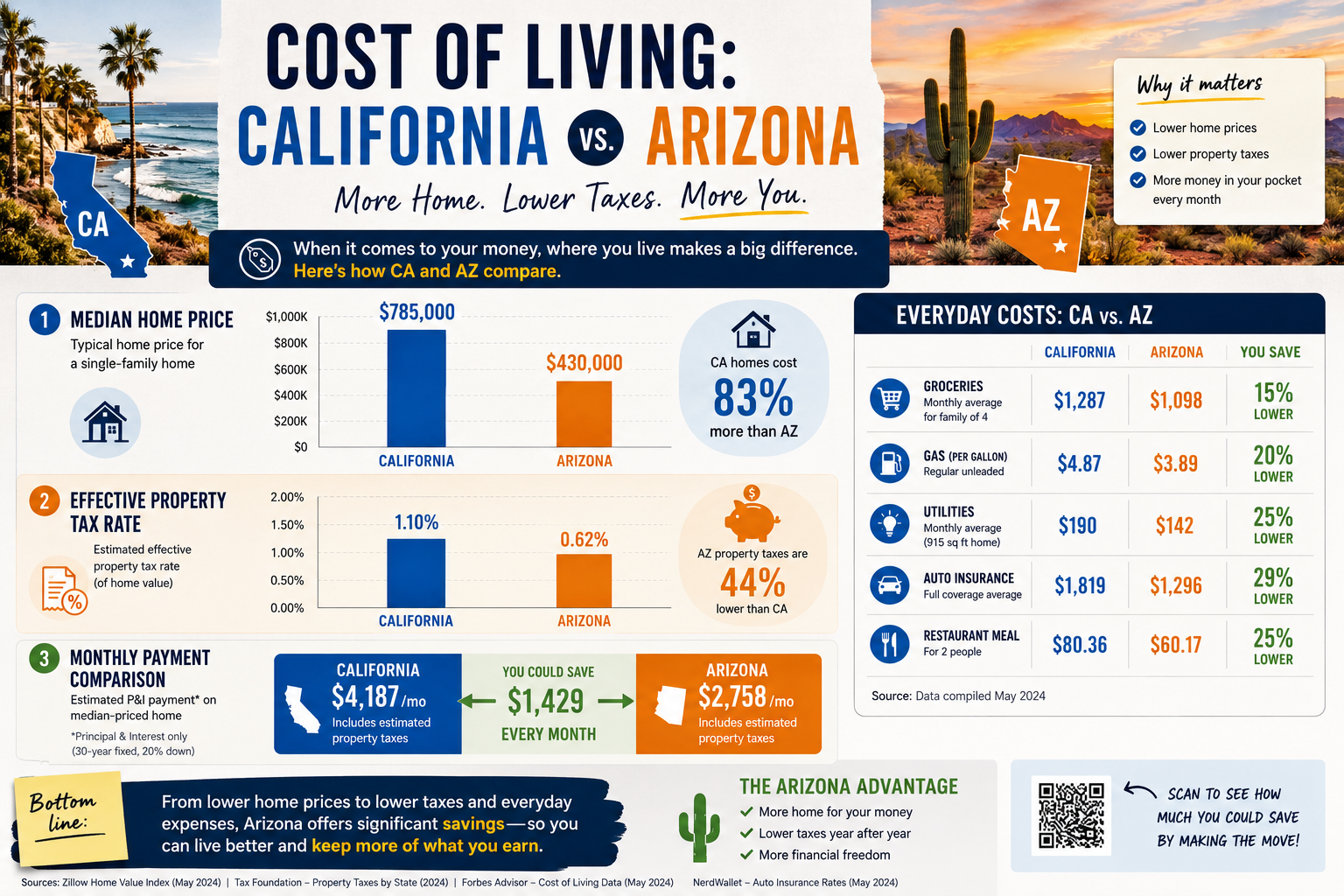
Bottom line: A family of four needs ~$134,000/yr to live modestly in Los Angeles. The same lifestyle in Phoenix costs ~$114,000. That $20,000 annual gap is a car payment, a vacation, or meaningful retirement savings — every single year.
Best Communities for California Transplants
Don't judge Arizona by a single visit to Scottsdale. The Phoenix metro is enormous and the communities within it are genuinely diverse. Here's an honest breakdown of the ones I see California transplants thrive in most.
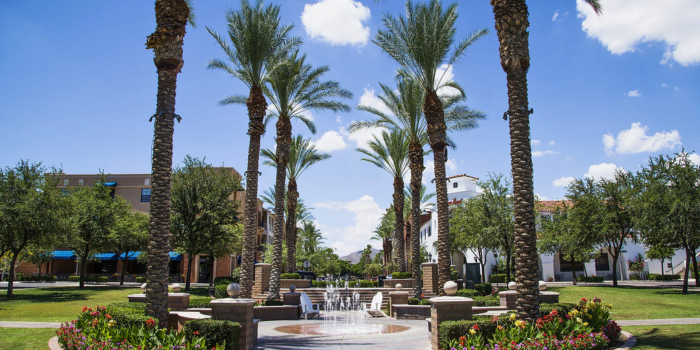

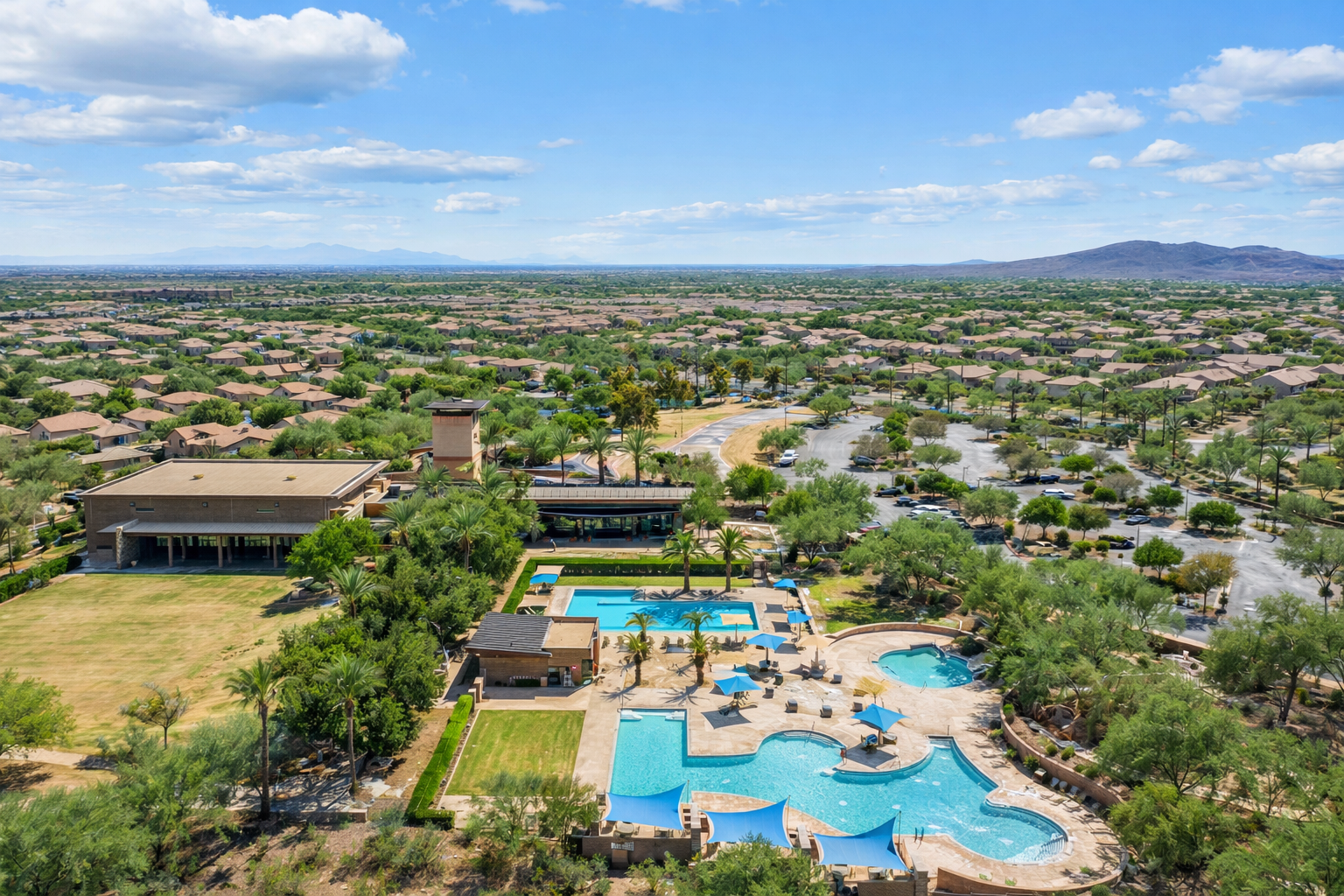

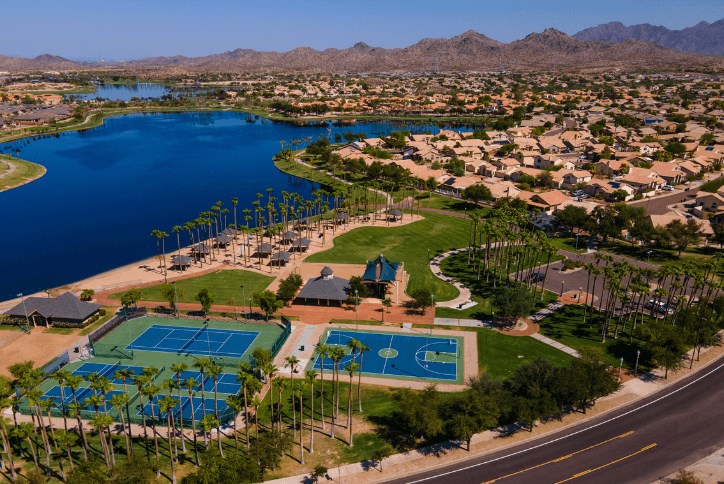
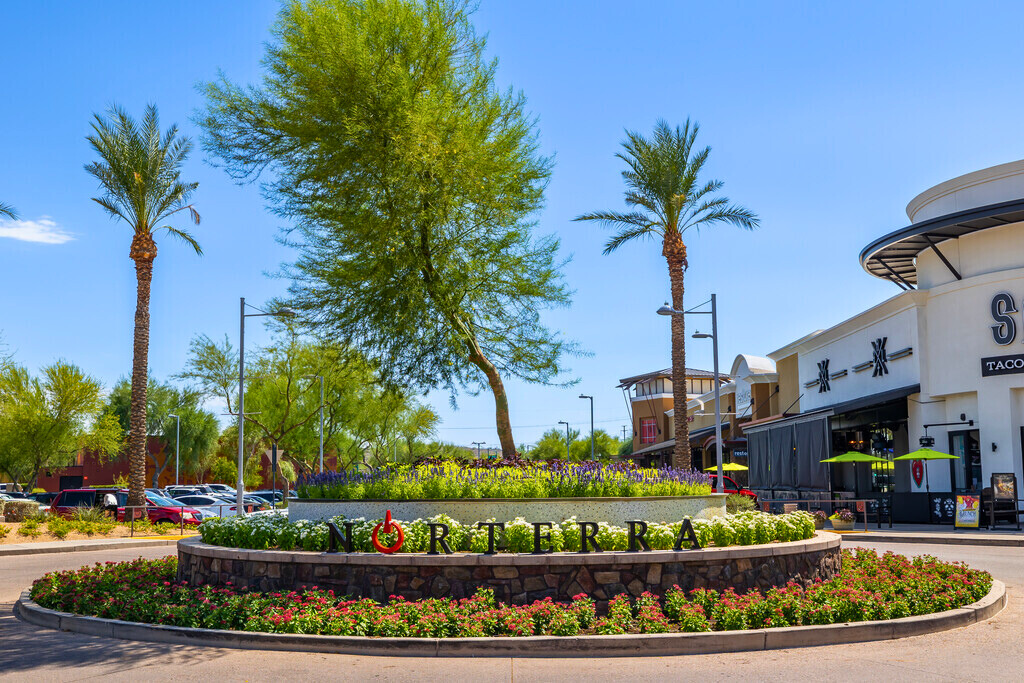
For the buyer who values access above everything else. At the junction of I-17 and Loop 101, most of the metro is within 25 minutes. Best-stocked retail corridor in the northwest valley, excellent trail access, and close to TSMC and USAA campuses.
Best For
Professionals, dual-income households
Highlight
Best freeway access in the northwest valley
Arizona Property Taxes Explained
How the Calculation Works
Arizona property taxes are based on your home's "Limited Property Value" (LPV) — not full market value. For residential properties, the assessment ratio is 10% of the LPV, and that assessed value is then multiplied by your combined local tax rate.
The 5% Annual Cap
Arizona's Limited Property Value can only increase by a maximum of 5% per year, regardless of how fast the market moves. Your property taxes won't spike the way they might in Texas or Florida during a hot market — long-term homeownership is financially predictable.
Retiree Exemptions & Valuation Freeze
If you're 65+ and have lived in Arizona for at least two years, you may qualify for a valuation freeze that locks in your LPV — essentially capping your property tax exposure for as long as you remain in the home. A significant benefit for retirees relocating from California.
New construction note: Your first tax bill is often based on land value only. Year two brings the full home assessment. I always walk buyers through this before close — it catches people off guard every year.
HOA Fees: What to Expect
Most master-planned communities in the Phoenix metro have HOAs. California transplants are often either over-prepared (having dealt with expensive CA HOAs) or under-prepared for what they cover. Here's the real breakdown.
Sub-associations: Many large communities like Vistancia, Eastmark, and Verrado have both a master HOA and neighborhood sub-associations — two fees. The combined total is almost always still less than what California buyers were paying.
I always recommend reviewing the HOA's reserve study and financials before closing. Newer Arizona communities generally have better-funded reserves than aging California HOA buildings — but verify it for the specific community you're considering.
Schools: Where the Strong Districts Are
Arizona's school system is highly variable — state averages don't tell the story. District-level research is what matters. Here's where to look first.
Charter & Private Options
Arizona has one of the most developed charter school systems in the country. Basis Schools, Great Hearts Academies, and Legacy Traditional Schools rank nationally — tuition-free. Private school tuition runs $12,000–$22,000/year, significantly less than comparable California options ($30,000–$50,000 in LA or the Bay Area).
My approach: Tell me your school priorities first. I'll map communities to them. The overlap between strong districts and well-priced communities is larger than most people expect.
The Arizona Job Market
Arizona's economy has genuinely diversified. TSMC's $40 billion semiconductor campus in north Phoenix has become a symbol of that transformation — bringing thousands of high-paying engineering jobs and triggering a wave of supplier companies setting up nearby. Maricopa County's unemployment rate consistently runs below 4%, compared to Los Angeles County's 5–6%.
Salaries that look 10–15% lower on paper often result in meaningfully more disposable income once taxes and housing are factored in. For remote workers keeping California salaries, the financial advantage is even larger.
Semiconductor & Manufacturing
TSMC, Intel, Microchip Technology, ON Semiconductor
Healthcare & Biotech
Banner Health, Mayo Clinic, HonorHealth, Dignity Health
Financial Services & Fintech
USAA, JPMorgan Chase, Charles Schwab, State Farm
Aerospace & Defense
Boeing, Honeywell, General Dynamics, Raytheon
Traffic & Driving
Better. Significantly better. I say this having driven both.
Most California buyers describe the same first-week experience: sitting at an on-ramp waiting for a gap in traffic — and then realizing they can just go. Average commute times in metro Phoenix run 24–28 minutes. Los Angeles averages over 32 minutes — and that's the average, not the worst case.
Phoenix is built on a near-perfect grid. Streets are numbered in predictable patterns — once you understand how it works, you rarely need GPS for local trips. Parking is plentiful and free almost everywhere.
One caveat: Summer heat is hard on cars. Covered parking or a garage matters more here than it did in coastal California. Most well-designed communities factor this in — it's worth prioritizing in your home search.
Healthcare
The Phoenix metro has a mature, well-resourced hospital system. Banner Health is the dominant regional system, operating in affiliation with the University of Arizona College of Medicine — Phoenix. Mayo Clinic has a major campus in north Scottsdale that draws patients nationally. HonorHealth and Dignity Health round out the major systems.
For most conditions — cardiology, orthopedics, cancer care, primary care — you will not need to leave Arizona. For highly specialized subspecialties, Los Angeles and San Diego academic medical centers are a day's drive. Arizona's proximity makes that feasible in a way it isn't from Texas or Florida.
For retirees: Arizona has a strong concentration of concierge medicine practices and Medicare Advantage plans with excellent Maricopa County coverage. The ACA marketplace in Arizona typically offers lower premiums than California's market.
Lifestyle: What Changes, What You Won't Miss
The Heat Has a Season
June through September in Phoenix is intense. 110°F days are not unusual in July. Outdoor activities happen early morning or after sunset. Pools become essential. This is not a footnote — it shapes four months of your year. But the tradeoff is extraordinary: October through April in metro Phoenix is some of the best weather in the country. Californians who warned you about the summers are the ones who won't stop talking about Arizona winters after their first one.
Outdoor Access Is World-Class
This surprises people more than anything. The Grand Canyon, Sedona, Antelope Canyon, Havasu Falls, Lake Powell, the Superstition Wilderness — all within a day's drive. Inside the metro: South Mountain, Camelback, Pinnacle Peak, the McDowell Sonoran Preserve, White Tank Mountain. Real mountain hiking right inside the city. If you moved to Southern California partly for outdoor access, Arizona will not disappoint you.
What About the Beach?
This is the one I tell people to think about honestly. San Diego and LA residents have the ocean woven into their identity. That doesn't exist in Arizona. Rocky Point in Mexico is a 3-hour drive and is a real option, but it's not PCH. For some people, this is a non-issue — they realize they went to the beach four times a year anyway. For others, it's the thing they miss most. I'd rather you know before you move than discover it after.
The Culture Has Grown Up
Phoenix has matured significantly. Roosevelt Row is a legitimate arts district. The Heard Museum is world-class. The dining scene — especially in Scottsdale, Downtown Phoenix, and the East Valley — is genuinely good. It's not Los Angeles, but it's a real city with real culture — and the cost of participating in that culture is a fraction of what it would be in California.
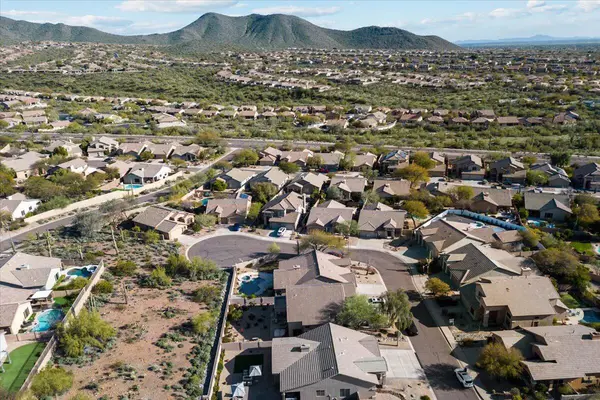
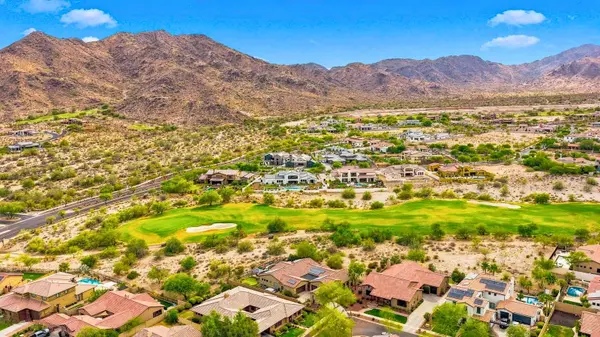
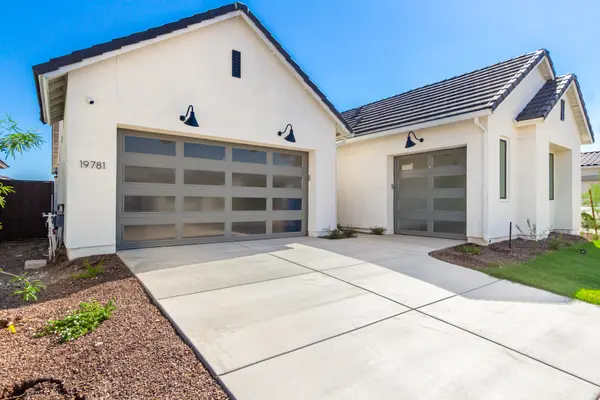
Arizona in Photos
What You'll Wake Up To

📷 Replace placeholder images with your own Arizona photography for maximum authenticity.
Practical Steps for Making the Move
Before You Decide
Visit in summer, not just winter. Get an honest feel for the heat before you commit.
Spend time in multiple communities — east valley, west valley, north Phoenix. The differences are real.
Run a side-by-side budget. Most people are surprised how large the all-in gap actually is.
If you have kids, research specific schools before you pick a neighborhood — not after.
Once You Decide
Get pre-approved before touring. Phoenix inventory moves fast and sellers prioritize prepared buyers.
Change your driver's license within 10 days of establishing residency, and vehicle registration within 15.
Notify the California Franchise Tax Board. California has a history of asserting continued tax jurisdiction — keep a clean paper trail.
If you have CA rental or business income, consult a CPA familiar with both states before you move.
Real Stories from California Transplants
Names changed. Stories real. Read verified client reviews →
Data citations: All statistics are sourced from publicly available data and updated semi-annually. Home price figures reflect median sale prices as reported by Redfin and Zillow. Tax rates sourced from the Tax Foundation and Arizona Department of Revenue. Cost-of-living comparisons based on Bureau of Economic Analysis regional price parities. Unemployment figures from the Bureau of Labor Statistics LAUS program.
Client stories in Section 11 are representative composites based on real transaction types. Names and identifying details have been changed to protect client privacy. Not intended as financial, tax, or legal advice — consult a licensed CPA or attorney for guidance specific to your situation.
Common Questions — Answered Honestly
Will the savings disappear once I factor everything in?
For most households, no. The 32% cost-of-living differential is real and shows up across every category. Even in a high-amenity gated community with a higher HOA, you're almost always ahead of California when you total it all up.
My salary will be lower in Arizona. Does that wipe out the benefit?
Only if you're switching employers. Remote workers keep their California income with Arizona's cost structure — a significant win. If switching to an Arizona employer, salaries run 10–20% lower on paper, but after taxes and housing, net take-home is usually comparable or better. The math is always in the specifics.
What about the schools? Are they really good?
In the right districts — yes, genuinely. Chandler Unified, Gilbert Unified, Scottsdale Unified, and Peoria Unified all compare favorably with the better California districts. The key is doing neighborhood-level research. Don't look at state averages.
Do I need to worry about water?
It's a legitimate long-term consideration and I won't wave it away. Phoenix draws from the Colorado River, the Salt River Project, and local groundwater — and has been actively managing supply for decades. The region is better positioned than most Western cities, but ongoing Colorado River negotiations are real. Research the specific water utility for any community you're seriously considering.
When is the best time to buy?
Late winter/spring has the most inventory. Summer means less competition — which can mean better negotiating leverage. Fall is the sweet spot: reasonable inventory, motivated sellers, and comfortable weather for touring. I'll give you a current read whenever you're ready to talk.
Do I really need a local agent for this?
I've closed many California-to-Arizona transactions where the buyer never set foot in Arizona until closing — it's doable. But someone on the ground who knows the communities, builders, HOA track records, and micro-market dynamics makes a real difference. That's not replaceable by a portal.
About the Author

Eric Ravenscroft, CRS
Owner, The Ravenscroft Group · Real Broker · Greater Phoenix Metro
Eric is a Top 1% REALTOR® across North America and one of Arizona's most trusted advisors for relocation, new construction, and wealth-focused real estate. With 15 years of combined experience in real estate and financial planning — including serving as a Director of Wealth Management — he brings a uniquely analytical approach to the Greater Phoenix Metro. He has closed more than $100 million in residential sales, earned 150+ five-star Google reviews, and helped clients create over $133 million in long-term wealth. Eric is a preferred real estate partner for USAA, Chase, SoFi, PennyMac, Citibank, RBC, and HomeStory, and has been featured in the Wall Street Journal, MarketWatch, Morningstar, and MSN.
Categories
- All Blogs (324)
- Active Adult & 55 Plus Communities (17)
- Arizona Relocation Guides (31)
- Buyers (214)
- Financial Planning (61)
- General Real Estate (141)
- Income From Real Estate (60)
- Market Update (26)
- New Construction (29)
- News, Updates and Coming Soon (57)
- Real Estate Agent Financial Planning (22)
- Real Estate Investing (96)
- Sellers (107)
- Vacation and Short Term Rentals (45)
Recent Posts






About the Author
Eric Ravenscroft is a Top 1% REALTOR® across North America and one of Arizona’s most trusted real estate strategists. With 15 years of experience spanning real estate, wealth management, and investment planning, he helps clients make smarter, financially grounded decisions, from new construction and relocations to STR investments, 1031 exchanges, and long-term portfolio strategy.
Eric’s expertise has earned him industry recognition, Elite status with Real Broker, and features in major publications including the Wall Street Journal, MarketWatch, MSN, and Morningstar. Clients across the Greater Phoenix Metro rely on his clarity, strategic insight, and results-driven guidance.
Ready to make a confident real estate move? Call or text Eric today.